Sundström Kati, Mishra Pashupati P, Pyysalo Mikko J, Lehtimäki Terho, Karhunen Pekka J, Pessi Tanja
Department of Forensic Medicine, Faculty of Medicine and Life Sciences, University of Tampere, Tampere, Finland.
Department of Clinical Chemistry, Faculty of Medicine and Health Technology, Tampere University, Tampere, Finland.
PeerJ. 2020 Apr 9;8:e8799. doi: 10.7717/peerj.8799. eCollection 2020.
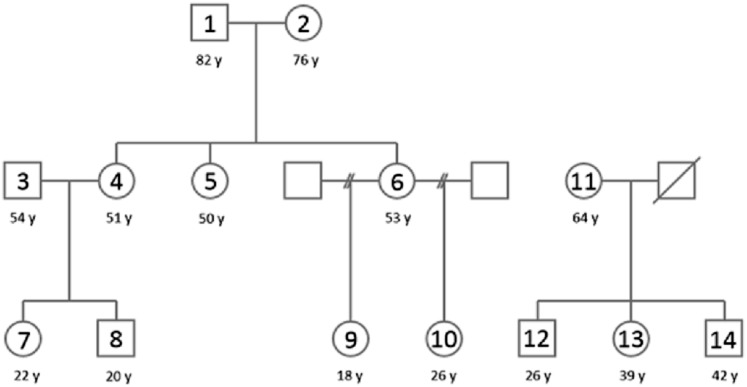
Human saliva contains approximately 700 bacterial species. It has been reported that the salivary microbiome of a large family of closely related individuals consisting of multiple households is similar but the relatedness of salivary bacteria between generations of parents and their children has not yet been investigated. The objectives were to investigate the entirety of salivary bacterial DNA profiles and whether and how families share these profiles and also compare these communities between grandparents and their first daughter generations (F1) using 16S rRNA gene amplicon sequencing.
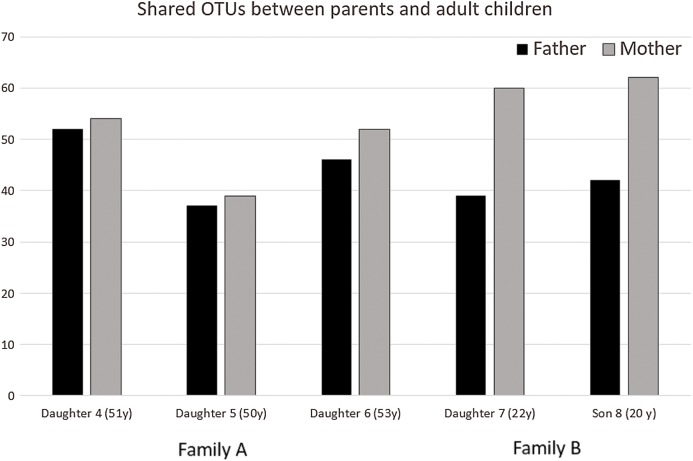
The most abundant phyla in two separate families were and . Family ties explained 13% of the variance between individuals' bacterial communities ( = 0.13; = 0.001). Mothers shared more OTUs with adult children compared to fathers, but this linkage seemed to be weaker in the nuclear family with older adult children. We identified 29 differentially abundant genus level OTUs (FDR < 0.05) between families, which accounted for 31% of the total identified genus level OTUs.
Our results indicate that adult family members share bacterial communities and adult children were more similar to mothers than fathers. The observed similarity in oral microbiome between parent-child pairs seemed to weaken over time. We suggest that our analysis approach is suitable for relatedness study of multigenerational salivary bacteria microbiome.
人类唾液中大约含有700种细菌。据报道,由多个家庭组成的一大群密切相关个体的唾液微生物群是相似的,但父母及其子女几代人之间唾液细菌的相关性尚未得到研究。目的是使用16S rRNA基因扩增子测序来研究唾液细菌DNA谱的整体情况,以及家庭是否共享这些谱以及如何共享,并比较祖父母与其第一代女儿(F1)之间的这些群落。
两个独立家庭中最丰富的门是 和 。家庭关系解释了个体细菌群落之间13%的差异( = 0.13; = 0.001)。与父亲相比,母亲与成年子女共享的操作分类单元(OTU)更多,但在有年长成年子女的核心家庭中,这种联系似乎较弱。我们在家庭之间鉴定出29个差异丰富的属水平OTU(FDR < 0.05),占已鉴定属水平OTU总数的31%。
我们的结果表明,成年家庭成员共享细菌群落,成年子女与母亲比与父亲更相似。亲子对之间口腔微生物群中观察到的相似性似乎会随着时间减弱。我们建议我们的分析方法适用于多代唾液细菌微生物群的相关性研究。