Rodríguez-Verdugo Alejandra, Lozano-Huntelman Natalie, Cruz-Loya Mauricio, Savage Van, Yeh Pamela
Department of Ecology and Evolutionary Biology, University of California Irvine, Irvine, CA 92697, USA.
Department of Ecology and Evolutionary Biology, University of California Los Angeles, Los Angeles, CA 90095, USA.
iScience. 2020 Apr 24;23(4):101024. doi: 10.1016/j.isci.2020.101024. Epub 2020 Mar 30.
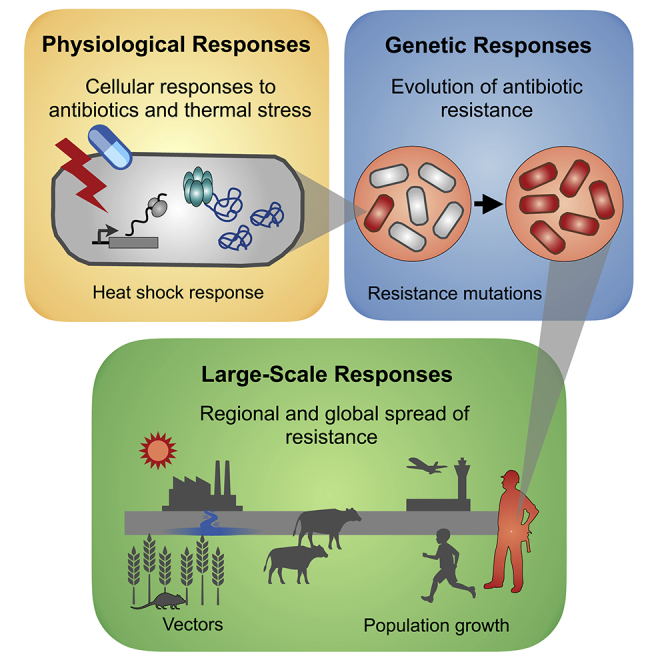
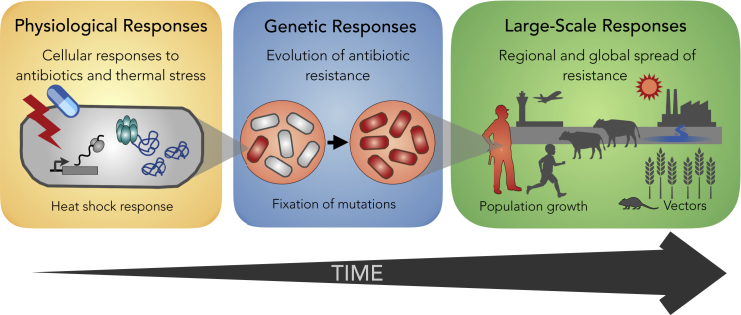
Bacteria have evolved diverse mechanisms to survive environments with antibiotics. Temperature is both a key factor that affects the survival of bacteria in the presence of antibiotics and an environmental trait that is drastically increasing due to climate change. Therefore, it is timely and important to understand links between temperature changes and selection of antibiotic resistance. This review examines these links by synthesizing results from laboratories, hospitals, and environmental studies. First, we describe the transient physiological responses to temperature that alter cellular behavior and lead to antibiotic tolerance and persistence. Second, we focus on the link between thermal stress and the evolution and maintenance of antibiotic resistance mutations. Finally, we explore how local and global changes in temperature are associated with increases in antibiotic resistance and its spread. We suggest that a multidisciplinary, multiscale approach is critical to fully understand how temperature changes are contributing to the antibiotic crisis.
细菌已经进化出多种机制来在有抗生素的环境中生存。温度既是影响细菌在抗生素存在下生存的关键因素,也是由于气候变化而急剧上升的一种环境特征。因此,了解温度变化与抗生素耐药性选择之间的联系既及时又重要。本综述通过综合实验室、医院和环境研究的结果来审视这些联系。首先,我们描述对温度的短暂生理反应,这些反应会改变细胞行为并导致抗生素耐受性和持续性。其次,我们关注热应激与抗生素耐药性突变的进化和维持之间的联系。最后,我们探讨温度的局部和全球变化如何与抗生素耐药性的增加及其传播相关联。我们认为,多学科、多尺度的方法对于全面理解温度变化如何导致抗生素危机至关重要。