Department of Epidemiology and Preventive Medicine, School of Public Health and Preventive Medicine, Monash University, Alfred Hospital, Melbourne, VIC 3004, Australia.
Research Methodology Division, School of Public Health and Preventive Medicine, Monash University, Melbourne, VIC, Australia.
BMJ. 2019 Jan 30;364:l42. doi: 10.1136/bmj.l42.
To examine the effect of regular breakfast consumption on weight change and energy intake in people living in high income countries.
Systematic review and meta-analysis.
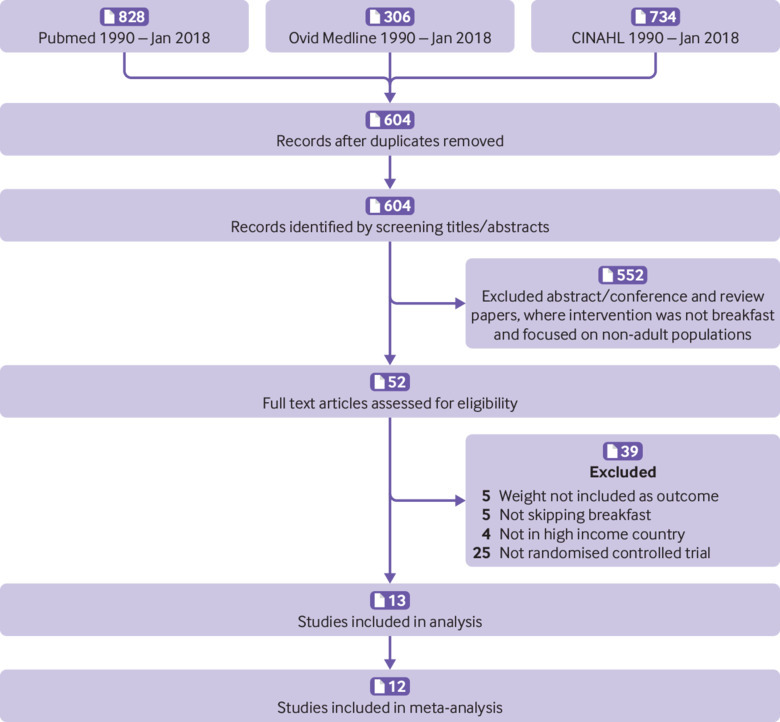
PubMed, Ovid Medline, and CINAHL were searched for randomised controlled trials published between January 1990 and January 2018 investigating the effect of breakfast on weight or energy intake. ClinicalTrials.gov and the World Health Organization's International Clinical Trials Registry Platform search portal were also searched in October 2018 to identify any registered yet unpublished or ongoing trials.
Randomised controlled trials from high income countries in adults comparing breakfast consumption with no breakfast consumption that included a measure of body weight or energy intake. Two independent reviewers extracted the data and assessed the risk of bias of included studies. Random effects meta-analyses of the effect of breakfast consumption on weight and daily energy intake were performed.
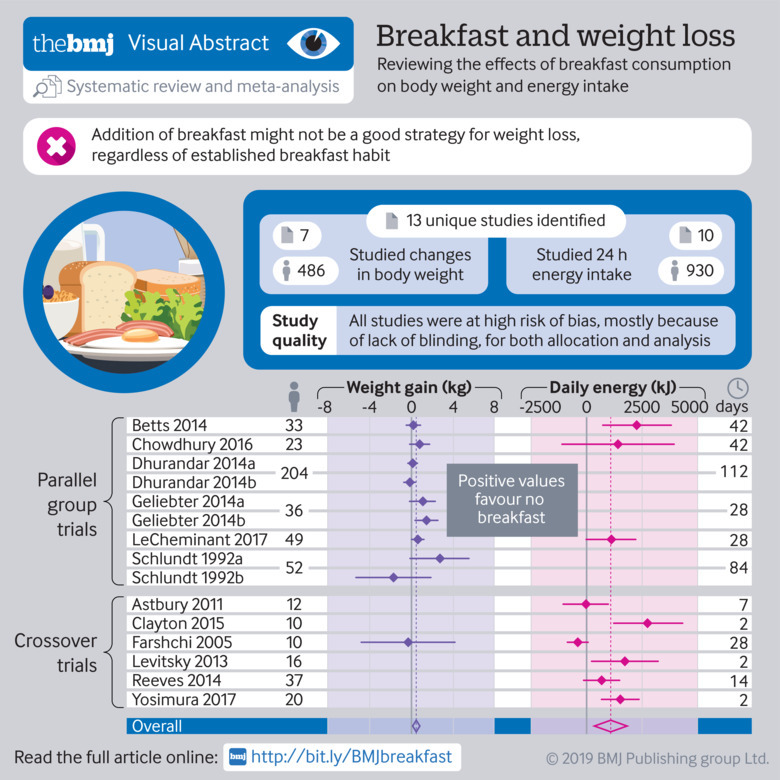
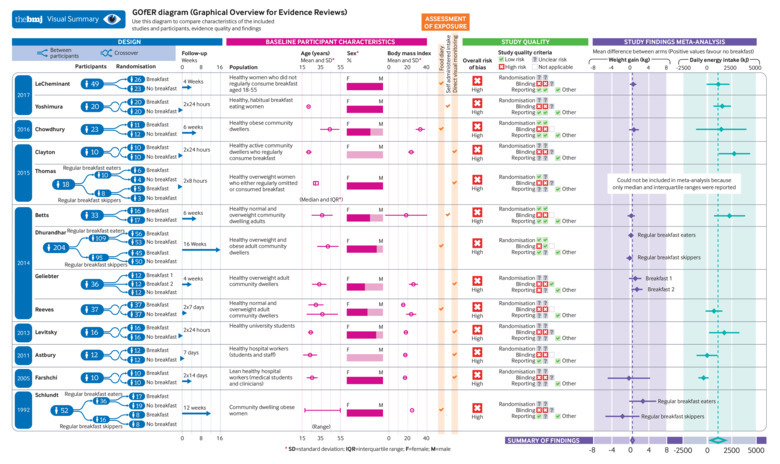
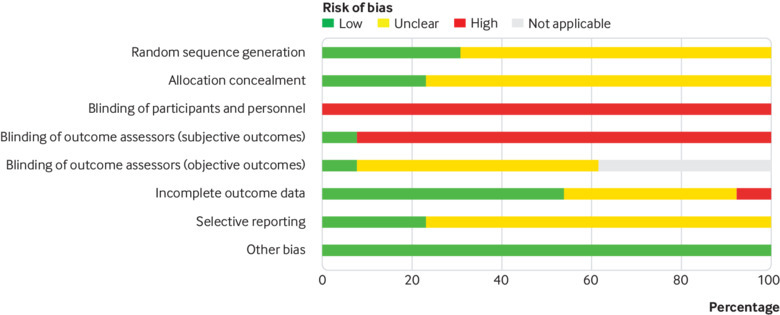
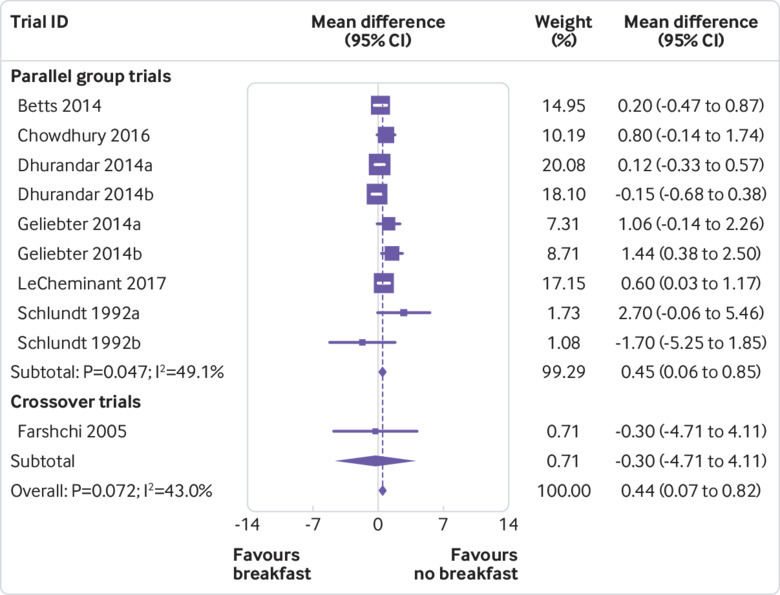
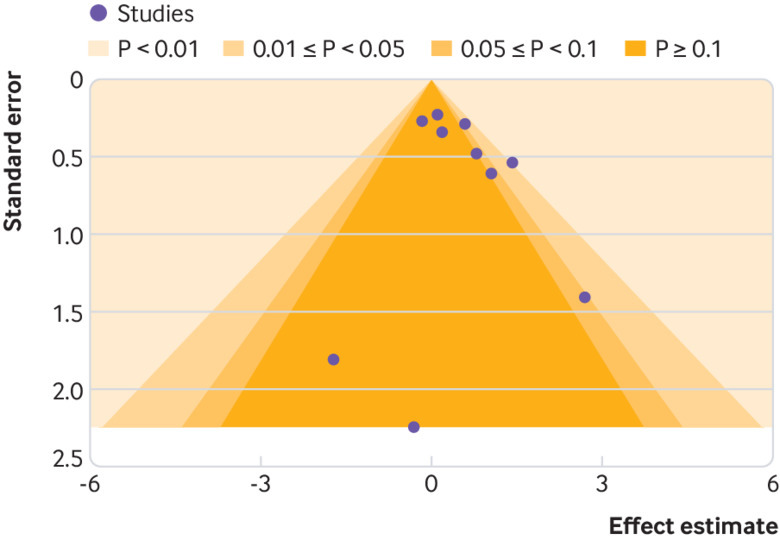
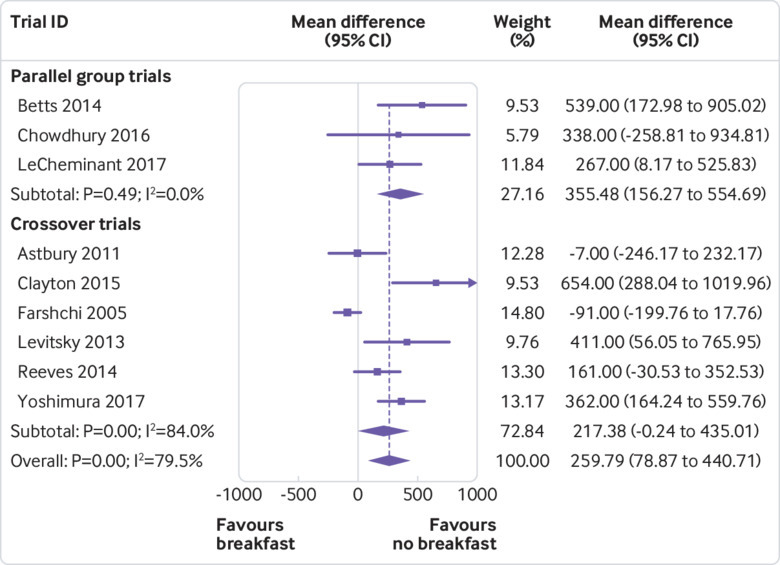
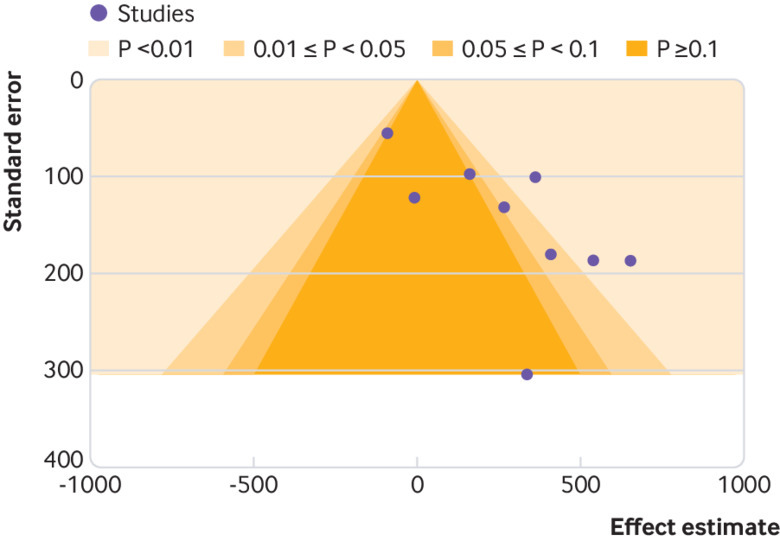
Of 13 included trials, seven examined the effect of eating breakfast on weight change, and 10 examined the effect on energy intake. Meta-analysis of the results found a small difference in weight favouring participants who skipped breakfast (mean difference 0.44 kg, 95% confidence interval 0.07 to 0.82), but there was some inconsistency across trial results (I=43%). Participants assigned to breakfast had a higher total daily energy intake than those assigned to skip breakfast (mean difference 259.79 kcal/day, 78.87 to 440.71; 1 kcal=4.18 kJ), despite substantial inconsistency across trial results (I=80%). All of the included trials were at high or unclear risk of bias in at least one domain and had only short term follow-ups (mean period seven weeks for weight, two weeks for energy intake). As the quality of the included studies was mostly low, the findings should be interpreted with caution.
This study suggests that the addition of breakfast might not be a good strategy for weight loss, regardless of established breakfast habit. Caution is needed when recommending breakfast for weight loss in adults, as it could have the opposite effect. Further randomised controlled trials of high quality are needed to examine the role of breakfast eating in the approach to weight management.
PROSPERO registration number CRD42017057687.
研究在高收入国家人群中,经常食用早餐对体重变化和能量摄入的影响。
系统评价和荟萃分析。
1990 年 1 月至 2018 年 1 月期间,在 PubMed、Ovid Medline 和 CINAHL 上检索了关于早餐对体重或能量摄入影响的随机对照试验。还于 2018 年 10 月在 ClinicalTrials.gov 和世界卫生组织国际临床试验注册平台搜索门户上进行了检索,以确定任何已注册但未发表或正在进行的试验。
比较早餐摄入与无早餐摄入对体重或能量摄入的影响的来自高收入国家的成年人的随机对照试验,且纳入研究均包含体重或能量摄入的测量。两位独立的综述作者提取数据并评估了纳入研究的偏倚风险。对早餐摄入对体重和每日能量摄入的影响进行了随机效应荟萃分析。
在 13 项纳入的试验中,有 7 项研究了吃早餐对体重变化的影响,有 10 项研究了早餐对能量摄入的影响。荟萃分析结果发现,不吃早餐的参与者体重略有减轻(平均差异 0.44kg,95%置信区间 0.07 至 0.82),但试验结果存在一定程度的不一致(I²=43%)。与不吃早餐相比,被分配吃早餐的参与者的总日能量摄入更高(平均差异 259.79kcal/天,78.87 至 440.71;1kcal=4.18kJ),尽管试验结果存在很大的不一致(I²=80%)。所有纳入的试验在至少一个领域都存在高风险或不确定的偏倚,且随访时间都较短(体重的平均随访时间为 7 周,能量摄入的平均随访时间为 2 周)。由于纳入研究的质量大多较低,因此应谨慎解释这些发现。
本研究表明,在高收入国家人群中,添加早餐可能不是一种减轻体重的好策略,无论早餐习惯如何。在建议成年人通过早餐来减轻体重时需要谨慎,因为这可能会产生相反的效果。需要进一步开展高质量的随机对照试验,以检验早餐在体重管理中的作用。
PROSPERO 注册号 CRD42017057687。