Li Yan, Moon Sucbei, Chen Jason J, Zhu Zhikai, Chen Zhongping
1Beckman Laser Institute, University of California, Irvine, Irvine, CA 92612 USA.
2Department of Biomedical Engineering, University of California, Irvine, Irvine, CA 92617 USA.
Light Sci Appl. 2020 Apr 13;9:58. doi: 10.1038/s41377-020-0297-9. eCollection 2020.
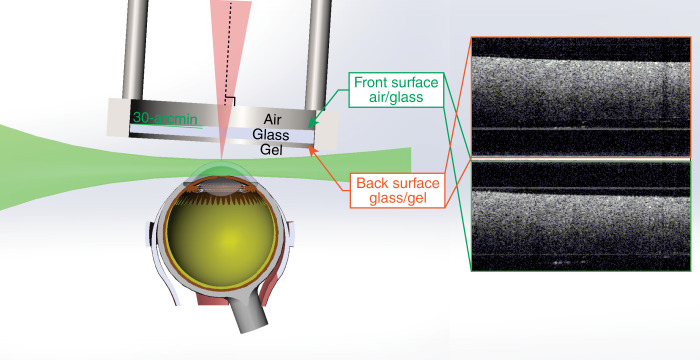
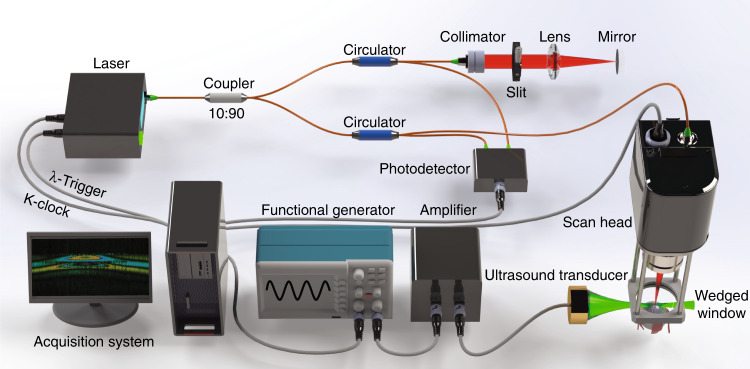
The phase stability of an optical coherence elastography (OCE) system is the key determining factor for achieving a precise elasticity measurement, and it can be affected by the signal-to-noise ratio (SNR), timing jitters in the signal acquisition process, and fluctuations in the optical path difference (OPD) between the sample and reference arms. In this study, we developed an OCE system based on swept-source optical coherence tomography (SS-OCT) with a common-path configuration (SS-OCE). Our system has a phase stability of 4.2 mrad without external stabilization or extensive post-processing, such as averaging. This phase stability allows us to detect a displacement as small as ~300 pm. A common-path interferometer was incorporated by integrating a 3-mm wedged window into the SS-OCT system to provide intrinsic compensation for polarization and dispersion mismatch, as well as to minimize phase fluctuations caused by the OPD variation. The wedged window generates two reference signals that produce two OCT images, allowing for averaging to improve the SNR. Furthermore, the electrical components are optimized to minimize the timing jitters and prevent edge collisions by adjusting the delays between the trigger, k-clock, and signal, utilizing a high-speed waveform digitizer, and incorporating a high-bandwidth balanced photodetector. We validated the SS-OCE performance in a tissue-mimicking phantom and an in vivo rabbit model, and the results demonstrated a significantly improved phase stability compared to that of the conventional SS-OCE. To the best of our knowledge, we demonstrated the first SS-OCE system, which possesses high-phase stability and can be utilized to significantly improve the sensitivity of elastography.
光学相干弹性成像(OCE)系统的相位稳定性是实现精确弹性测量的关键决定因素,它会受到信噪比(SNR)、信号采集过程中的定时抖动以及样品臂和参考臂之间光程差(OPD)波动的影响。在本研究中,我们开发了一种基于扫频光学相干断层扫描(SS-OCT)的具有共光路配置的OCE系统(SS-OCE)。我们的系统在没有外部稳定或诸如平均等广泛后处理的情况下,具有4.2毫弧度的相位稳定性。这种相位稳定性使我们能够检测到小至约300皮米的位移。通过将一个3毫米楔形窗口集成到SS-OCT系统中,引入了一个共光路干涉仪,以对偏振和色散失配提供固有补偿,并最小化由OPD变化引起的相位波动。楔形窗口产生两个参考信号,从而产生两幅OCT图像,允许进行平均以提高信噪比。此外,通过利用高速波形数字化仪并结合高带宽平衡光电探测器,对电气组件进行了优化,以最小化定时抖动并通过调整触发、k时钟和信号之间的延迟来防止边缘碰撞。我们在组织模拟体模和体内兔模型中验证了SS-OCE的性能,结果表明与传统SS-OCE相比,相位稳定性有了显著提高。据我们所知,我们展示了首个具有高相位稳定性且可用于显著提高弹性成像灵敏度的SS-OCE系统。