Graduate Institute of Physical Education, Health & Leisure Studies, National Cheng Kung University, Tainan City, Taiwan.
JMIR Mhealth Uhealth. 2020 Apr 28;8(4):e14707. doi: 10.2196/14707.
Wearable fitness trackers are devices that can record and enhance physical activity among users. Recently, photoplethysmography (PPG) devices that use optical heart rate sensors to detect heart rate in real time have become popular and help in monitoring and controlling exercise intensity. Although the benefits of using optical heart rate monitors have been highlighted through studies, the accuracy of the readouts these commercial devices generate has not been widely assessed for different age groups, especially for the East Asian population with Fitzpatrick skin type III or IV.
This study aimed to examine the accuracy of 2 wearable fitness trackers with PPG to monitor heart rate in real time during moderate exercise in young and older adults.
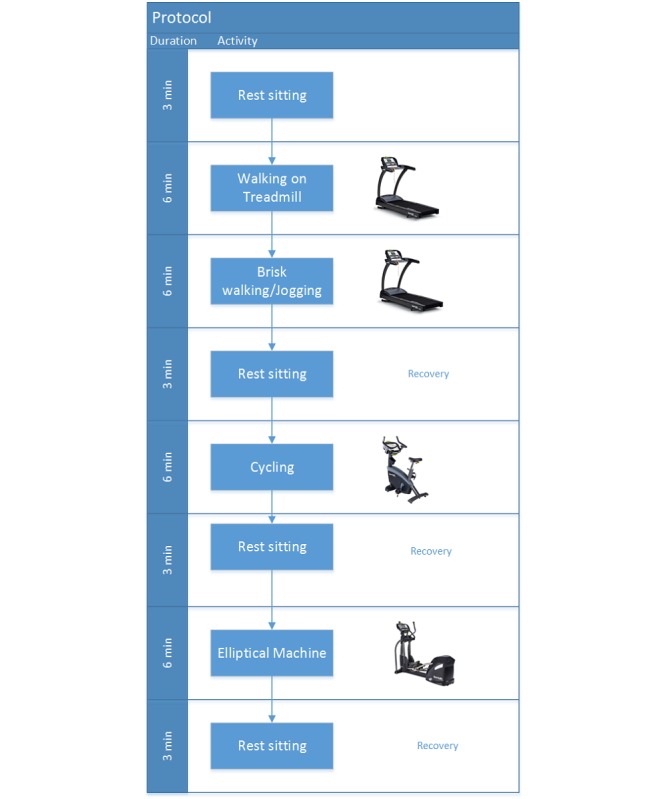
A total of 20 young adults and 20 older adults were recruited for this study. All participants were asked to undergo a series of sedentary and moderate physical activities using indoor aerobic exercise equipment. In this study, the Polar H7 chest-strapped heart rate monitor was used as the criterion measure in 2 fitness trackers, namely Xiaomi Mi Band 2 and Garmin Vivosmart HR+. The real-time, second-by-second heart rate data obtained from both devices were recorded using the broadcast heart rate mode. To critically analyze the results, multiple statistical parameters including the mean absolute percentage error (MAPE), Lin concordance correlation coefficient (CCC), intraclass correlation coefficient, the Pearson product moment correlation coefficient, and the Bland-Altman coefficient were determined to examine the performances of the devices.
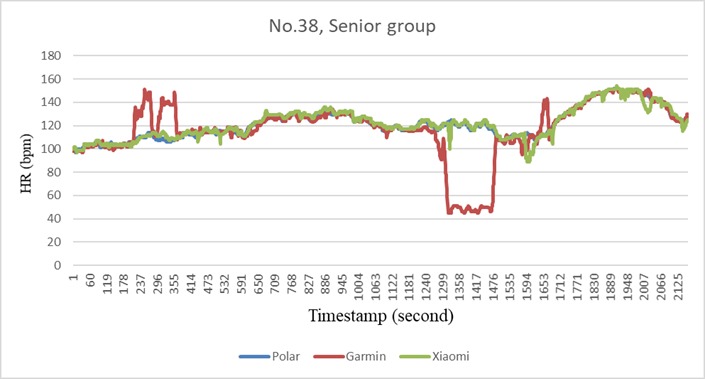
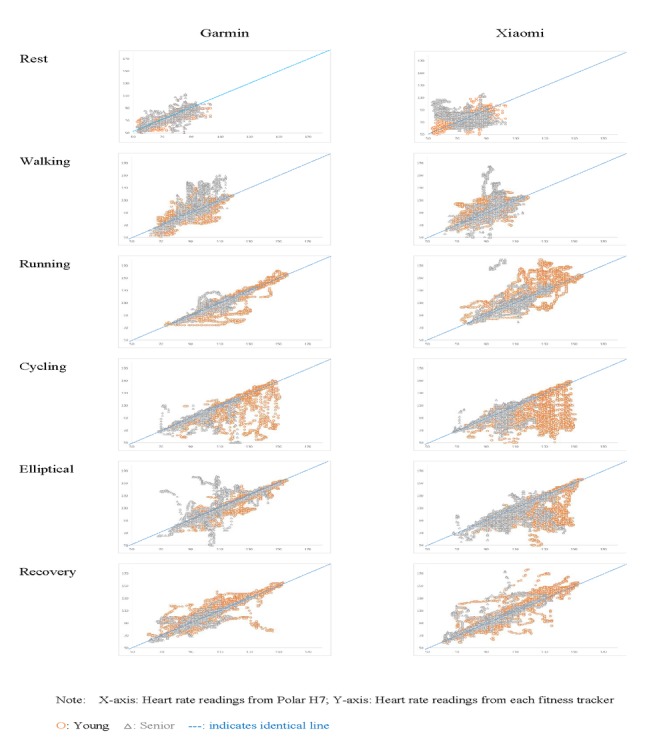
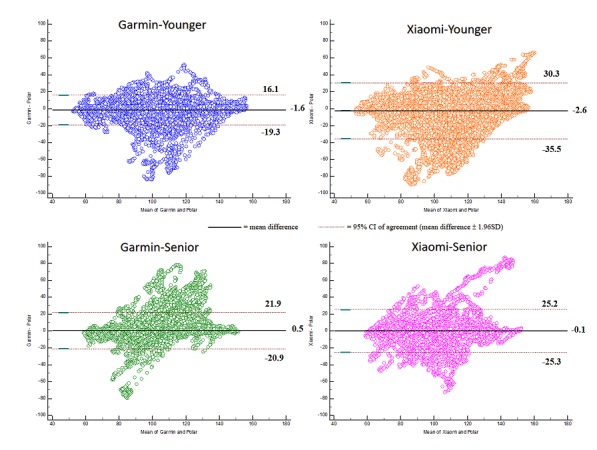
Both test devices exhibited acceptable overall accuracy as heart rate sensors based on several statistical tests. Notably, the MAPE values were below 10% (the designated threshold) in both devices (Garmin=3.77%; Garmin=4.73%; Xiaomi=7.69%; and Xiaomi=6.04%). The scores for reliability test of CCC for Garmin were 0.92 (Young) and 0.80 (Senior), whereas those for Xiaomi were 0.76 (Young) and 0.73 (Senior). However, the results obtained using the Bland-Altman analysis indicated that both test optical devices underestimated the average heart rate. More importantly, the study documented some unexpected outlier readings reported by these devices when used on certain participants.
The study reveals that commonly used optical heart rate sensors, such as the ones used herein, generally produce accurate heart rate readings irrespective of the age of the user. However, users should avoid relying entirely on these readings to indicate exercise intensities, as these devices have a tendency to produce erroneous, extreme readings, which might misinterpret the real-time exercise intensity. Future studies should therefore emphasize the occurrence rate of such errors, as this will likely benefit the development of improved models of heart rate sensors.
可穿戴健身追踪器是一种可以记录和增强用户身体活动的设备。最近,使用光学心率传感器实时检测心率的光体积描记法(PPG)设备变得流行起来,有助于监测和控制运动强度。尽管使用光学心率监测器的益处已经通过研究得到了强调,但是这些商业设备生成的读数的准确性尚未广泛评估不同年龄组,特别是对于具有 Fitzpatrick 皮肤类型 III 或 IV 的东亚人群。
本研究旨在检查 2 款具有 PPG 的可穿戴健身追踪器在年轻和老年成年人进行中等强度运动时实时监测心率的准确性。
共有 20 名年轻成年人和 20 名老年成年人参加了这项研究。所有参与者都被要求使用室内有氧运动设备进行一系列静坐和中等强度的身体活动。在这项研究中,Polar H7 胸带心率监测器被用作 2 款健身追踪器(小米手环 2 和 Garmin Vivosmart HR+)的标准测量设备。使用广播心率模式记录来自这两款设备的实时、逐秒心率数据。为了进行严格的分析,确定了多个统计参数,包括平均绝对百分比误差(MAPE)、Lin 一致性相关系数(CCC)、组内相关系数、皮尔逊积矩相关系数和 Bland-Altman 系数,以检查设备的性能。
基于多项统计测试,两种测试设备均表现出可接受的整体准确性,作为心率传感器。值得注意的是,两种设备的 MAPE 值均低于 10%(指定阈值)(Garmin=3.77%;Garmin=4.73%;小米=7.69%;小米=6.04%)。Garmin 的 CCC 可靠性测试得分分别为 0.92(年轻)和 0.80(老年),而小米的得分分别为 0.76(年轻)和 0.73(老年)。然而,使用 Bland-Altman 分析得到的结果表明,这两种测试光学设备均低估了平均心率。更重要的是,该研究记录了这些设备在某些参与者身上报告的一些意外异常读数。
本研究表明,常用的光学心率传感器,如本文中使用的传感器,通常可以产生准确的心率读数,而与用户的年龄无关。然而,用户不应完全依赖这些读数来指示运动强度,因为这些设备有产生错误、极端读数的趋势,这可能会误解实时运动强度。因此,未来的研究应强调此类错误的发生率,因为这将有助于开发改进的心率传感器模型。