Department of Instrumentation Engineering, Madras Institute of Technology Campus, Anna University, Chennai, Tamil Nadu, India.
JMIR Public Health Surveill. 2020 May 7;6(2):e19368. doi: 10.2196/19368.
The World Health Organization has declared the novel coronavirus disease (COVID-19) to be a public health emergency; at present, India is facing a major threat of community spread. We developed a mathematical model for investigating and predicting the effects of lockdown on future COVID-19 cases with a specific focus on India.
The objective of this work was to develop and validate a mathematical model and to assess the impact of various lockdown scenarios on COVID-19 transmission in India.
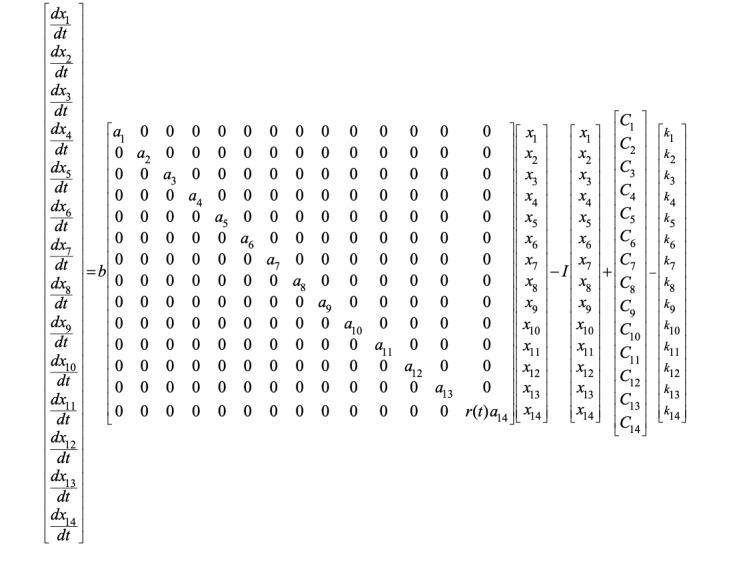
A model consisting of a framework of ordinary differential equations was developed by incorporating the actual reported cases in 14 countries. After validation, the model was applied to predict COVID-19 transmission in India for different intervention scenarios in terms of lockdown for 4, 14, 21, 42, and 60 days. We also assessed the situations of enhanced exposure due to aggregation of individuals in transit stations and shopping malls before the lockdown.
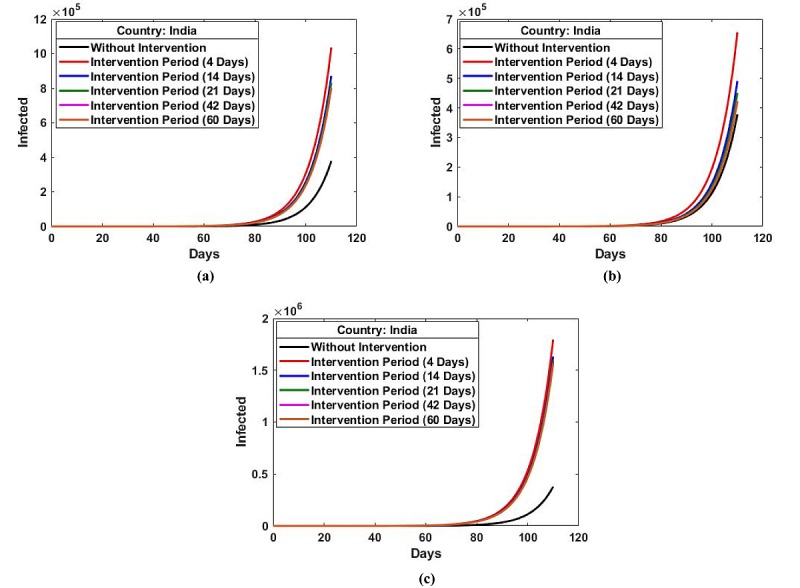
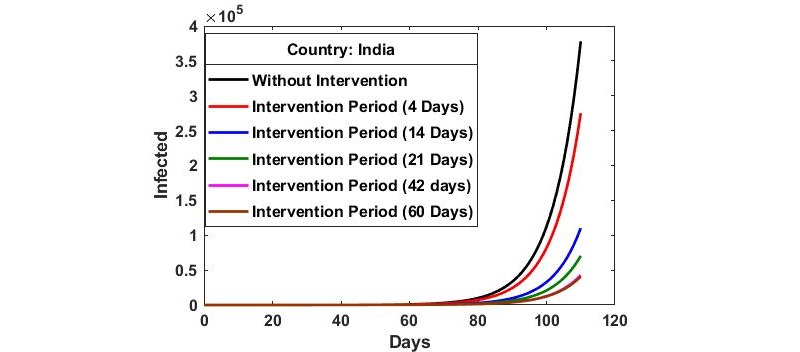
The developed model is efficient in predicting the number of COVID-19 cases compared to the actual reported cases in 14 countries. For India, the model predicted marked reductions in cases for the intervention periods of 14 and 21 days of lockdown and significant reduction for 42 days of lockdown. Such intervention exceeding 42 days does not result in measurable improvement. Finally, for the scenario of "panic shopping" or situations where there is a sudden increase in the factors leading to higher exposure to infection, the model predicted an exponential transmission, resulting in failure of the considered intervention strategy.
Implementation of a strict lockdown for a period of at least 21 days is expected to reduce the transmission of COVID-19. However, a further extension of up to 42 days is required to significantly reduce the transmission of COVID-19 in India. Any relaxation in the lockdown may lead to exponential transmission, resulting in a heavy burden on the health care system in the country.
世界卫生组织已宣布新型冠状病毒病(COVID-19)为公共卫生紧急事件;目前,印度正面临社区传播的重大威胁。我们开发了一种数学模型,用于调查和预测封锁对未来 COVID-19 病例的影响,特别关注印度。
本工作的目的是开发和验证一种数学模型,并评估各种封锁情景对印度 COVID-19 传播的影响。
通过纳入 14 个国家实际报告的病例,开发了一个由常微分方程框架组成的模型。验证后,该模型用于预测印度在不同干预情景下的 COVID-19 传播,包括封锁 4、14、21、42 和 60 天。我们还评估了封锁前在过境站和购物中心聚集的个人导致暴露增加的情况。
与 14 个国家的实际报告病例相比,所开发的模型在预测 COVID-19 病例数量方面效率较高。对于印度,模型预测封锁 14 天和 21 天的干预期内病例数明显减少,封锁 42 天的干预期内病例数显著减少。这种干预超过 42 天不会产生可衡量的改善。最后,对于“恐慌性购物”或导致更高感染暴露因素突然增加的情况,模型预测传播呈指数增长,导致所考虑的干预策略失败。
预计实施至少 21 天的严格封锁将减少 COVID-19 的传播。然而,需要进一步延长 42 天才能显著减少印度的 COVID-19 传播。封锁的任何放宽都可能导致指数传播,从而给该国的医疗保健系统带来沉重负担。