• 文献检索
  • 文档翻译
  • 深度研究
  • 学术资讯
  • Suppr Zotero 插件Zotero 插件
  • 邀请有礼
  • 套餐&价格
  • 历史记录
应用&插件
Suppr Zotero 插件Zotero 插件浏览器插件Mac 客户端Windows 客户端微信小程序
定价
高级版会员购买积分包购买API积分包
服务
文献检索文档翻译深度研究API 文档MCP 服务
关于我们
关于 Suppr公司介绍联系我们用户协议隐私条款
关注我们

Suppr 超能文献

核心技术专利:CN118964589B侵权必究
粤ICP备2023148730 号-1Suppr @ 2026

文献检索

告别复杂PubMed语法,用中文像聊天一样搜索,搜遍4000万医学文献。AI智能推荐,让科研检索更轻松。

立即免费搜索

文件翻译

保留排版,准确专业,支持PDF/Word/PPT等文件格式,支持 12+语言互译。

免费翻译文档

深度研究

AI帮你快速写综述,25分钟生成高质量综述,智能提取关键信息,辅助科研写作。

立即免费体验

打开放射学中机器学习的“黑箱”:标注病例的临近程度是否可以成为一种方法?

Opening the black box of machine learning in radiology: can the proximity of annotated cases be a way?

机构信息

Dipartimento di Elettronica, Informazione e Bioingegneria, Politecnico di Milano, Via Golgi 39, 20133, Milan, Italy.

Present Address: Department of Radiology, Stanford University School of Medicine, 300 Pasteur Dr., Stanford, CA, 94305, USA.

出版信息

Eur Radiol Exp. 2020 May 5;4(1):30. doi: 10.1186/s41747-020-00159-0.

DOI:10.1186/s41747-020-00159-0
PMID:32372200
原文链接:https://pmc.ncbi.nlm.nih.gov/articles/PMC7200961/
Abstract

Machine learning (ML) and deep learning (DL) systems, currently employed in medical image analysis, are data-driven models often considered as black boxes. However, improved transparency is needed to translate automated decision-making to clinical practice. To this aim, we propose a strategy to open the black box by presenting to the radiologist the annotated cases (ACs) proximal to the current case (CC), making decision rationale and uncertainty more explicit. The ACs, used for training, validation, and testing in supervised methods and for validation and testing in the unsupervised ones, could be provided as support of the ML/DL tool. If the CC is localised in a classification space and proximal ACs are selected by proper metrics, the latter ones could be shown in their original form of images, enriched with annotation to radiologists, thus allowing immediate interpretation of the CC classification. Moreover, the density of ACs in the CC neighbourhood, their image saliency maps, classification confidence, demographics, and clinical information would be available to radiologists. Thus, encrypted information could be transmitted to radiologists, who will know model output (what) and salient image regions (where) enriched by ACs, providing classification rationale (why). Summarising, if a classifier is data-driven, let us make its interpretation data-driven too.

摘要

机器学习 (ML) 和深度学习 (DL) 系统目前应用于医学图像分析,它们是基于数据的模型,通常被认为是黑盒。然而,为了将自动化决策转化为临床实践,需要提高透明度。为此,我们提出了一种通过向放射科医生展示与当前病例 (CC) 接近的注释病例 (AC) 的策略,使决策依据和不确定性更加明确,从而打开黑盒。AC 可用于监督方法中的训练、验证和测试,以及无监督方法中的验证和测试,并可作为 ML/DL 工具的支持。如果 CC 位于分类空间中,并且通过适当的指标选择了近端 AC,则可以以图像的原始形式显示后者,并添加注释,以便放射科医生立即解释 CC 的分类。此外,AC 在 CC 附近的密度、图像显著图、分类置信度、人口统计学和临床信息将提供给放射科医生。因此,可以将加密信息传输给放射科医生,他们将知道模型输出 (what) 和通过 AC 丰富的显著图像区域 (where),提供分类依据 (why)。总之,如果分类器是基于数据的,让我们也使其解释基于数据。
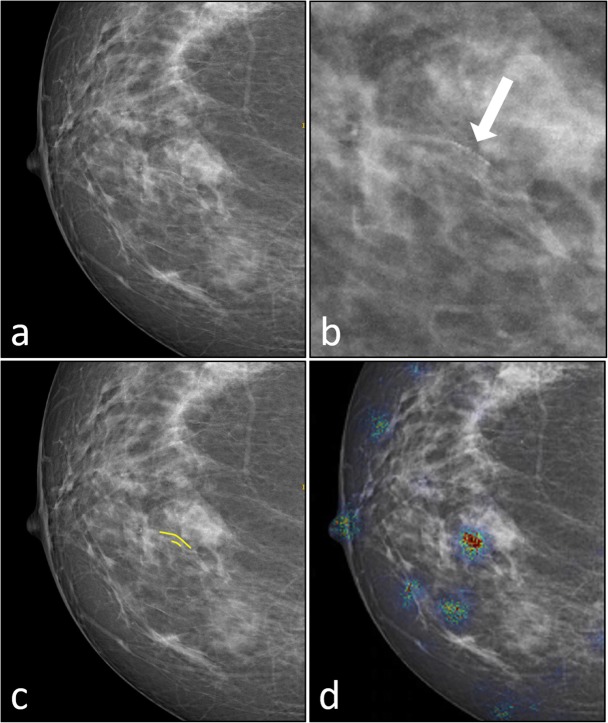
https://cdn.ncbi.nlm.nih.gov/pmc/blobs/5ddc/7200961/372783f5bd33/41747_2020_159_Fig5_HTML.jpg
https://cdn.ncbi.nlm.nih.gov/pmc/blobs/5ddc/7200961/51a0333819c9/41747_2020_159_Fig1_HTML.jpg
https://cdn.ncbi.nlm.nih.gov/pmc/blobs/5ddc/7200961/285381646c34/41747_2020_159_Fig2_HTML.jpg
https://cdn.ncbi.nlm.nih.gov/pmc/blobs/5ddc/7200961/73b1da2d2745/41747_2020_159_Fig3_HTML.jpg
https://cdn.ncbi.nlm.nih.gov/pmc/blobs/5ddc/7200961/9a7618f38ba5/41747_2020_159_Fig4_HTML.jpg
https://cdn.ncbi.nlm.nih.gov/pmc/blobs/5ddc/7200961/372783f5bd33/41747_2020_159_Fig5_HTML.jpg
https://cdn.ncbi.nlm.nih.gov/pmc/blobs/5ddc/7200961/51a0333819c9/41747_2020_159_Fig1_HTML.jpg
https://cdn.ncbi.nlm.nih.gov/pmc/blobs/5ddc/7200961/285381646c34/41747_2020_159_Fig2_HTML.jpg
https://cdn.ncbi.nlm.nih.gov/pmc/blobs/5ddc/7200961/73b1da2d2745/41747_2020_159_Fig3_HTML.jpg
https://cdn.ncbi.nlm.nih.gov/pmc/blobs/5ddc/7200961/9a7618f38ba5/41747_2020_159_Fig4_HTML.jpg
https://cdn.ncbi.nlm.nih.gov/pmc/blobs/5ddc/7200961/372783f5bd33/41747_2020_159_Fig5_HTML.jpg

相似文献

1
Opening the black box of machine learning in radiology: can the proximity of annotated cases be a way?打开放射学中机器学习的“黑箱”:标注病例的临近程度是否可以成为一种方法?
Eur Radiol Exp. 2020 May 5;4(1):30. doi: 10.1186/s41747-020-00159-0.
2
Machine Learning in Radiology: Applications Beyond Image Interpretation.机器学习在放射学中的应用:超越图像解读的应用。
J Am Coll Radiol. 2018 Feb;15(2):350-359. doi: 10.1016/j.jacr.2017.09.044. Epub 2017 Nov 17.
3
Implementing Machine Learning in Radiology Practice and Research.在放射学实践与研究中实施机器学习
AJR Am J Roentgenol. 2017 Apr;208(4):754-760. doi: 10.2214/AJR.16.17224. Epub 2017 Jan 26.
4
Machine Learning in Medical Imaging.医学影像中的机器学习。
J Am Coll Radiol. 2018 Mar;15(3 Pt B):512-520. doi: 10.1016/j.jacr.2017.12.028. Epub 2018 Feb 2.
5
Role of Big Data and Machine Learning in Diagnostic Decision Support in Radiology.大数据和机器学习在放射诊断决策支持中的作用。
J Am Coll Radiol. 2018 Mar;15(3 Pt B):569-576. doi: 10.1016/j.jacr.2018.01.028.
6
Basic Artificial Intelligence Techniques: Machine Learning and Deep Learning.基础人工智能技术:机器学习和深度学习。
Radiol Clin North Am. 2021 Nov;59(6):933-940. doi: 10.1016/j.rcl.2021.06.004.
7
Peering Into the Black Box of Artificial Intelligence: Evaluation Metrics of Machine Learning Methods.窥视人工智能的黑箱:机器学习方法的评估指标。
AJR Am J Roentgenol. 2019 Jan;212(1):38-43. doi: 10.2214/AJR.18.20224. Epub 2018 Oct 17.
8
A novel end-to-end classifier using domain transferred deep convolutional neural networks for biomedical images.一种使用域转移深度卷积神经网络的新型端到端生物医学图像分类器。
Comput Methods Programs Biomed. 2017 Mar;140:283-293. doi: 10.1016/j.cmpb.2016.12.019. Epub 2017 Jan 6.
9
Deep learning for liver tumor diagnosis part II: convolutional neural network interpretation using radiologic imaging features.深度学习在肝脏肿瘤诊断中的应用 Ⅱ:利用影像学特征进行卷积神经网络解释。
Eur Radiol. 2019 Jul;29(7):3348-3357. doi: 10.1007/s00330-019-06214-8. Epub 2019 May 15.
10
Upstream Machine Learning in Radiology.放射学中的上游机器学习。
Radiol Clin North Am. 2021 Nov;59(6):967-985. doi: 10.1016/j.rcl.2021.07.009.

引用本文的文献

1
Federated learning as a smart tool for research on infectious diseases.联邦学习作为传染病研究的智能工具。
BMC Infect Dis. 2024 Nov 21;24(1):1327. doi: 10.1186/s12879-024-10230-5.
2
Impact of AI on radiology: a EuroAIM/EuSoMII 2024 survey among members of the European Society of Radiology.人工智能对放射学的影响:欧洲放射学会成员中的一项2024年欧洲人工智能医学影像(EuroAIM)/欧洲医学影像信息学会(EuSoMII)调查。
Insights Imaging. 2024 Oct 7;15(1):240. doi: 10.1186/s13244-024-01801-w.
3
Deep transfer learning for detection of breast arterial calcifications on mammograms: a comparative study.

本文引用的文献

1
Preparing Medical Imaging Data for Machine Learning.医学影像数据的机器学习准备
Radiology. 2020 Apr;295(1):4-15. doi: 10.1148/radiol.2020192224. Epub 2020 Feb 18.
2
Questions for Artificial Intelligence in Health Care.医疗保健领域中人工智能的相关问题。
JAMA. 2019 Jan 1;321(1):31-32. doi: 10.1001/jama.2018.18932.
3
Artificial intelligence in medical imaging: threat or opportunity? Radiologists again at the forefront of innovation in medicine.医学成像中的人工智能:威胁还是机遇?放射科医生再次站在医学创新的前沿。
基于深度迁移学习的乳腺钼靶动脉钙化检测:一项对比研究。
Eur Radiol Exp. 2024 Jul 15;8(1):80. doi: 10.1186/s41747-024-00478-6.
4
Saliency of breast lesions in breast cancer detection using artificial intelligence.人工智能在乳腺癌检测中对乳腺病变的凸显作用。
Sci Rep. 2023 Nov 23;13(1):20545. doi: 10.1038/s41598-023-46921-3.
5
Artificial intelligence to enhance clinical value across the spectrum of cardiovascular healthcare.人工智能提升心血管医疗保健全领域的临床价值。
Eur Heart J. 2023 Mar 1;44(9):713-725. doi: 10.1093/eurheartj/ehac758.
6
Open issues for education in radiological research: data integrity, study reproducibility, peer-review, levels of evidence, and cross-fertilization with data scientists.放射学研究教育中的待解决问题:数据完整性、研究可重复性、同行评审、证据水平,以及与数据科学家的交叉融合。
Radiol Med. 2023 Feb;128(2):133-135. doi: 10.1007/s11547-022-01582-6. Epub 2022 Dec 31.
7
Artificial Intellgence in the Era of Precision Oncological Imaging.人工智能在精准肿瘤影像学时代
Technol Cancer Res Treat. 2022 Jan-Dec;21:15330338221141793. doi: 10.1177/15330338221141793.
8
Localization-adjusted diagnostic performance and assistance effect of a computer-aided detection system for pneumothorax and consolidation.气胸和实变计算机辅助检测系统的定位调整诊断性能及辅助效果
NPJ Digit Med. 2022 Jul 30;5(1):107. doi: 10.1038/s41746-022-00658-x.
9
A Comparison of Computer-Aided Diagnosis Schemes Optimized Using Radiomics and Deep Transfer Learning Methods.使用放射组学和深度迁移学习方法优化的计算机辅助诊断方案的比较
Bioengineering (Basel). 2022 Jun 15;9(6):256. doi: 10.3390/bioengineering9060256.
10
Semantic annotation for computational pathology: multidisciplinary experience and best practice recommendations.计算病理学的语义标注:多学科经验和最佳实践建议。
J Pathol Clin Res. 2022 Mar;8(2):116-128. doi: 10.1002/cjp2.256. Epub 2022 Jan 10.
Eur Radiol Exp. 2018 Oct 24;2(1):35. doi: 10.1186/s41747-018-0061-6.
4
Opening the black box of machine learning.打开机器学习的黑箱。
Lancet Respir Med. 2018 Nov;6(11):801. doi: 10.1016/S2213-2600(18)30425-9. Epub 2018 Oct 18.
5
Solving the Diagnostic Challenge: A Patient-Centered Approach.解决诊断挑战:以患者为中心的方法。
Ann Fam Med. 2018 Jul;16(4):353-358. doi: 10.1370/afm.2264.
6
Artificial intelligence in radiology.人工智能在放射学中的应用。
Nat Rev Cancer. 2018 Aug;18(8):500-510. doi: 10.1038/s41568-018-0016-5.
7
Deep Learning: A Primer for Radiologists.深度学习:放射科医生入门。
Radiographics. 2017 Nov-Dec;37(7):2113-2131. doi: 10.1148/rg.2017170077.
8
A survey on deep learning in medical image analysis.深度学习在医学图像分析中的应用研究综述。
Med Image Anal. 2017 Dec;42:60-88. doi: 10.1016/j.media.2017.07.005. Epub 2017 Jul 26.
9
Unintended Consequences of Machine Learning in Medicine.机器学习在医学领域的意外后果。
JAMA. 2017 Aug 8;318(6):517-518. doi: 10.1001/jama.2017.7797.
10
Deep Learning in Medical Image Analysis.医学图像分析中的深度学习
Annu Rev Biomed Eng. 2017 Jun 21;19:221-248. doi: 10.1146/annurev-bioeng-071516-044442. Epub 2017 Mar 9.