Hoffman Robert D, Li Chang-Yu, He Kai, Wu Xiaoxing, He Bai-Cheng, He Tong-Chuan, Gao Jian-Li
International Education College, Zhejiang Chinese Medical University, Hangzhou, China.
DAOM Department, Five Branches University, San Jose, CA, United States.
Front Pharmacol. 2020 Apr 21;11:492. doi: 10.3389/fphar.2020.00492. eCollection 2020.
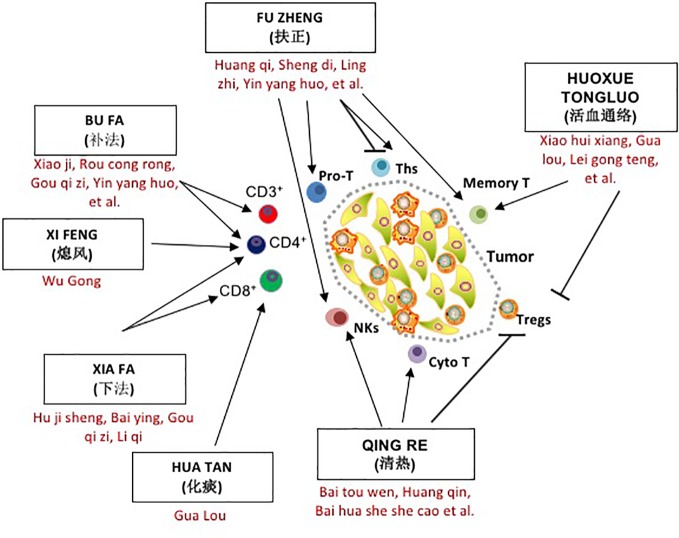
Traditional Chinese medicine is an accepted and integral part of clinical cancer management alongside Western medicine in China. However, historically TCM physicians were unaware of the chemical constituents of their formulations, and the specific biological targets in the body. Through HPLC, flow cytometry, and other processes, researchers now have a much clearer picture of how herbal medicine works in conjunction with the immune system in cancer therapy. Among them, the regulation of tumor-related T cells plays the most important role in modulating tumor immunity by traditional Chinese medicine. Encouraging results have been well-documented, including an increase in T cell production along with their associated cytokines, enhanced regulation of Tregs and important T cell ratios, the formation and function of Tregs in tumor microenvironments, and the promotion of the number and function of normal T Cells to reduce conventional cancer therapy side effects. Chinese herbal medicine represents a rich field of research from which to draw further inspiration for future studies. While promising agents have already been identified, the vast majority of Chinese herbal mechanisms remain undiscovered. In this review, we summarize the effects and mechanisms of specific Chinese herbs and herbal decoctions on tumor related T cells.
在中国,传统中医是临床癌症治疗中被认可且不可或缺的一部分,与西医相辅相成。然而,从历史上看,中医医生并不了解其方剂的化学成分以及体内特定的生物学靶点。通过高效液相色谱法、流式细胞术等方法,研究人员现在对草药在癌症治疗中如何与免疫系统协同作用有了更清晰的认识。其中,肿瘤相关T细胞的调节在传统中医调节肿瘤免疫中起着最重要的作用。已有充分记录的令人鼓舞的结果,包括T细胞及其相关细胞因子的产生增加、Tregs和重要T细胞比例的调节增强、肿瘤微环境中Tregs的形成和功能,以及促进正常T细胞的数量和功能以减少传统癌症治疗的副作用。中草药代表了一个丰富的研究领域,可为未来的研究提供进一步的灵感。虽然已经确定了有前景的药物,但绝大多数中草药的作用机制仍未被发现。在这篇综述中,我们总结了特定中草药和草药汤剂对肿瘤相关T细胞的作用及机制。