Goufo Piebiep, Singh Rupesh Kumar, Cortez Isabel
Centre for the Research and Technology of Agro-Environment and Biological Sciences, Departamento de Agronomia, Universidade de Trás-os-Montes e Alto Douro, Quinta de Prados, 5000-801 Vila Real, Portugal.
Centro de Química de Vila Real, Universidade de Trás-os-Montes e Alto Douro, Quinta de Prados, 5000-801, Vila Real, Portugal.
Antioxidants (Basel). 2020 May 8;9(5):398. doi: 10.3390/antiox9050398.
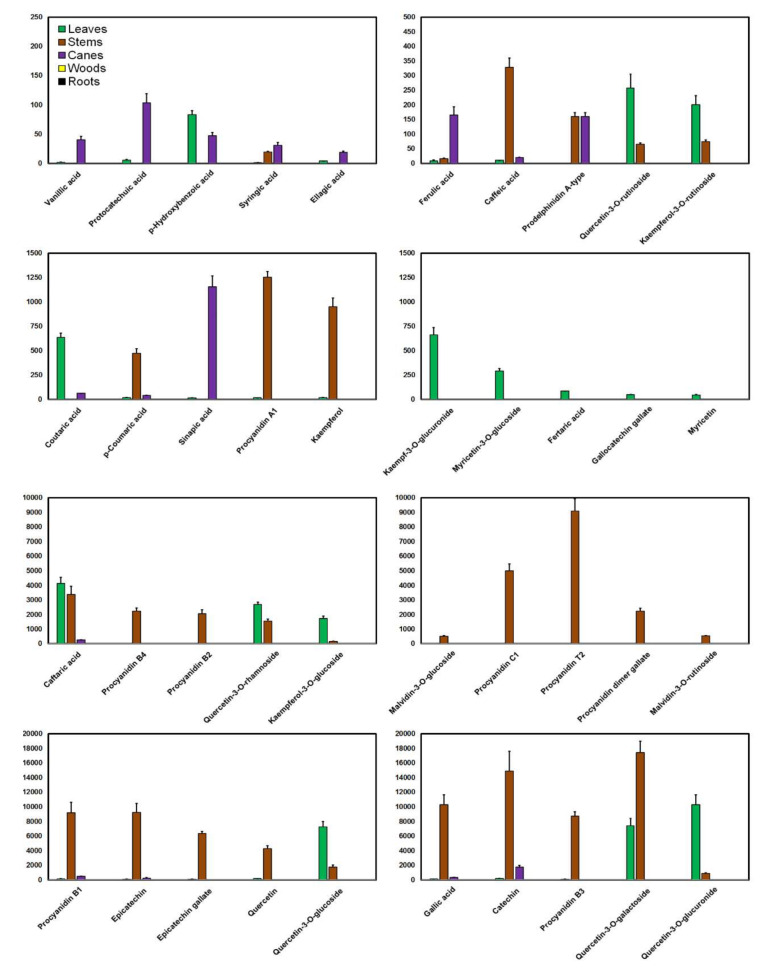
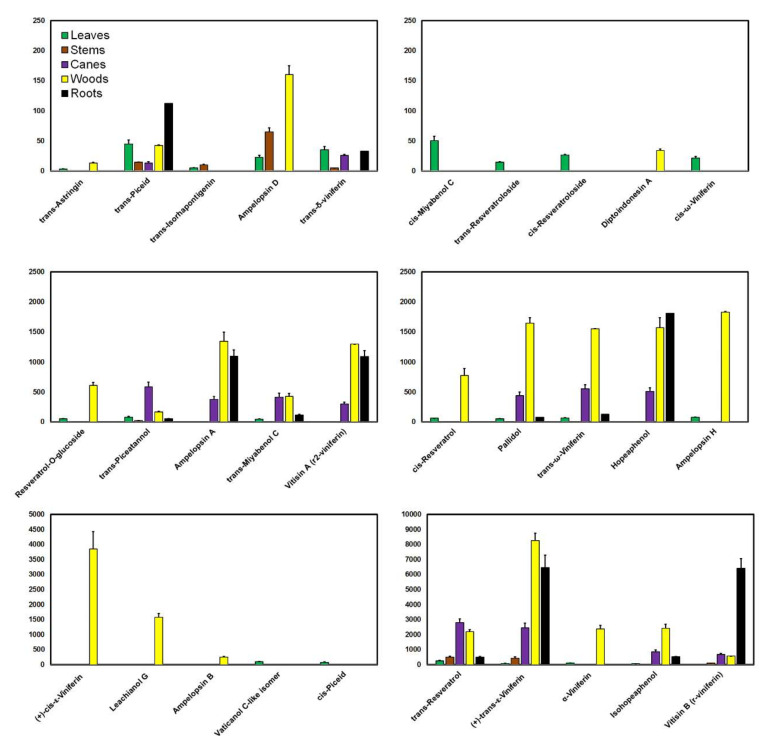
Due to their biological activities, both in plants and in humans, there is a great interest in finding natural sources of phenolic compounds or ways to artificially manipulate their levels. During the last decade, a significant amount of these compounds has been reported in the vegetative organs of the vine plant. In the roots, woods, canes, stems, and leaves, at least 183 phenolic compounds have been identified, including 78 stilbenes (23 monomers, 30 dimers, 8 trimers, 16 tetramers, and 1 hexamer), 15 hydroxycinnamic acids, 9 hydroxybenzoic acids, 17 flavan-3-ols (of which 9 are proanthocyanidins), 14 anthocyanins, 8 flavanones, 35 flavonols, 2 flavones, and 5 coumarins. There is great variability in the distribution of these chemicals along the vine plant, with leaves and stems/canes having flavonols (83.43% of total phenolic levels) and flavan-3-ols (61.63%) as their main compounds, respectively. In light of the pattern described from the same organs, quercetin-3--glucuronide, quercetin-3--galactoside, quercetin-3--glucoside, and caftaric acid are the main flavonols and hydroxycinnamic acids in the leaves; the most commonly represented flavan-3-ols and flavonols in the stems and canes are catechin, epicatechin, procyanidin B1, and quercetin-3--galactoside. The main stilbenes (-ε-viniferin, -resveratrol, isohopeaphenol/hopeaphenol, vitisin B, and ampelopsins) accumulate primarily in the woods, followed by the roots, the canes, and the stems, whereas the leaves, which are more exposed to environmental stresses, have a low concentration of these compounds. Data provided in this review could be used as (i) a metabolomic tool for screening in targeted and untargeted analyses and (ii) a reference list in studies aimed at finding ways to induce naturally occurring polyphenols on an industrial scale for pant and human disease control.
由于酚类化合物在植物和人类中都具有生物活性,因此人们对寻找酚类化合物的天然来源或人工调控其含量的方法有着浓厚的兴趣。在过去十年中,葡萄植株的营养器官中已报道了大量此类化合物。在根、木材、藤茎、茎和叶中,已鉴定出至少183种酚类化合物,包括78种芪类化合物(23种单体、30种二聚体、8种三聚体、16种四聚体和1种六聚体)、15种羟基肉桂酸、9种羟基苯甲酸、17种黄烷-3-醇(其中9种是原花青素)、14种花青素、8种黄烷酮、35种黄酮醇、2种黄酮和5种香豆素。这些化学物质在葡萄植株中的分布差异很大,叶和茎/藤茎的主要化合物分别是黄酮醇(占总酚含量的83.43%)和黄烷-3-醇(占61.63%)。根据同一器官的描述模式,槲皮素-3-O-葡萄糖醛酸苷、槲皮素-3-O-半乳糖苷、槲皮素-3-O-葡萄糖苷和咖啡酸是叶中主要的黄酮醇和羟基肉桂酸;茎和藤茎中最常见的黄烷-3-醇和黄酮醇是儿茶素、表儿茶素、原花青素B1和槲皮素-3-O-半乳糖苷。主要的芪类化合物(白藜芦醇、白藜芦醇、异希望草酚/希望草酚、葡萄素B和蛇葡萄素)主要积累在木材中,其次是根、藤茎和茎,而更容易受到环境胁迫的叶中这些化合物的浓度较低。本综述提供的数据可作为(i)用于靶向和非靶向分析筛选的代谢组学工具,以及(ii)旨在寻找在工业规模上诱导天然存在的多酚以控制植物和人类疾病的研究中的参考列表。