Department of Nutrition, Faculty of Health Sciences, University of Brasilia (UnB), Campus Darcy Ribeiro, Asa Norte, Brasilia DF 70910-900, Brazil.
Department of Statistics, University of Brasilia, Brasilia DF 70910-900, Brazil.
Nutrients. 2020 May 14;12(5):1406. doi: 10.3390/nu12051406.
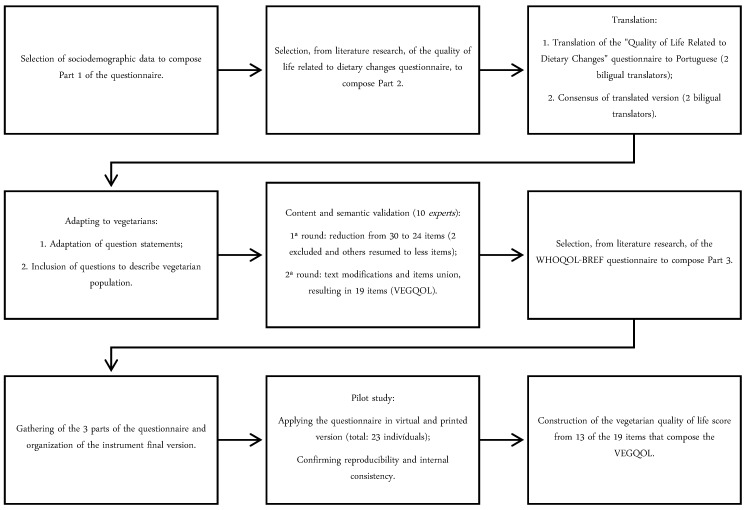
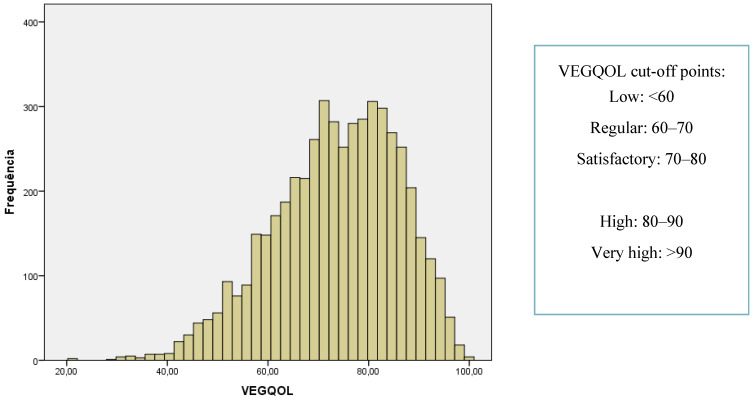
The adoption of a vegetarian diet has been associated with positive health outcomes. However, few studies evaluate the effect of this eating pattern on quality of life. Moreover, no specific instrument for the vegetarian population to measure the quality of life is available worldwide. Therefore, this study aimed to elaborate and validate a specific questionnaire to measure the quality of life in vegetarians. The Specific Vegetarian Quality of Life Questionnaire (VEGQOL) was constructed based on other instruments and studies related to vegetarianism. The content and semantic validation were performed by a group of experts, followed by a pilot study to evaluate the questionnaire acceptability and reproducibility. Discriminant validation was tested using the WHOQOL as the gold standard measure (Pearson correlation ranging from 0.302 of the domain 3 to 0.392 of the domain 2). Afterward, a nationwide survey was conducted using VEGQOL. Content and semantic validation selected 19 of the initial 30 items. VEGQOL presented good reproducibility (Cohen's Kappa coefficient ranging from 0.361 to 0.730 and intraclass correlation coefficient of 0.820) and internal consistency (0.708), both adequate to evaluate the quality of life in vegetarians. The sample size ( = 5014 individuals, error of 3% at a level of significance of 5%) and distribution was representative of the Brazilian vegetarian population. In general, the quality of life of Brazilian vegetarians was considered satisfactory (VEGQOL cut off points 70-80). Among different types of vegetarians, the vegans showed better results with a VEGQOL mean value of 79.2 ± 10.7. Older individuals, the ones who adopted the diet for a longer time (VEGQOL mean value of 75.8 ± 12.7) and the ones who had other vegetarians in their social network (VEGQOL mean value of 74.6 ± 12.2) also had a better quality of life score. Individuals who adopted it for ethical or health reasons had a higher quality of life score. The questionnaire produced in this study is a useful tool for future research in this area. Results were better for vegans and for the ones who adopt the diet for ethical or health reasons.
素食饮食与健康结果呈正相关。然而,很少有研究评估这种饮食模式对生活质量的影响。此外,全球范围内没有专门用于衡量素食人群生活质量的工具。因此,本研究旨在制定和验证专门用于衡量素食者生活质量的问卷。特定素食生活质量问卷(VEGQOL)是基于其他与素食相关的工具和研究构建的。内容和语义验证由一组专家进行,随后进行了一项试点研究,以评估问卷的可接受性和可重复性。区分验证使用 WHOQOL 作为金标准测量(从域 3 的 0.302 到域 2 的 0.392 的 Pearson 相关)。之后,使用 VEGQOL 进行了全国性调查。内容和语义验证选择了最初 30 个项目中的 19 个。VEGQOL 表现出良好的可重复性(Cohen 的 Kappa 系数范围为 0.361 至 0.730,组内相关系数为 0.820)和内部一致性(0.708),足以评估素食者的生活质量。样本量(n=5014 人,置信水平为 5%时的误差为 3%)和分布代表了巴西素食人群。总的来说,巴西素食者的生活质量被认为是令人满意的(VEGQOL 截止点为 70-80)。在不同类型的素食者中,素食者的得分更好,VEGQOL 的平均值为 79.2±10.7。年龄较大、饮食时间较长(VEGQOL 的平均值为 75.8±12.7)和社交网络中有其他素食者的人(VEGQOL 的平均值为 74.6±12.2)生活质量得分也更高。出于道德或健康原因采用素食的人生活质量得分更高。本研究中产生的问卷是该领域未来研究的有用工具。结果对于素食者和出于道德或健康原因采用素食的人更好。