Andreu-Fernández Vicente, Almeida Toledano Laura, Pizarro Nieves, Navarro-Tapia Elisabet, Gómez-Roig María Dolores, de la Torre Rafael, García-Algar Óscar
Grup de Recerca Infancia i Entorn (GRIE), Institut d'investigacions Biomèdiques August Pi i Sunyer (IDIBAPS), 08036 Barcelona, Spain.
Valencian International University (VIU), 46002 Valencia, Spain.
Antioxidants (Basel). 2020 May 19;9(5):440. doi: 10.3390/antiox9050440.
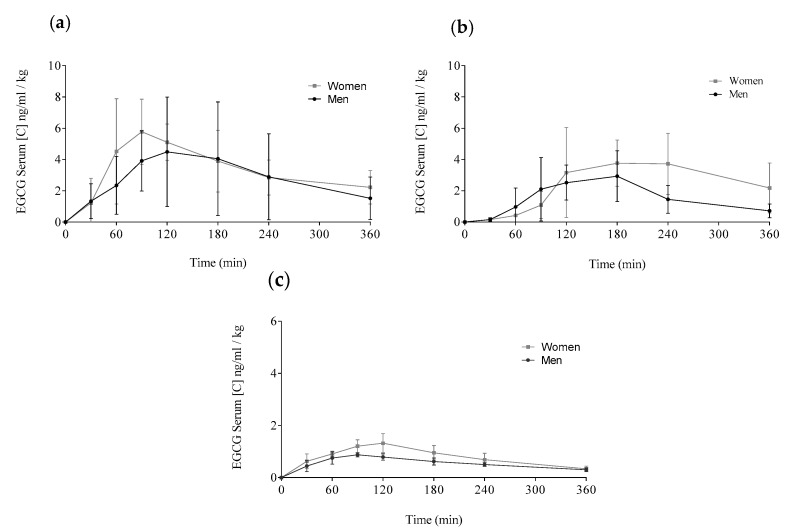
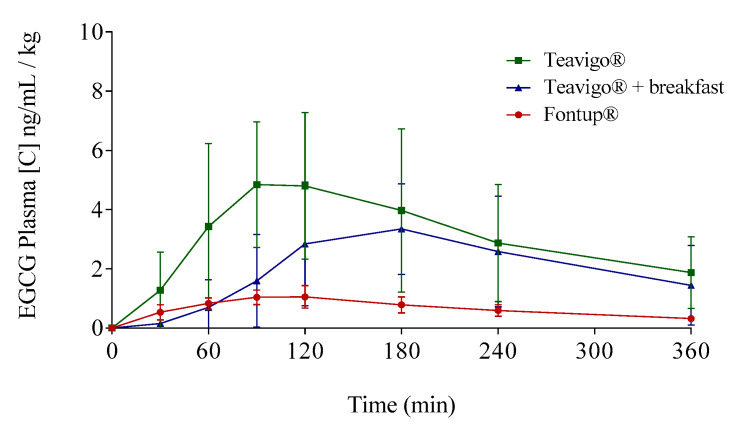
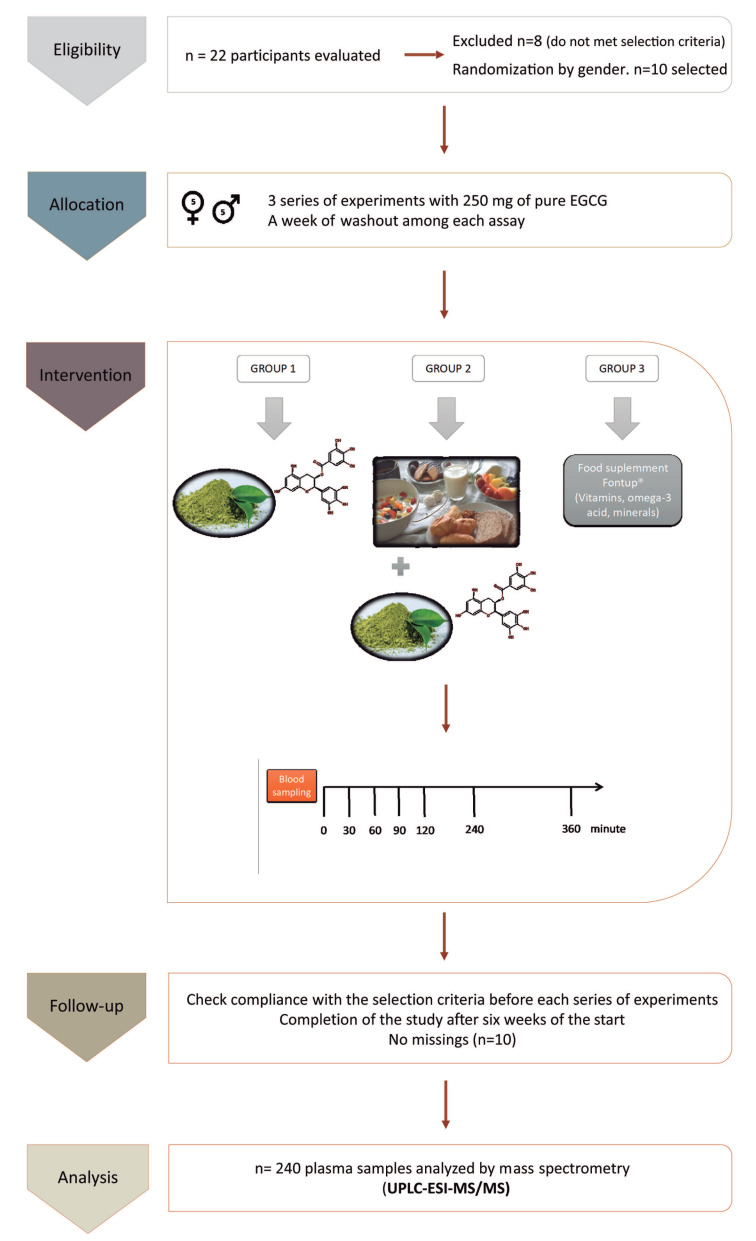
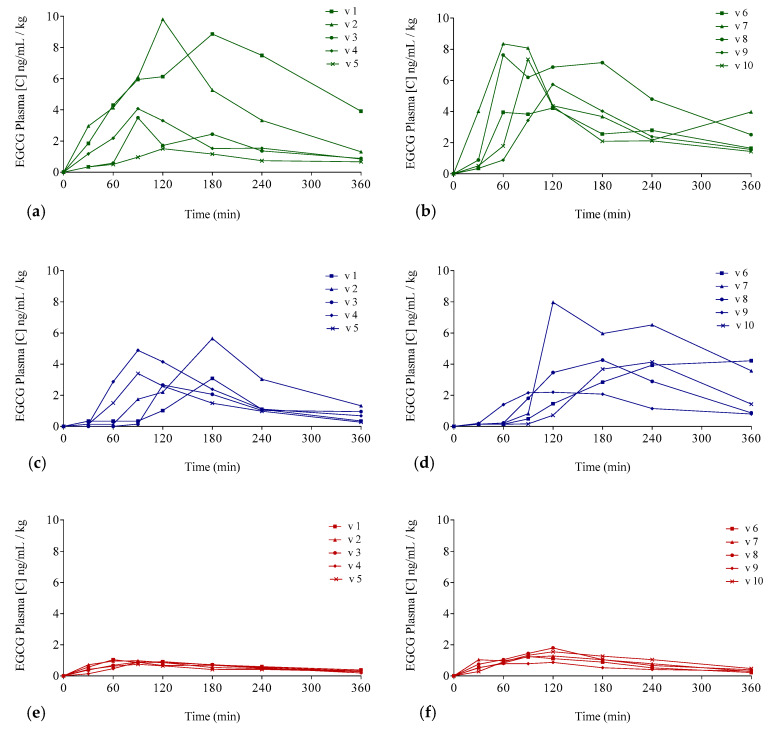
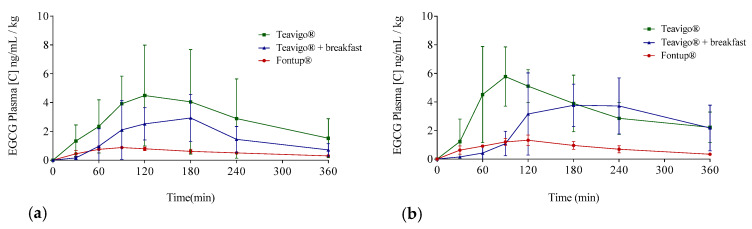
The flavanol epigallocatechin gallate (EGCG) is being tested for the treatment of several diseases in humans. However, its bioavailability and pharmacokinetic profile needs a better understanding to enable its use in clinical trials. There is no consensus on the most appropriate concentration of EGCG in the body to obtain the maximum therapeutic effects. Therefore, the aim of this study is to analyze the bioavailability of EGCG orally administered alone or with different food supplements after overnight fasting in order to determine its optimal conditions (high concentrations in blood and the lowest interindividual variations) to be used as a pharmacological tool in human trials. Ten healthy volunteers (5 men and 5 women) aged 25 to 35 years were recruited prospectively. Three series of clinical experiments with a washout period of seven days among each were performed: 1) Teavigo (EGCG extract) alone, 2) Teavigo with a standard breakfast, and 3) FontUp (Teavigo commercially prepared with fats, carbohydrates, proteins, vitamins, and minerals). Blood samples were collected at 0, 30, 60, 90, 120, 180, 240, and 360 min after EGCG intake. Free EGCG in plasma was measured using a liquid chromatography and mass spectrometry UPLC-ESI-MS/MS analytical method. The pharmacokinetic variables analyzed statistically were area under the curve (AUC), C, C, C, T, and T. EGCG (Teavigo) alone was the group with higher AUC C, and C both in men (3.86 ± 4.11 µg/mL/kg/6 h; 5.95 ng/mL/kg; 2.96 ng/mL/kg) and women (3.33 ± 1.08 µg/mL/kg/6 h; 6.66 ng/mL/kg; 3.66 ng/mL). Moreover, FontUp was the group with the highest value of T both in men (192 ± 66 min) and women (133 ± 28 min). Teavigo intake after fasting overnight revealed the highest concentration of EGCG in plasma according to its pharmacokinetic profile, indicating that this is an excellent alternative of administration if the experimental design requires good absorption in the gastrointestinal tract. Moreover, EGCG taken along with food supplements (FontUp) improved the stability of the molecule in the body, being the best choice if the experimental design wants to reduce interindividual variation.
黄烷醇表没食子儿茶素没食子酸酯(EGCG)正在进行人体多种疾病治疗的测试。然而,其生物利用度和药代动力学特征需要更好地了解,以便能用于临床试验。对于体内获得最大治疗效果时EGCG的最合适浓度尚无共识。因此,本研究的目的是分析空腹过夜后单独口服EGCG或与不同食物补充剂一起口服时的生物利用度,以确定其最佳条件(血液中高浓度且个体间差异最小),用作人体试验中的药理学工具。前瞻性招募了10名年龄在25至35岁的健康志愿者(5名男性和5名女性)。进行了三个系列的临床实验,每个系列之间有7天的洗脱期:1)单独服用Teavigo(EGCG提取物),2)Teavigo与标准早餐一起服用,3)FontUp(Teavigo与脂肪、碳水化合物、蛋白质、维生素和矿物质一起商业制备)。在摄入EGCG后的0、30、60、90、120、180、240和360分钟采集血样。使用液相色谱和质谱UPLC - ESI - MS/MS分析方法测量血浆中的游离EGCG。经统计学分析的药代动力学变量为曲线下面积(AUC)、Cmax、Cmin、Cavg、Tmax和Tmin。单独服用EGCG(Teavigo)的组在男性(3.86±4.11μg/mL/kg/6 h;5.95 ng/mL/kg;2.96 ng/mL/kg)和女性(3.33±1.08μg/mL/kg/6 h;6.66 ng/mL/kg;3.66 ng/mL)中均具有较高的AUC、Cmax和Cavg。此外,FontUp组在男性(192±66分钟)和女性(133±28分钟)中Tmax值最高。根据其药代动力学特征,空腹过夜后服用Teavigo显示血浆中EGCG浓度最高,表明如果实验设计要求在胃肠道有良好吸收,这是一种极好的给药方式。此外,与食物补充剂(FontUp)一起服用EGCG可提高分子在体内的稳定性,如果实验设计想要减少个体间差异,这是最佳选择。