Division of Neurology Faculty of Medicine Chulalongkorn University and King Chulalongkorn Memorial Hospital Bangkok Thailand.
King Chulalongkorn Memorial Hospital Thai Red Cross Society Bangkok Thailand.
J Am Heart Assoc. 2020 Jun 16;9(12):e016299. doi: 10.1161/JAHA.119.016299. Epub 2020 Jun 1.
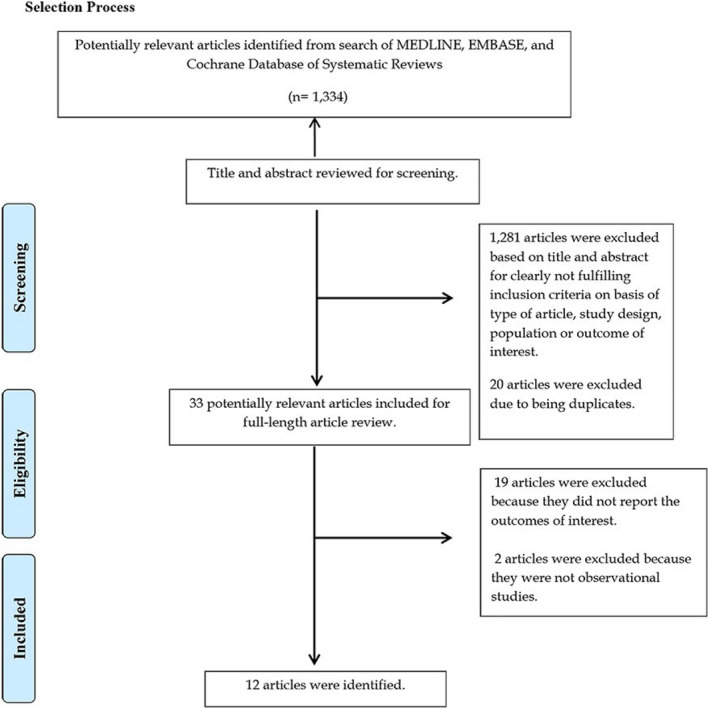
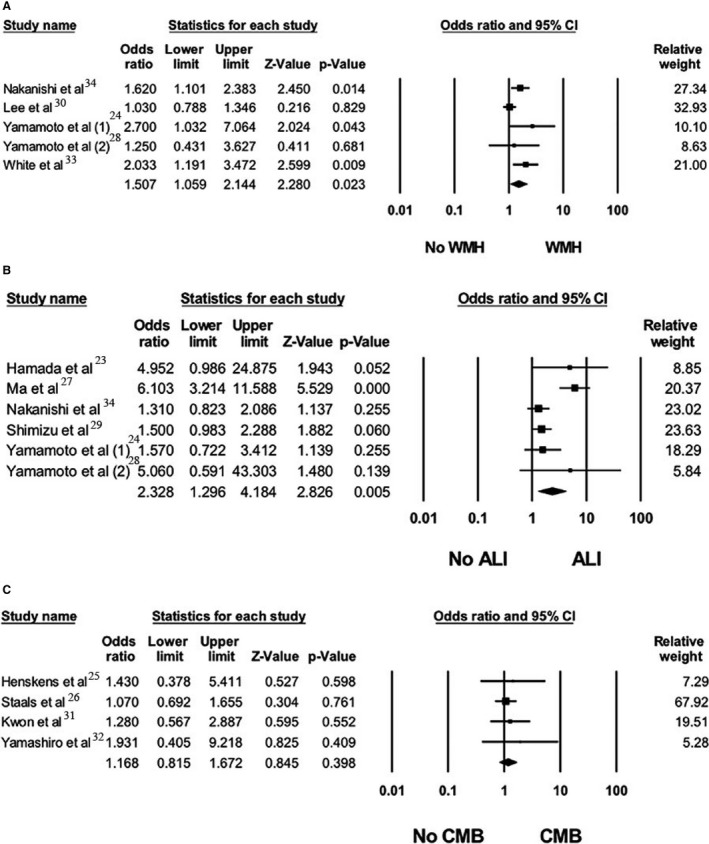
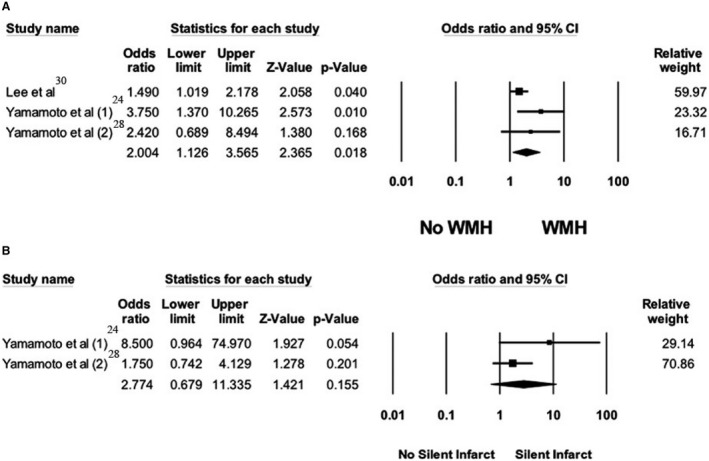
Background Abnormal circadian blood pressure (BP) variations during sleep, specifically the non-dipping (<10% fall in nocturnal BP) and reverse-dipping patterns (rise in nocturnal BP), have been associated with an increased risk of cardiovascular events and target organ damage. However, the relationship between abnormal sleep BP variations and cerebral small vessel disease markers is poorly established. This study aims to assess the association between non-dipping and reverse-dipping BP patterns with markers of silent cerebral small vessel disease. Methods and Results MEDLINE, Embase, and Cochrane Databases were searched from inception through November 2019. Studies that reported the odds ratios (ORs) for cerebral small vessel disease markers in patients with non-dipping or reverse-dipping BP patterns were included. Effect estimates from the individual studies were extracted and combined using the random-effect, generic inverse variance method of DerSimonian and Laird. Twelve observational studies composed of 3497 patients were included in this analysis. The reverse-dipping compared with normal dipping BP pattern was associated with a higher prevalence of white matter hyperintensity with a pooled adjusted OR of 2.00 (95% CI, 1.13-2.37; I=36%). Non-dipping BP pattern compared with normal dipping BP pattern was associated with higher prevalence of white matter hyperintensity and asymptomatic lacunar infarction, with pooled ORs of 1.38 (95% CI, 0.95-2.02; I=52%) and 2.33 (95% CI, 1.30-4.18; I=73%), respectively. Limiting to only studies with confounder-adjusted analysis resulted in a pooled OR of 1.38 (95% CI, 0.95-2.02; I=52%) for white matter hyperintensity and 1.44 (95% CI, 0.97-2.13; I=0%) for asymptomatic lacunar infarction. Conclusions The non-dipping and reverse-dipping BP patterns are associated with neuroimaging cerebral small vessel disease markers.
睡眠期间异常的血压(BP)变化,特别是非杓型(夜间 BP 下降<10%)和反杓型(夜间 BP 升高),与心血管事件和靶器官损害风险增加相关。然而,异常睡眠 BP 变化与脑小血管疾病标志物之间的关系尚未确定。本研究旨在评估非杓型和反杓型 BP 模式与脑小血管疾病标志物之间的关系。
从建库到 2019 年 11 月,检索 MEDLINE、Embase 和 Cochrane 数据库。纳入报告非杓型或反杓型 BP 模式患者脑小血管疾病标志物比值比(OR)的研究。提取来自单个研究的效应估计值,并使用 DerSimonian 和 Laird 的随机效应、通用逆方差方法进行合并。本分析纳入了 12 项包含 3497 例患者的观察性研究。与正常杓型 BP 模式相比,反杓型 BP 模式与更高的脑白质高信号发生率相关,合并调整后 OR 为 2.00(95%CI,1.13-2.37;I=36%)。与正常杓型 BP 模式相比,非杓型 BP 模式与更高的脑白质高信号和无症状腔隙性梗死发生率相关,合并 OR 分别为 1.38(95%CI,0.95-2.02;I=52%)和 2.33(95%CI,1.30-4.18;I=73%)。仅纳入有混杂因素调整分析的研究,脑白质高信号的合并 OR 为 1.38(95%CI,0.95-2.02;I=52%),无症状腔隙性梗死的合并 OR 为 1.44(95%CI,0.97-2.13;I=0%)。
非杓型和反杓型 BP 模式与神经影像学脑小血管疾病标志物相关。