Kerr-Gaffney Jess, Halls Daniel, Harrison Amy, Tchanturia Kate
Department of Psychological Medicine, Institute of Psychiatry, Psychology, and Neuroscience, King's College London, London, United Kingdom.
Department of Psychology and Human Development, University College London, London, United Kingdom.
Front Psychiatry. 2020 May 12;11:401. doi: 10.3389/fpsyt.2020.00401. eCollection 2020.
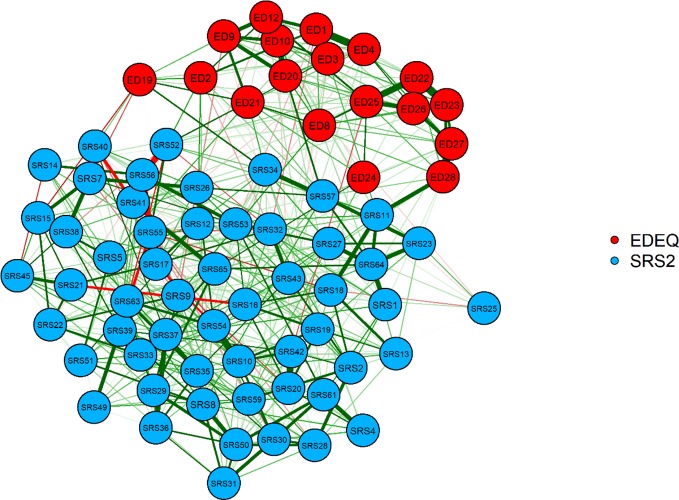
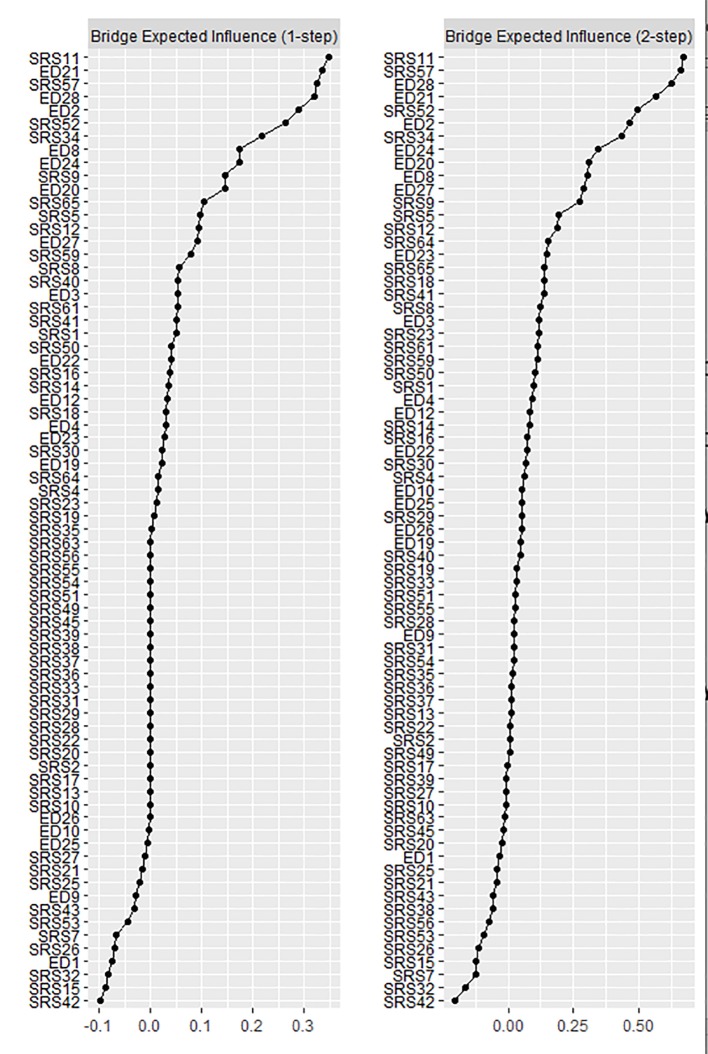
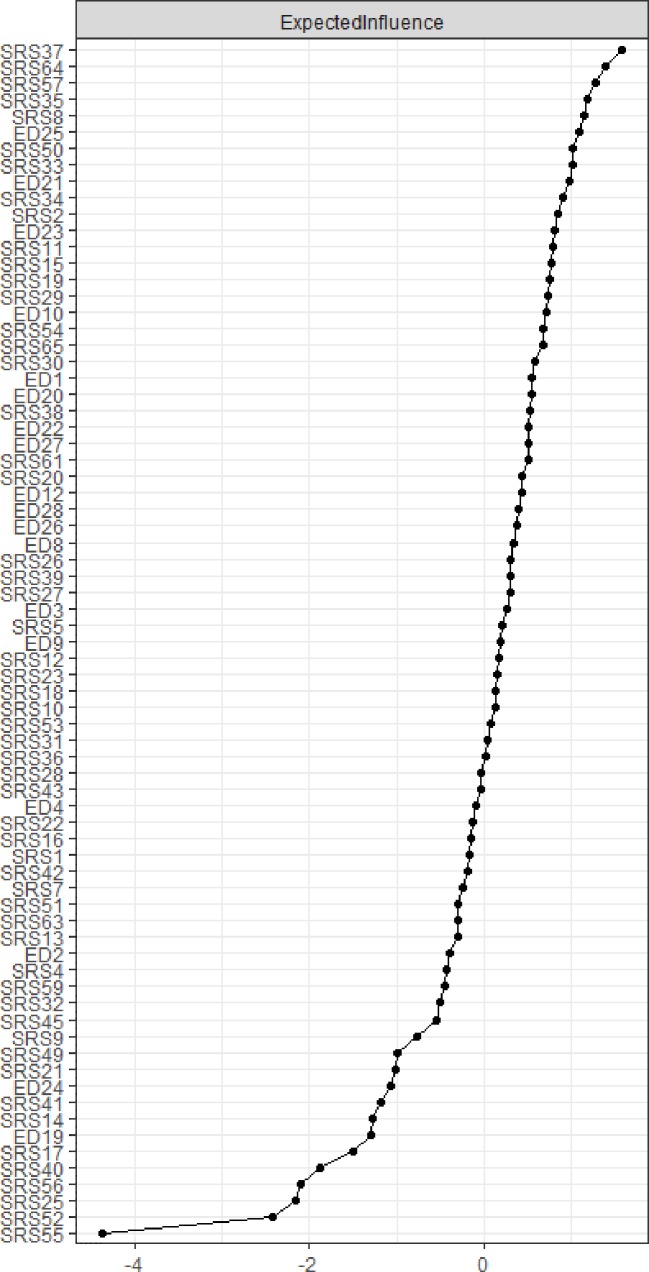
Over the past few decades, research has accumulated to suggest a relationship between anorexia nervosa (AN) and autism spectrum disorder (ASD). Elevated ASD traits are present in around one third of those with AN, and there is some evidence to suggest that ASD traits are associated with more severe eating disorder (ED) psychopathology. The current study aimed to examine relationships between ED and ASD symptoms in individuals with a lifetime history of AN using network analysis. One hundred and one participants completed the ED Examination Questionnaire (EDE-Q) and the Social Responsiveness Scale (SRS-2). A regularized partial correlation network was estimated using a graphical least absolute shrinkage and selection operator. Expected influence (EI) and bridge EI values were calculated to identify central and bridge symptoms respectively. Isolation, difficulties with relating to others, and feelings of tension during social situations were most central to the network, while poor self-confidence, concerns over eating around others, and concerns over others seeing one's body were the strongest bridge symptoms. Our findings confirm that interpersonal problems are central to ED psychopathology. They also suggest poor self-confidence and social anxiety-type worries may mediate the relationship between ED and ASD symptoms in those with a lifetime diagnosis of AN. Longitudinal studies examining fluctuations in symptoms over time may be helpful in understanding direction of causality.
在过去几十年里,已有大量研究表明神经性厌食症(AN)与自闭症谱系障碍(ASD)之间存在关联。约三分之一的神经性厌食症患者具有较高的自闭症谱系障碍特征,并且有证据表明这些特征与更严重的饮食失调(ED)心理病理学有关。本研究旨在使用网络分析方法,探究有神经性厌食症终生病史的个体中饮食失调与自闭症谱系障碍症状之间的关系。101名参与者完成了饮食失调检查问卷(EDE-Q)和社会反应量表(SRS-2)。使用图形化最小绝对收缩和选择算子估计了一个正则化偏相关网络。计算了预期影响(EI)和桥梁EI值,分别以识别核心症状和桥梁症状。社交场合中的孤立感、与他人交往困难以及紧张情绪在网络中最为核心,而自信心不足、在他人面前进食的担忧以及担心他人看到自己身体的担忧是最强的桥梁症状。我们的研究结果证实,人际关系问题是饮食失调心理病理学的核心。研究结果还表明,自信心不足和社交焦虑型担忧可能在终生诊断为神经性厌食症的个体中,介导饮食失调与自闭症谱系障碍症状之间的关系。研究症状随时间波动的纵向研究,可能有助于理解因果关系的方向。