Lip Ka Ying Florence, García-Ríos Estéfani, Costa Carlos E, Guillamón José Manuel, Domingues Lucília, Teixeira José, van Gulik Walter M
Department of Biotechnology, Delft University of Technology, Delft 2629HZ, the Netherlands.
Food Biotechnology Department, Instituto de Agroquímica y Tecnología de Alimentos (IATA), Consejo Superior de Investigaciones Científicas (CSIC), Valencia, Spain.
Biotechnol Rep (Amst). 2020 May 13;26:e00462. doi: 10.1016/j.btre.2020.e00462. eCollection 2020 Jun.
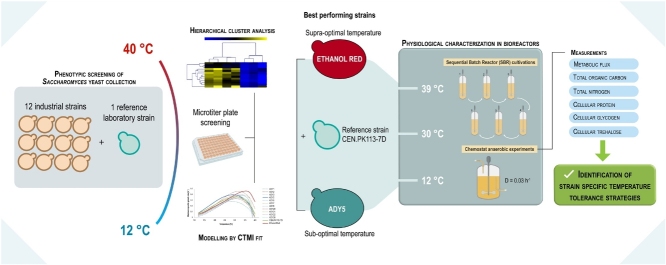
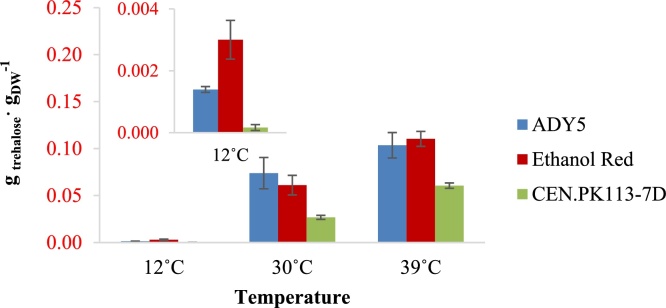
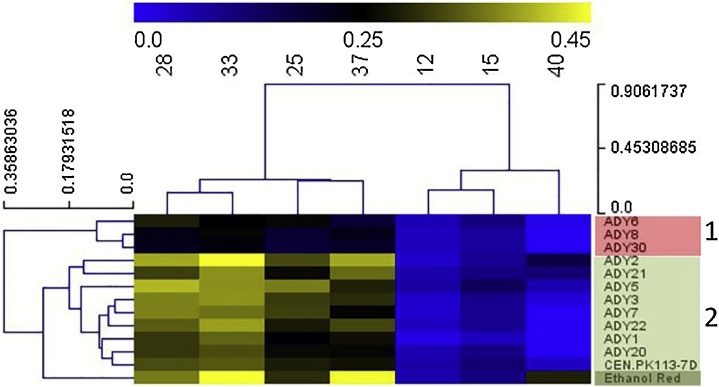
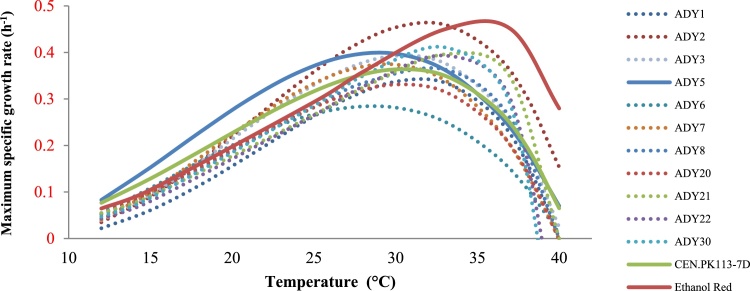
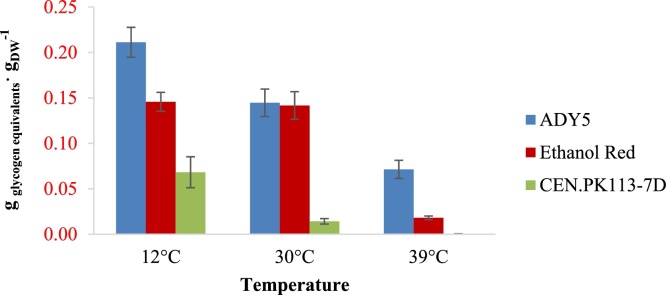
A phenotypic screening of 12 industrial yeast strains and the well-studied laboratory strain CEN.PK113-7D at cultivation temperatures between 12 °C and 40 °C revealed significant differences in maximum growth rates and temperature tolerance. From those 12, two strains, one performing best at 12 °C and the other at 40 °C, plus the laboratory strain, were selected for further physiological characterization in well-controlled bioreactors. The strains were grown in anaerobic chemostats, at a fixed specific growth rate of 0.03 h and sequential batch cultures at 12 °C, 30 °C, and 39 °C. We observed significant differences in biomass and ethanol yields on glucose, biomass protein and storage carbohydrate contents, and biomass yields on ATP between strains and cultivation temperatures. Increased temperature tolerance coincided with higher energetic efficiency of cell growth, indicating that temperature intolerance is a result of energy wasting processes, such as increased turnover of cellular components (e.g. proteins) due to temperature induced damage.
对12种工业酵母菌株以及研究充分的实验室菌株CEN.PK113 - 7D在12°C至40°C的培养温度下进行表型筛选,结果显示最大生长速率和温度耐受性存在显著差异。从这12种菌株中,挑选出在12°C时表现最佳的一种菌株、在40°C时表现最佳的另一种菌株以及实验室菌株,在控制良好的生物反应器中进行进一步的生理特性研究。这些菌株在厌氧恒化器中,以0.03 h的固定比生长速率生长,并在12°C、30°C和39°C下进行连续批次培养。我们观察到,在菌株和培养温度之间,葡萄糖的生物量和乙醇产量、生物量蛋白质和储存碳水化合物含量以及ATP的生物量产量存在显著差异。温度耐受性的提高与细胞生长的能量效率提高相一致,这表明温度不耐受是能量浪费过程的结果,例如由于温度诱导的损伤导致细胞成分(如蛋白质)周转增加。