Tan Chia Wanq, Rukayadi Yaya, Hasan Hanan, Thung Tze Young, Lee Epeng, Rollon Wendy Dayang, Hara Hirofumi, Kayali Ahmad Yaman, Nishibuchi Mitsuaki, Radu Son
Department of Food Science, Faculty of Food Science and Technology, Universiti Putra Malaysia, UPM Serdang, 43400 Selangor Darul Ehsan, Malaysia.
Food Safety and Food Integrity, Institute of Tropical Agriculture and Food Security (ITAFoS), Universiti Putra Malaysia, UPM Serdang, 43400 Selangor Darul Ehsan, Malaysia.
Saudi J Biol Sci. 2020 Jun;27(6):1602-1608. doi: 10.1016/j.sjbs.2020.01.002. Epub 2020 Jan 16.
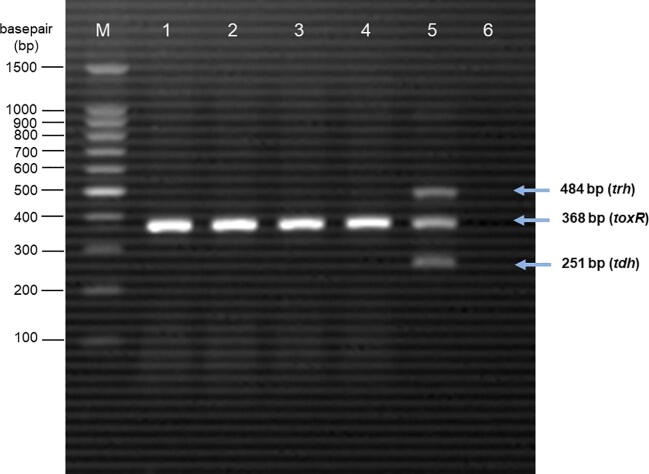
is a foodborne bacterial pathogen that may cause gastroenteritis in humans through the consumption of seafood contaminated with this microorganism. The emergence of antimicrobial and multidrug-resistant bacteria is another serious public health threat worldwide. In this study, the prevalence and antibiotic susceptibility test of in blood clams, shrimps, surf clams, and squids were determined. The overall prevalence of in seafood was 85.71% (120/140), consisting of 91.43% (32/35) in blood clam, 88.57% (31/35) in shrimps, 82.86% (29/35) in surf clams, and 80% (28/35) in squids. The majority of isolates from the seafood samples were found to be susceptible to most antibiotics except ampicillin, cefazolin, and penicillin. The MAR indices of isolates ranged from 0.04 to 0.71 and about 90.83% of isolates were found resistant to more than one antibiotic. The high prevalence of in seafood and multidrug-resistant isolates detected in this study could pose a potential risk to human health and hence appropriate control methods should be in place to minimize the potential contamination and prevent the emergence of antibiotic resistance.
是一种食源性细菌病原体,通过食用被这种微生物污染的海鲜可能会导致人类患肠胃炎。抗菌和耐多药细菌的出现是全球另一个严重的公共卫生威胁。在本研究中,测定了血蛤、虾、 surf clams(此处原文可能有误,推测为文蛤之类的词,暂按 surf clams 翻译)和鱿鱼中该菌的流行率及抗生素敏感性试验。海鲜中该菌的总体流行率为85.71%(120/140),其中血蛤中为91.43%(32/35),虾中为88.57%(31/35), surf clams 中为82.86%(29/35),鱿鱼中为80%(28/35)。除氨苄西林、头孢唑林和青霉素外,从海鲜样本中分离出的大多数该菌对大多数抗生素敏感。该菌分离株的多重耐药指数(MAR)范围为0.04至0.71,约90.83%的分离株对一种以上抗生素耐药。本研究中检测到的海鲜中该菌的高流行率和多重耐药分离株可能对人类健康构成潜在风险,因此应采取适当的控制方法,以尽量减少潜在污染并防止抗生素耐药性的出现。