Ota Koshi, Fukui Keisuke, Nakamura Eriko, Oka Masahiro, Ota Kanna, Sakaue Masahide, Sano Yohei, Takasu Akira
Department of Emergency Medicine Osaka Medical College Takatsuki Japan.
Research and Development Center Osaka Medical College Takatsuki Japan.
J Gen Fam Med. 2020 Feb 16;21(3):56-62. doi: 10.1002/jgf2.302. eCollection 2020 May.
Previous clinical studies have reported that Shakuyaku-kanzo-to (SKT) has a therapeutic effect on muscle cramps, but few studies have clarified how SKT acts to treat muscle cramps. The aim of this study was to perform an updated systematic review of clinical trials for SKT in patients with muscle cramps.
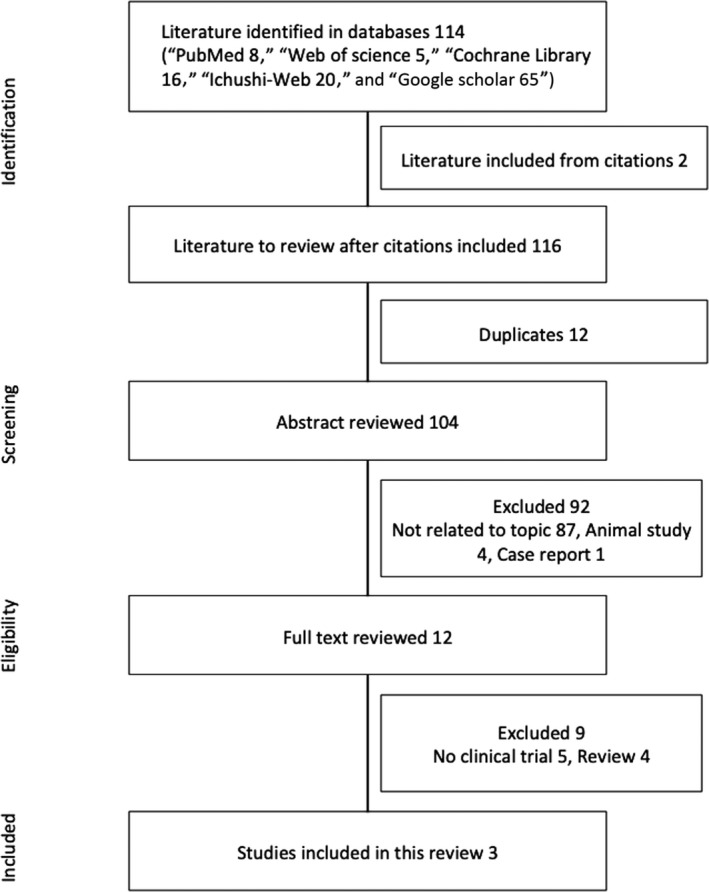
The literature was systematically reviewed to assess the effects of SKT in patients with muscle cramps. PubMed, Web of Science, Cochrane Library, Google Scholar, and Ichushi-Web were searched using the terms "Shakuyaku-kanzo-to" ("shakuyakukanzoto", etc), "clinical trials" and "muscle cramps". Two quality assessments were conducted independently by three authors. Data were extracted using a standardized extraction tool, and a qualitative synthesis of evidence was performed.
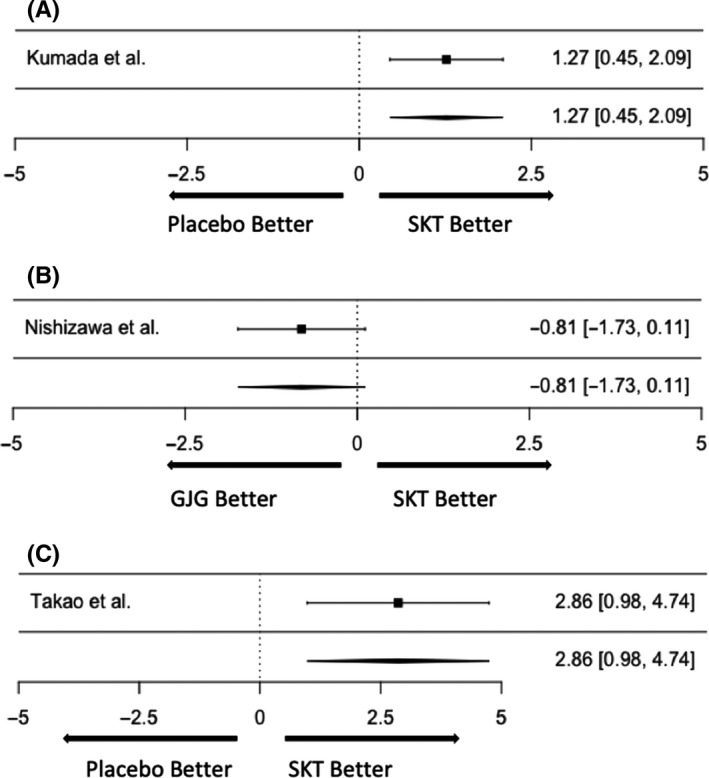
Three randomized controlled articles were identified and enrolled in this study. A systematic review, but not a meta-analysis, was performed because of the high heterogeneity and limited number of studies. In patients with liver cirrhosis, the odds ratio (OR) for improvement with SKT compared to placebo was 1.27 (95% confidence interval [CI], 0.445-2.086) and compared to Goshajinkigan was 0.81 (95%CI, -1.734-0.114). The OR for improvement with SKT compared with eperisone hydrochloride in patients with lumbar spinal stenosis was 2.86 (95%CI, 0.980-4.744).
Current evidence appears insufficient to allow a meta-analysis of the effects of SKT, but SKT might show efficacy in treating muscle cramps in patients with cirrhosis or lumbar spinal stenosis.
既往临床研究报道,芍药甘草汤(SKT)对肌肉痉挛有治疗作用,但很少有研究阐明SKT治疗肌肉痉挛的作用机制。本研究旨在对SKT治疗肌肉痉挛患者的临床试验进行更新的系统评价。
系统检索文献以评估SKT对肌肉痉挛患者的疗效。使用“芍药甘草汤”(“shakuyakukanzoto”等)、“临床试验”和“肌肉痉挛”等检索词在PubMed、科学网、Cochrane图书馆、谷歌学术和医中志网络数据库进行检索。由三位作者独立进行两项质量评估。使用标准化提取工具提取数据,并对证据进行定性综合分析。
本研究纳入了3篇随机对照文章。由于研究的高度异质性和数量有限,仅进行了系统评价而非Meta分析。在肝硬化患者中,与安慰剂相比,SKT改善的比值比(OR)为1.27(95%置信区间[CI],0.445 - 2.086),与柴芍六君子汤相比为0.81(95%CI,-1.734 - 0.114)。在腰椎管狭窄症患者中,与盐酸乙哌立松相比,SKT改善的OR为2.86(95%CI,0.980 - 4.744)。
目前的证据似乎不足以对SKT的疗效进行Meta分析,但SKT可能对肝硬化或腰椎管狭窄症患者的肌肉痉挛具有治疗效果。