Xu Junshen, Zhang Molin, Turk Esra Abaci, Zhang Larry, Grant Ellen, Ying Kui, Golland Polina, Adalsteinsson Elfar
Department of Electrical Engineering and Computer Science, MIT, Cambridge, MA, USA.
Department of Engineering Physics, Tsinghua University, Beijing, China.
Med Image Comput Comput Assist Interv. 2019 Oct;11767:403-410. doi: 10.1007/978-3-030-32251-9_44. Epub 2019 Oct 10.
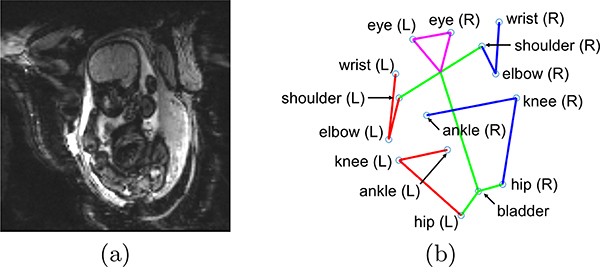
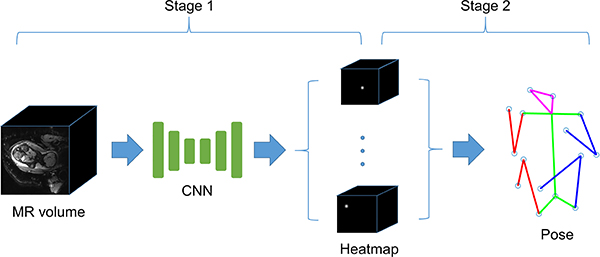
The performance and diagnostic utility of magnetic resonance imaging (MRI) in pregnancy is fundamentally constrained by fetal motion. Motion of the fetus, which is unpredictable and rapid on the scale of conventional imaging times, limits the set of viable acquisition techniques to single-shot imaging with severe compromises in signal-to-noise ratio and diagnostic contrast, and frequently results in unacceptable image quality. Surprisingly little is known about the characteristics of fetal motion during MRI and here we propose and demonstrate methods that exploit a growing repository of MRI observations of the gravid abdomen that are acquired at low spatial resolution but relatively high temporal resolution and over long durations (10-30 minutes). We estimate fetal pose per frame in MRI volumes of the pregnant abdomen via deep learning algorithms that detect key fetal landmarks. Evaluation of the proposed method shows that our framework achieves quantitatively an average error of 4.47 mm and 96.4% accuracy (with error less than 10 mm). Fetal pose estimation in MRI time series yields novel means of quantifying fetal movements in health and disease, and enables the learning of kinematic models that may enhance prospective mitigation of fetal motion artifacts during MRI acquisition.
磁共振成像(MRI)在孕期的性能及诊断效用从根本上受到胎儿运动的限制。胎儿的运动在传统成像时间尺度上是不可预测且快速的,这将可行的采集技术限制为单次成像,导致信噪比和诊断对比度严重受损,并且常常导致图像质量无法接受。令人惊讶的是,对于MRI期间胎儿运动的特征了解甚少,在此我们提出并展示了一些方法,这些方法利用了不断增加的妊娠腹部MRI观察库,这些观察是在低空间分辨率但相对高时间分辨率且长时间(10 - 30分钟)内获取的。我们通过检测关键胎儿标志点的深度学习算法,估计妊娠腹部MRI容积中每一帧的胎儿姿势。对所提出方法的评估表明,我们的框架在定量上实现了平均误差4.47毫米和96.4%的准确率(误差小于10毫米)。MRI时间序列中的胎儿姿势估计产生了量化健康和疾病状态下胎儿运动的新方法,并能够学习运动学模型,这可能会在MRI采集期间增强对胎儿运动伪影的前瞻性减轻。