Ruan Weiwei, Sun Xun, Hu Xuehan, Liu Fang, Hu Fan, Guo Jinxia, Zhang Yongxue, Lan Xiaoli
Department of Nuclear Medicine, Union Hospital, Tongji Medical College, Huazhong University of Science and Technology, No. 1277 Jiefang Ave, Wuhan, 430022, China.
Hubei Province Key Laboratory of Molecular Imaging, Wuhan, 430022, China.
EJNMMI Res. 2020 Jun 8;10(1):60. doi: 10.1186/s13550-020-00648-8.
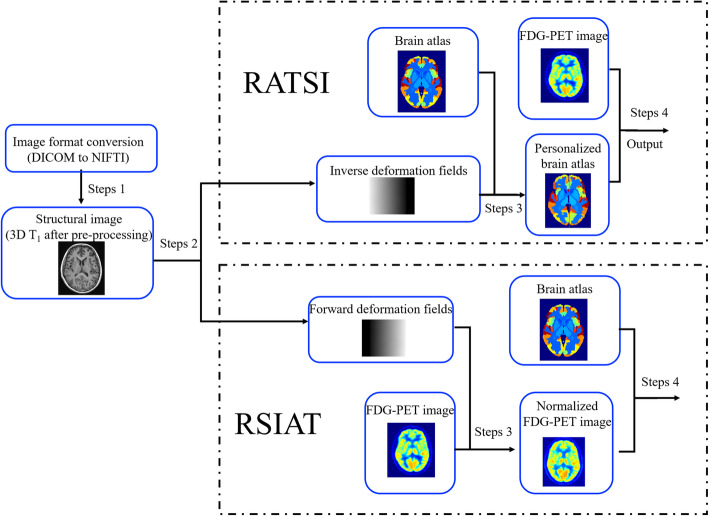
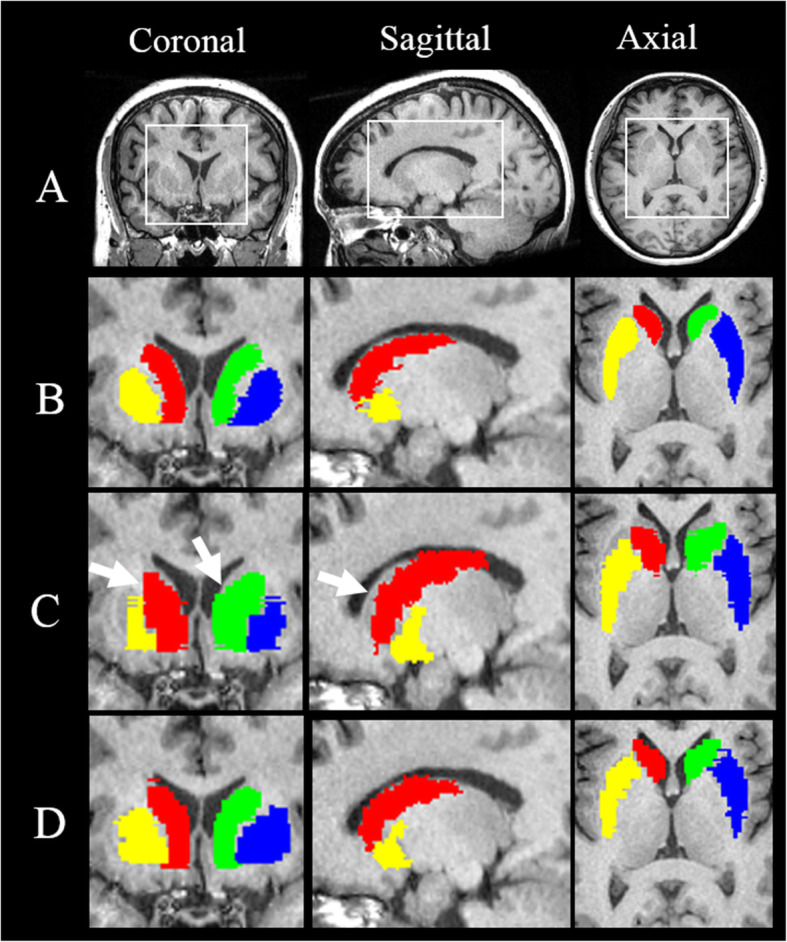
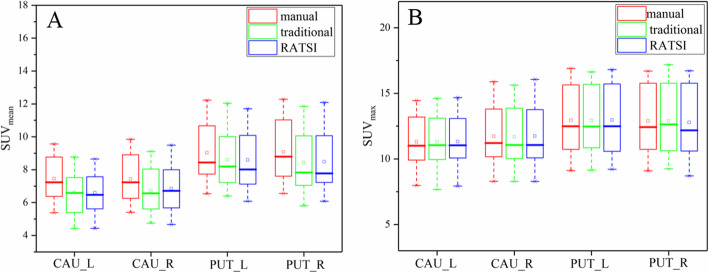
Quantitative analysis of brain positron-emission tomography (PET) depends on structural segmentation, which can be time-consuming and operator-dependent when performed manually. Previous automatic segmentation usually registered subjects' images onto an atlas template (defined as RSIAT here) for group analysis, which changed the individuals' images and probably affected regional PET segmentation. In contrast, we could register atlas template to subjects' images (RATSI), which created an individual atlas template and may be more accurate for PET segmentation. We segmented two representative brain areas in twenty Parkinson disease (PD) and eight multiple system atrophy (MSA) patients performed in hybrid positron-emission tomography/magnetic resonance imaging (PET/MR). The segmentation accuracy was evaluated using the Dice coefficient (DC) and Hausdorff distance (HD), and the standardized uptake value (SUV) measurements of these two automatic segmentation methods were compared, using manual segmentation as a reference.
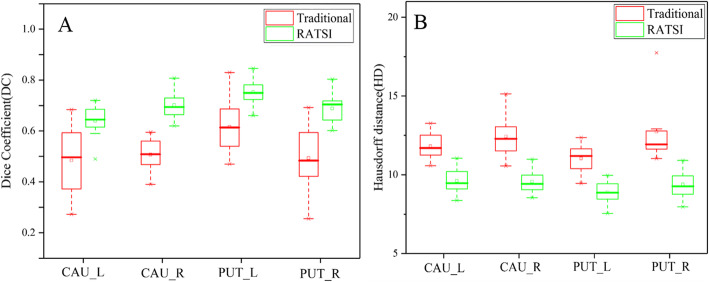
The DC of RATSI increased, and the HD decreased significantly (P < 0.05) compared with the RSIAT in PD, while the results of one-way analysis of variance (ANOVA) found no significant differences in the SUV and SUV among the two automatic and the manual segmentation methods. Further, RATSI was used to compare regional differences in cerebral metabolism pattern between PD and MSA patients. The SUV in the segmented cerebellar gray matter for the MSA group was significantly lower compared with the PD group (P < 0.05), which is consistent with previous reports.
The RATSI was more accurate for the caudate nucleus and putamen automatic segmentation and can be used for regional PET analysis in hybrid PET/MR.
脑正电子发射断层扫描(PET)的定量分析依赖于结构分割,手动进行时既耗时又依赖操作人员。以往的自动分割通常将受试者的图像配准到一个图谱模板(此处定义为RSIAT)上进行组分析,这改变了个体图像,可能会影响PET区域分割。相比之下,我们可以将图谱模板配准到受试者的图像上(RATSI),从而创建个体图谱模板,这对于PET分割可能更准确。我们在20例帕金森病(PD)患者和8例多系统萎缩(MSA)患者中,对两个具有代表性的脑区进行了混合正电子发射断层扫描/磁共振成像(PET/MR)检查,并进行了分割。使用Dice系数(DC)和豪斯多夫距离(HD)评估分割准确性,并以手动分割为参考,比较这两种自动分割方法的标准化摄取值(SUV)测量结果。
与PD患者的RSIAT相比,RATSI的DC增加,HD显著降低(P<0.05),而单因素方差分析(ANOVA)结果显示,两种自动分割方法和手动分割方法之间的SUV和SUV均无显著差异。此外,使用RATSI比较了PD和MSA患者脑代谢模式的区域差异。MSA组分割的小脑灰质SUV显著低于PD组(P<0.05),这与先前的报道一致。
RATSI对尾状核和壳核的自动分割更准确,可用于混合PET/MR中的区域PET分析。