Suárez Nicolás M, Blyth Emily, Li Kathy, Ganzenmueller Tina, Camiolo Salvatore, Avdic Selmir, Withers Barbara, Linnenweber-Held Silvia, Gwinner Wilfried, Dhingra Akshay, Heim Albert, Schulz Thomas F, Gunson Rory, Gottlieb David, Slobedman Barry, Davison Andrew J
MRC-University of Glasgow Centre for Virus Research, Glasgow, United Kingdom.
Westmead Institute for Medical Research, Sydney, NSW, Australia.
Front Cell Infect Microbiol. 2020 Jun 15;10:267. doi: 10.3389/fcimb.2020.00267. eCollection 2020.
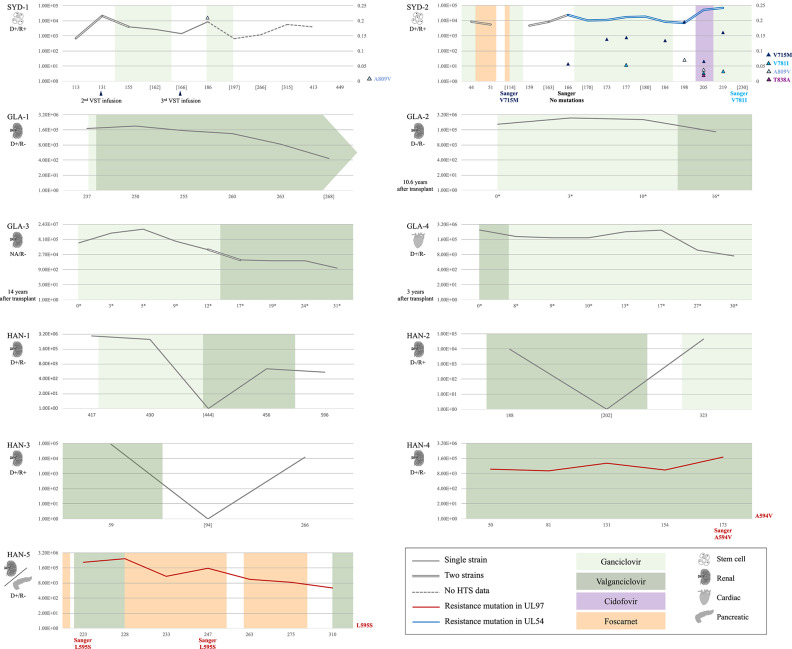
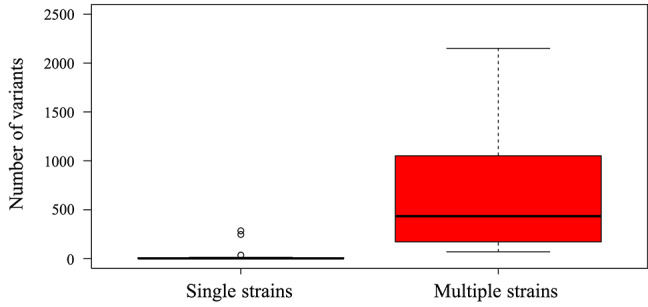
Human cytomegalovirus (HCMV) is the most frequent cause of opportunistic viral infection following transplantation. Viral factors of potential clinical importance include the selection of mutants resistant to antiviral drugs and the occurrence of infections involving multiple HCMV strains. These factors are typically addressed by analyzing relevant HCMV genes by PCR and Sanger sequencing, which involves independent assays of limited sensitivity. To assess the dynamics of viral populations with high sensitivity, we applied high-throughput sequencing coupled with HCMV-adapted target enrichment to samples collected longitudinally from 11 transplant recipients (solid organ, = 9, and allogeneic hematopoietic stem cell, = 2). Only the latter presented multiple-strain infections. Four cases presented resistance mutations ( = 6), two (A594V and L595S) at high (100%) and four (V715M, V781I, A809V, and T838A) at low (<25%) frequency. One allogeneic hematopoietic stem cell transplant recipient presented up to four resistance mutations, each at low frequency. The use of high-throughput sequencing to monitor mutations and strain composition in people at risk of HCMV disease is of potential value in helping clinicians implement the most appropriate therapy.
人巨细胞病毒(HCMV)是移植后机会性病毒感染最常见的病因。具有潜在临床重要性的病毒因素包括对抗病毒药物耐药的突变体的选择以及涉及多种HCMV毒株的感染的发生。这些因素通常通过聚合酶链反应(PCR)和桑格测序分析相关HCMV基因来解决,这涉及到灵敏度有限的独立检测。为了高灵敏度地评估病毒群体的动态变化,我们将高通量测序与适应HCMV的靶向富集技术应用于从11名移植受者(实体器官移植9例,异基因造血干细胞移植2例)纵向采集的样本。只有后者出现了多毒株感染。4例出现耐药突变(共6个),其中2个(A594V和L595S)高频(100%),4个(V715M、V781I、A809V和T838A)低频(<25%)。1例异基因造血干细胞移植受者出现多达4个耐药突变,每个突变频率都很低。使用高通量测序监测有HCMV疾病风险人群中的突变和毒株组成,对于帮助临床医生实施最合适的治疗具有潜在价值。