ISI Foundation, via Chisola 5, Turin, 10126, Italy.
Cuebiq Inc., New York, NY, USA.
Sci Data. 2020 Jul 8;7(1):230. doi: 10.1038/s41597-020-00575-2.
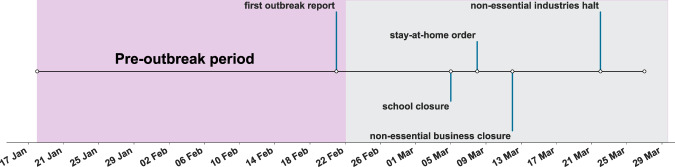
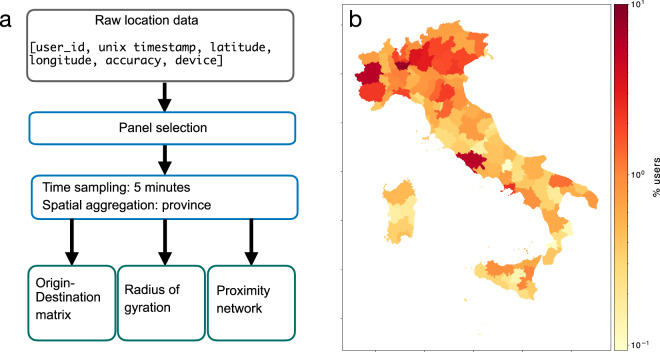
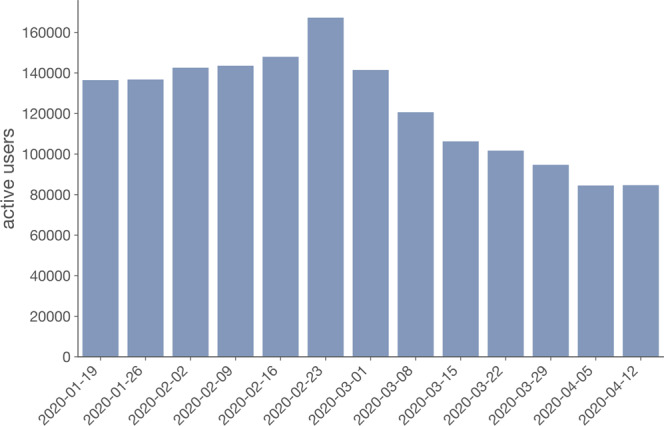
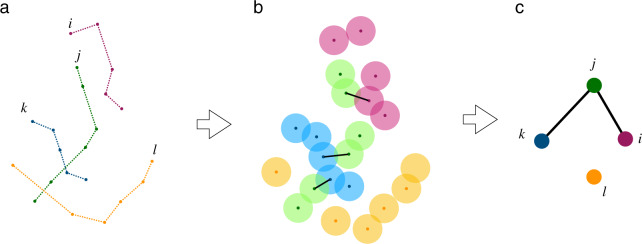
Italy has been severely affected by the COVID-19 pandemic, reporting the highest death toll in Europe as of April 2020. Following the identification of the first infections, on February 21, 2020, national authorities have put in place an increasing number of restrictions aimed at containing the outbreak and delaying the epidemic peak. On March 12, the government imposed a national lockdown. To aid the evaluation of the impact of interventions, we present daily time-series of three different aggregated mobility metrics: the origin-destination movements between Italian provinces, the radius of gyration, and the average degree of a spatial proximity network. All metrics were computed by processing a large-scale dataset of anonymously shared positions of about 170,000 de-identified smartphone users before and during the outbreak, at the sub-national scale. This dataset can help to monitor the impact of the lockdown on the epidemic trajectory and inform future public health decision making.
意大利受到 COVID-19 疫情的严重影响,截至 2020 年 4 月,报告的死亡人数为欧洲最高。在 2020 年 2 月 21 日首次发现感染病例后,国家当局采取了越来越多的限制措施,旨在控制疫情爆发并推迟疫情高峰期。3 月 12 日,政府实施了全国封锁。为了评估干预措施的影响,我们展示了三种不同聚合移动性指标的每日时间序列:意大利各省之间的起源-目的地移动、回旋半径和空间接近网络的平均度数。所有指标都是通过处理一个大规模匿名共享大约 170000 个智能手机用户在疫情爆发前和爆发期间的位置数据集来计算的,该数据集的规模为次国家尺度。该数据集可用于监测封锁对疫情轨迹的影响,并为未来的公共卫生决策提供信息。