Faculty of Education, Arts and Sports, Western Norway University of Applied Sciences, Sogndal, Norway.
Department of Sport Science and Physical Education, Nord University, Levanger, Norway.
PLoS One. 2020 Jul 9;15(7):e0235555. doi: 10.1371/journal.pone.0235555. eCollection 2020.
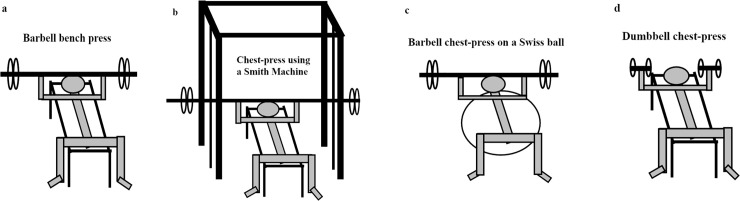
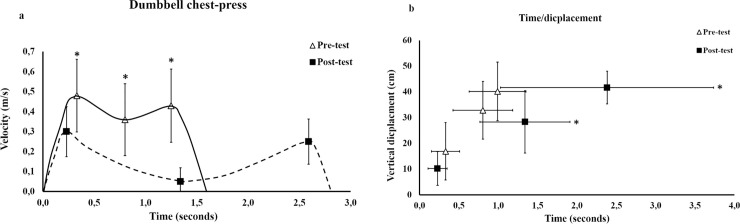
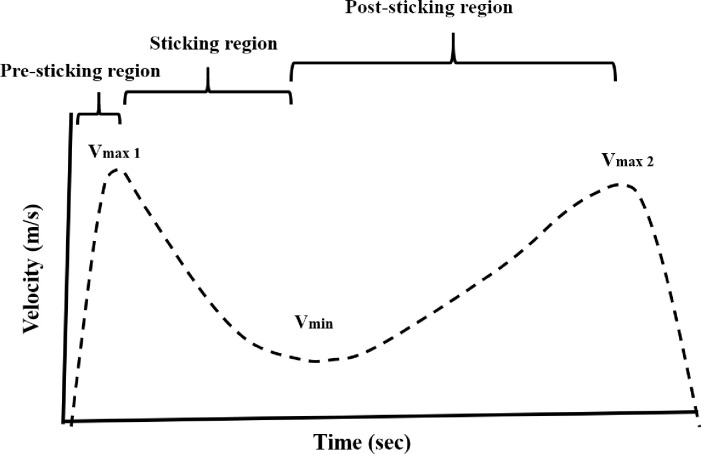
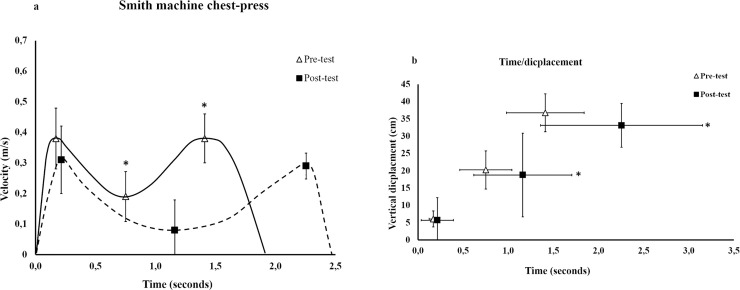
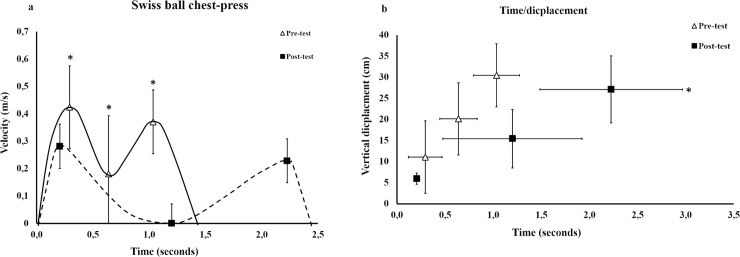
The aim of the study was to compare the effects of a 10-week chest-press resistance training on lifting regions in a trained exercise and a none-trained exercise; the barbell bench press (BBP). Thirty-five resistance trained men with 4.2 (± 2.3) years of resistance training experience were recruited. The participants were randomized to attend a resistance program, performing the chest-press, twice per week using either, Smith machine, dumbbells or laying on Swiss ball using a barbell. A six-repetitions maximum (6RM) test was conducted pre- and post-training in the trained chest-press exercise and non-trained BBP to examine lifting velocity, load displacement and the time of the pre-sticking, sticking and post-sticking regions. Additionally, the muscle activity in pectoralis major, triceps brachii, biceps brachii and deltoid anterior was examined. In the post-test, all three chest-press groups decreased lifting velocity and increased the time to reach the sticking- and post-sticking region. Independent of the type of chest-press exercise trained, no differences were observed in vertical displacement or in the muscle activity for the three lifting regions. In general, similar changes in kinematics in trained exercise and those observed in the BBP were observed for all three groups. This indicates that none of the three chest-press exercises (Swiss ball, Smith machine or dumbbells) were specific regarding the lifting regions but displaced a transferability towards the non-trained BBP. However, improved strength altered the sticking region among resistance trained men.
本研究旨在比较 10 周的卧推抗阻训练对有训练和无训练的上肢推举区域的影响,其中包括杠铃卧推(BBP)。研究招募了 35 名有 4.2(±2.3)年抗阻训练经验的男性。参与者被随机分配到一个抗阻训练计划中,每周进行两次卧推训练,使用史密斯机、哑铃或躺在瑞士球上用杠铃。在训练的卧推和非训练的 BBP 中,进行了 6 次最大重复(6RM)测试,以检查提升速度、负荷位移和预粘滞、粘滞和后粘滞区域的时间。此外,还检查了胸大肌、肱三头肌、肱二头肌和三角肌前束的肌肉活动。在后测中,所有三组卧推训练组的提升速度都降低了,达到粘滞和后粘滞区域的时间也增加了。无论使用哪种卧推训练,都没有观察到垂直位移或三个提升区域的肌肉活动的差异。总的来说,所有三组都观察到了在训练的卧推和 BBP 中相似的运动学变化,这表明三种卧推练习(瑞士球、史密斯机或哑铃)在提升区域都没有特异性,但都可以转移到非训练的 BBP 上。然而,力量的提高改变了抗阻训练男性的粘滞区域。