Haugen Markus E, Vårvik Fredrik T, Larsen Stian, Haugen Arvid S, van den Tillaar Roland, Bjørnsen Thomas
Department of Sport Sciences and Physical Education, Nord University, Levanger, Norway.
Department of Sport Science and Physical Education, Faculty of Health and Sport Sciences, University of Agder, Kristiansand, Norway.
BMC Sports Sci Med Rehabil. 2023 Aug 15;15(1):103. doi: 10.1186/s13102-023-00713-4.
The effectiveness of strength training with free-weight vs. machine equipment is heavily debated. Thus, the purpose of this meta-analysis was to summarize the data on the effect of free-weight versus machine-based strength training on maximal strength, jump height and hypertrophy.
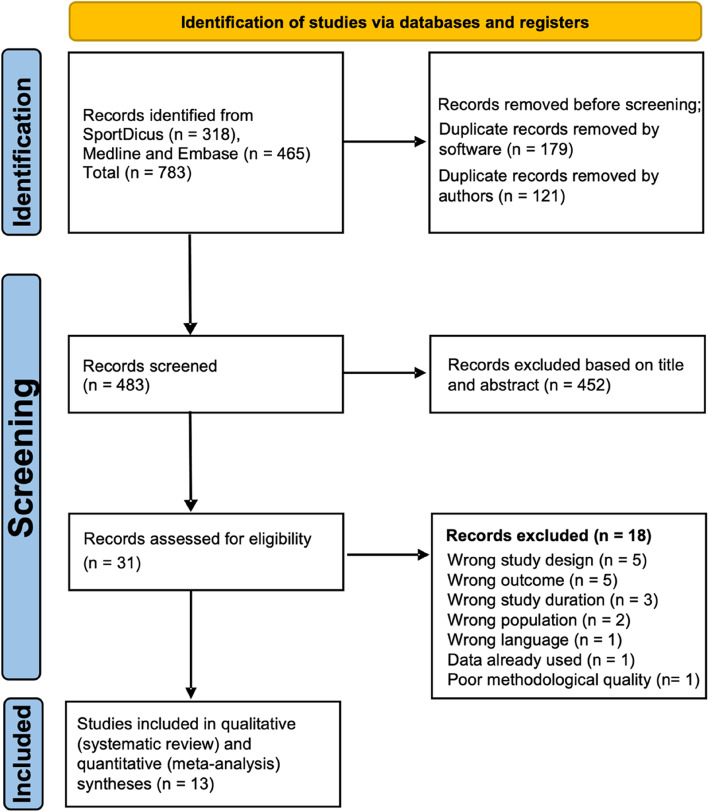
The review was conducted in accordance with the preferred reporting items for systematic reviews and meta-analyses (PRISMA) guidelines, and the systematic search of literature was conducted up to January 1, 2023. Studies that directly compared free-weight vs. machine-based strength training for a minimum of 6 weeks in adults (18-60 yrs.) were included.
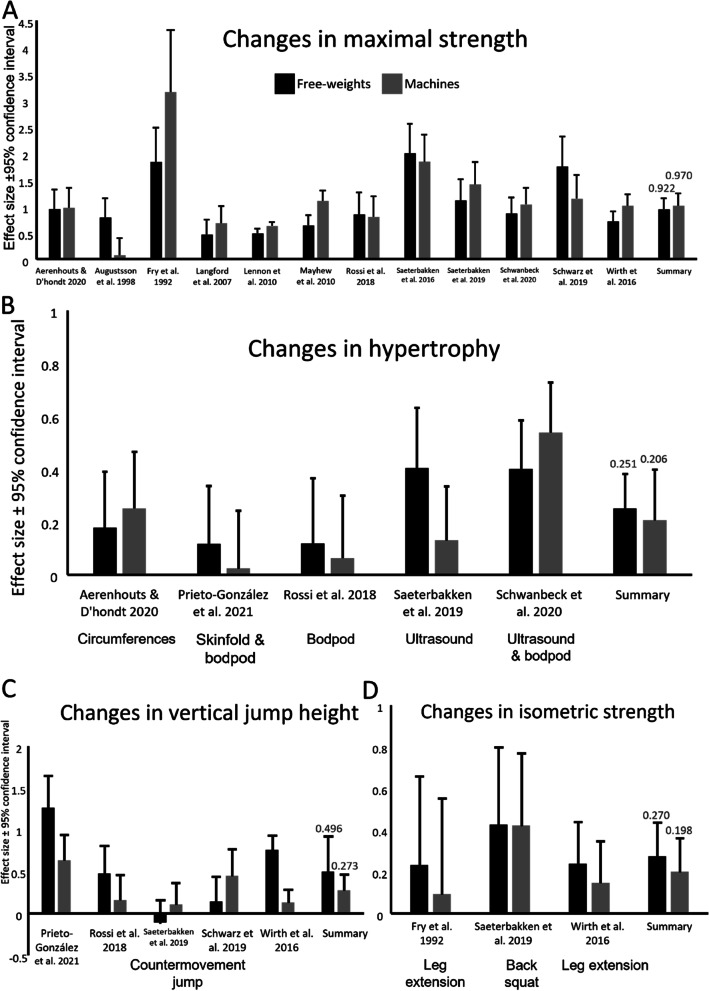
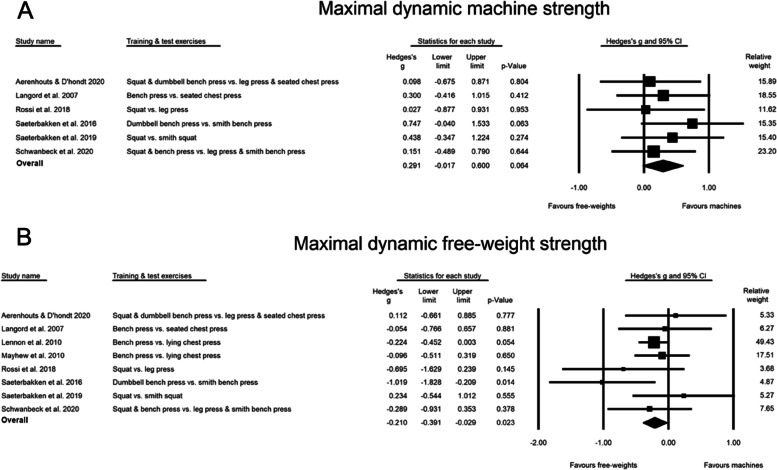
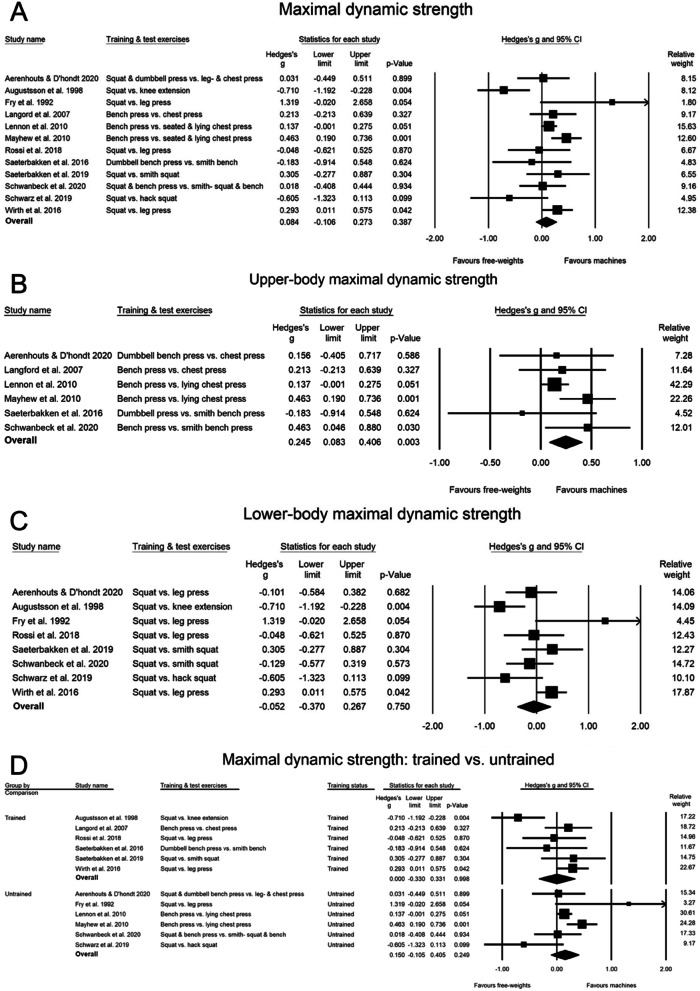
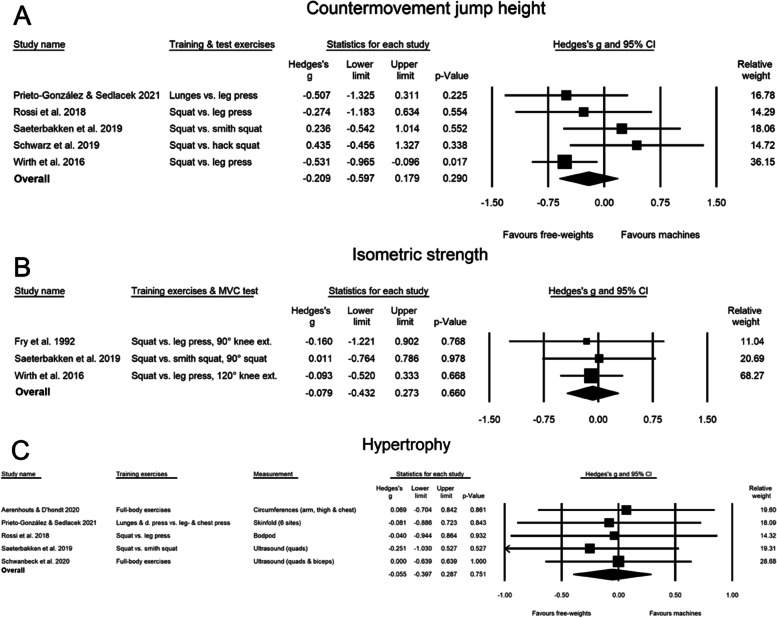
Thirteen studies (outcomes: maximal strength [n = 12], jump performance [n = 5], muscle hypertrophy [n = 5]) with a total sample of 1016 participants (789 men, 219 women) were included. Strength in free-weight tests increased significantly more with free-weight training than with machines (SMD: -0.210, CI: -0.391, -0.029, p = 0.023), while strength in machine-based tests tended to increase more with machine training than with free-weights (SMD: 0.291, CI: -0.017, 0.600, p = 0.064). However, no differences were found between modalities in direct comparison (free-weight strength vs. machine strength) for dynamic strength (SMD: 0.084, CI: -0.106, 0.273, p = 0.387), isometric strength (SMD: -0.079, CI: -0.432, 0.273, p = 0.660), countermovement jump (SMD: -0.209, CI: -0.597, 0.179, p = 0.290) and hypertrophy (SMD: -0.055, CI: -0.397, 0.287, p = 0.751).
No differences were detected in the direct comparison of strength, jump performance and muscle hypertrophy. Current body of evidence indicates that strength changes are specific to the training modality, and the choice between free-weights and machines are down to individual preferences and goals.
自由重量器械与器械设备力量训练的效果存在激烈争论。因此,本荟萃分析的目的是总结关于自由重量器械训练与器械基础力量训练对最大力量、跳跃高度和肌肉肥大影响的数据。
本综述按照系统评价和荟萃分析的首选报告项目(PRISMA)指南进行,对文献的系统检索截至2023年1月1日。纳入了在成年人(18 - 60岁)中直接比较自由重量器械训练与器械基础力量训练至少6周的研究。
纳入了13项研究(结果:最大力量[n = 12]、跳跃表现[n = 5]、肌肉肥大[n = 5]),总样本量为1016名参与者(789名男性,219名女性)。自由重量测试中的力量通过自由重量训练比器械训练显著增加更多(标准化均数差:-0.210,可信区间:-0.391,-0.029,p = 0.023),而器械基础测试中的力量通过器械训练比自由重量训练往往增加更多(标准化均数差:0.291,可信区间:-0.017,0.600,p = 0.064)。然而,在动态力量(标准化均数差:0.084,可信区间:-0.106,0.273,p = 0.387)、等长力量(标准化均数差:-0.079,可信区间:-0.432,0.273,p = 0.660)、反向纵跳(标准化均数差:-0.209,可信区间:-0.597,0.179,p = 0.290)和肌肉肥大(标准化均数差:-0.055,可信区间:-0.397,0.287,p = 0.751)的直接比较(自由重量力量与器械力量)中,未发现两种训练方式之间存在差异。
在力量、跳跃表现和肌肉肥大的直接比较中未检测到差异。当前的证据表明,力量变化特定于训练方式,自由重量器械和器械设备之间的选择取决于个人偏好和目标。