Institute of Nutrition and Food Technology, University of Chile, Av. El Líbano 5524, Macul, Casilla 138-11, Santiago, Chile.
Carolina Population Center, University of North Carolina at Chapel Hill, 123 West Franklin St., Suite 210, Chapel Hill, 27516, NC, United States.
Nutr J. 2020 Jul 10;19(1):69. doi: 10.1186/s12937-020-00583-3.
Consumption of non-nutritive sweeteners (NNS) is becoming increasingly more frequent, particularly in the context of obesity prevention policies. The aim of this study was to describe the consumption of NNS in an ongoing cohort of pre-schoolers (4-6-year-old) before the implementation of the Chilean Food Labelling and Advertising Law, identify sociodemographic and anthropometric characteristics associated with their consumption, and describe the main dietary sources of each NNS sub-type.
In 959 low-medium income pre-schoolers from the Food and Environment Chilean Cohort (FECHIC), dietary data from a single 24-h recall was linked to NNS content information obtained from packaged foods (n = 12,233). The prevalence of NNS consumption was estimated by food source and characterized by child and maternal sociodemographic and anthropometric variables. Intakes and main dietary sources were described for the six most prevalent NNS in Chile: Sodium Cyclamate, Saccharin, Aspartame, Acesulfame Potassium, Sucralose, and Steviol glycosides.
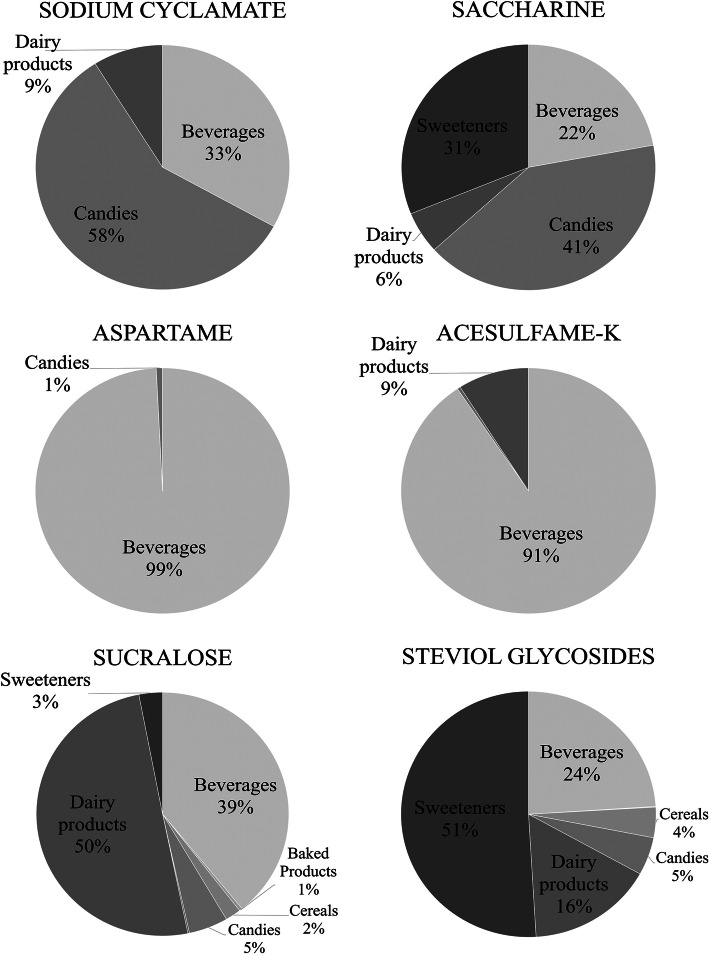
Sixty-eight percent of the pre-schoolers consumed at least one source of NNS on the day of the dietary recall; most of them consumed NNS from foods and beverages (n = 532), while only 12% (n = 119) also consumed table-top sweeteners. The prevalence of NNS consumption was significantly higher among children whose mothers had a high educational level compared to children whose mothers did not complete high school (p < 0.05); however, it did not differ by any other variable studied. The highest intakes of NNS were observed for Aspartame [2.5 (1.4-3.7) mg/kg per consumer], followed by Sodium Cyclamate [1.6 (1.3-2.6) mg/kg per consumer] and Steviol glycosides [1.2 (0.2-2.1) mg/kg per consumer]. Beverages were the only food group that contributed to the intake of the six NNS studied, accounting for 22% of the overall intake of Saccharine and up to 99% of Aspartame intake.
Before the implementation of the Food Labelling and Advertising Law, NNS consumption was highly prevalent among a cohort of low-middle income Chilean pre-schoolers. Continuous monitoring of NNS consumption is essential given potential food reformulation associated with the implementation of this set of obesity-prevention policies.
非营养性甜味剂(NNS)的消费越来越普遍,尤其是在肥胖预防政策的背景下。本研究的目的是描述在智利食品标签和广告法实施之前,一个正在进行的学龄前儿童(4-6 岁)队列中 NNS 的消费情况,确定与 NNS 消费相关的社会人口学和人体测量学特征,并描述每种 NNS 亚类的主要饮食来源。
在智利食品与环境队列(FECHIC)的 959 名中低收入学龄前儿童中,对单次 24 小时回顾性饮食数据进行了分析,并将其与从包装食品中获得的 NNS 含量信息进行了关联(n=12233)。通过食物来源估计 NNS 消费的流行率,并通过儿童和母亲的社会人口学和人体测量学变量对其进行特征描述。描述了智利六种最常见 NNS 的摄入量和主要饮食来源:环己基氨基磺酸钠、糖精、阿斯巴甜、安赛蜜钾、三氯蔗糖和甜菊糖苷。
68%的学龄前儿童在饮食回忆日至少摄入了一种 NNS 的来源;其中大多数从食物和饮料中摄入 NNS(n=532),而只有 12%(n=119)还摄入餐桌甜味剂。与母亲未完成高中学业的儿童相比,母亲具有高教育水平的儿童 NNS 消费的流行率显著更高(p<0.05);然而,它并不因任何其他研究变量而有所不同。NNS 的最高摄入量为阿斯巴甜[2.5(1.4-3.7)mg/kg/消费者],其次是环己基氨基磺酸钠[1.6(1.3-2.6)mg/kg/消费者]和甜菊糖苷[1.2(0.2-2.1)mg/kg/消费者]。饮料是唯一为六种研究的 NNS 摄入量做出贡献的食物组,占糖精总摄入量的 22%,阿斯巴甜摄入量的 99%。
在智利食品标签和广告法实施之前,中低收入智利学龄前儿童的 NNS 消费非常普遍。鉴于与这一系列肥胖预防政策实施相关的食品潜在重新配方,连续监测 NNS 的消费是必要的。