Centro Investigación y Formación ElikaSport, Cerdanyola del Valles, 08290 Barcelona, Spain.
Institute of Biomedicine (IBIOMED), Physiotherapy Department, University of Leon, Campus de Vegazana, 24071 Leon, Spain.
Nutrients. 2020 Jul 15;12(7):2094. doi: 10.3390/nu12072094.
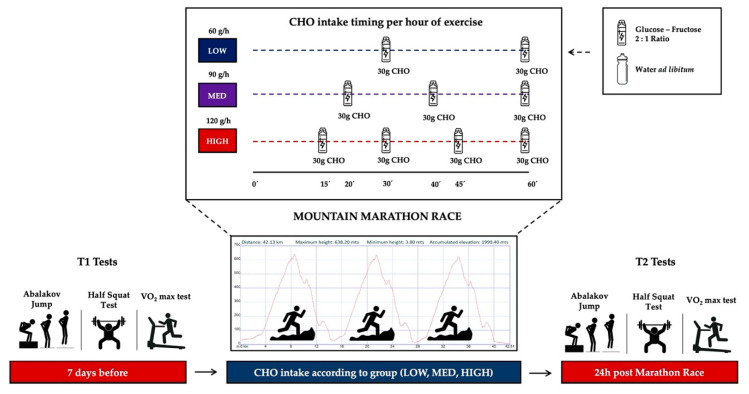
Current carbohydrate (CHO) intake recommendations for ultra-trail activities lasting more than 2.5 h is 90 g/h. However, the benefits of ingesting 120 g/h during a mountain marathon in terms of post-exercise muscle damage have been recently demonstrated. Therefore, the aim of this study was to analyze and compare the effects of 120 g/h CHO intake with the recommendations (90 g/h) and the usual intake for ultra-endurance athletes (60 g/h) during a mountain marathon on internal exercise load, and post-exercise neuromuscular function and recovery of high intensity run capacity.
Twenty-six elite trail-runners were randomly distributed into three groups: LOW (60 g/h), MED (90 g/h) and HIGH (120 g/h), according to CHO intake during a 4000-m cumulative slope mountain marathon. Runners were measured using the Abalakov Jump test, a maximum a half-squat test and an aerobic power-capacity test at baseline (T1) and 24 h after completing the race (T2).
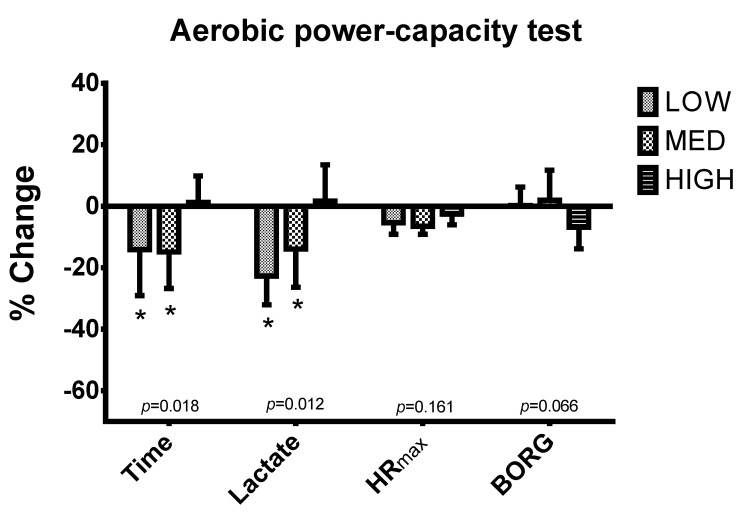
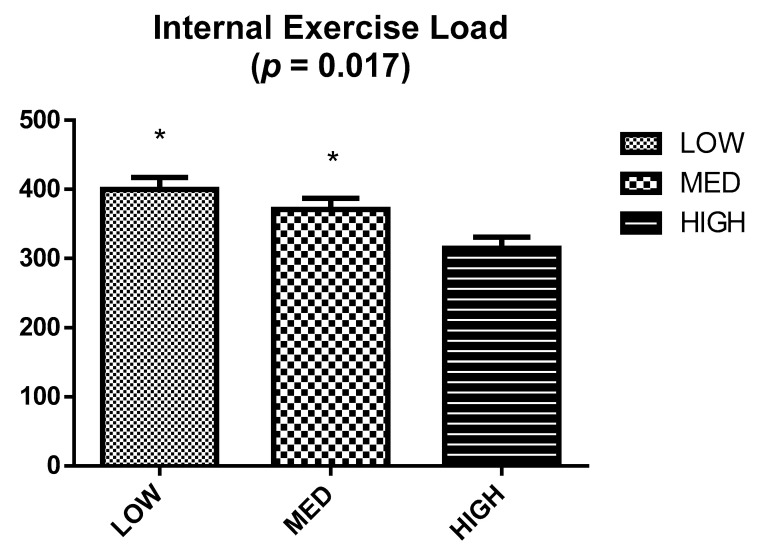
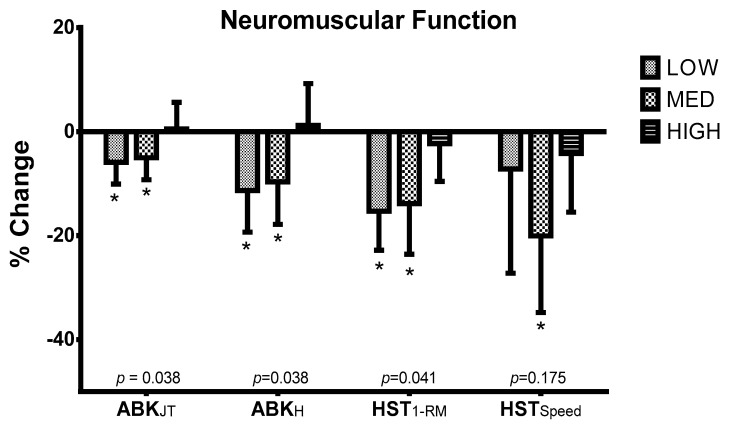
Changes in Abalakov jump time (ABK), Abalakov jump height (ABK), half-squat test 1 repetition maximum (HST) between T1 and T2 showed significant differences by Wilcoxon signed rank test only in LOW and MED ( < 0.05), but not in the HIGH group ( > 0.05). Internal load was significantly lower in the HIGH group ( = 0.017) regarding LOW and MED by Mann Whitney test. A significantly lower change during the study in ABK ( = 0.038), ABK ( = 0.038) HST ( = 0.041) and in terms of fatigue ( = 0.018) and lactate ( = 0.012) within the aerobic power-capacity test was presented in HIGH relative to LOW and MED.
120 g/h CHO intake during a mountain marathon might limit neuromuscular fatigue and improve recovery of high intensity run capacity 24 h after a physiologically challenging event when compared to 90 g/h and 60 g/h.
目前,对于持续时间超过 2.5 小时的超长距离户外活动,建议每小时摄入 90 克碳水化合物(CHO)。然而,最近有研究表明,在山地马拉松比赛中每小时摄入 120 克 CHO 可以减少运动后肌肉损伤。因此,本研究旨在分析和比较在山地马拉松比赛中,每小时摄入 120 克 CHO(高 CHO 组)与推荐量(90 克 CHO/小时)和超耐力运动员通常摄入量(60 克 CHO/小时)对运动内部负荷、运动后神经肌肉功能和高强度跑步能力恢复的影响。
26 名精英山地跑运动员随机分为三组,根据 4000 米累计坡度山地马拉松比赛中 CHO 的摄入量,分别为低 CHO 组(60 克 CHO/小时)、中 CHO 组(90 克 CHO/小时)和高 CHO 组(120 克 CHO/小时)。在基线(T1)和比赛后 24 小时(T2),使用阿巴洛夫纵跳测试、半蹲最大重复次数测试和有氧功率测试测量运动员的情况。
阿巴洛夫纵跳测试时间(ABK)和高度(ABK)以及半蹲最大重复次数测试 1 次(HST)的变化在 T1 和 T2 之间仅在低 CHO 组和中 CHO 组中通过 Wilcoxon 符号秩检验有显著差异(<0.05),而在高 CHO 组中无显著差异(>0.05)。通过 Mann Whitney U 检验,与低 CHO 组和中 CHO 组相比,高 CHO 组的内部负荷显著降低(=0.017)。在研究过程中,高 CHO 组的 ABK(=0.038)、HST(=0.038)变化较小,且在有氧功率测试中疲劳(=0.018)和乳酸(=0.012)的变化也较小。
与 90 克 CHO/小时和 60 克 CHO/小时相比,在山地马拉松比赛中每小时摄入 120 克 CHO 可能会限制神经肌肉疲劳,并在生理挑战性事件后 24 小时改善高强度跑步能力的恢复。