Carnegie School of Sport, Fairfax Hall, Research Institute for Sport, Physical Activity and Leisure, Leeds Beckett University, Leeds, LS6 3QT, UK.
Leeds Trinity University, Leeds, UK.
Eur J Appl Physiol. 2019 May;119(5):1157-1169. doi: 10.1007/s00421-019-04106-9. Epub 2019 Mar 6.
This study investigated the effect of small manipulations in carbohydrate (CHO) dose on exogenous and endogenous (liver and muscle) fuel selection during exercise.
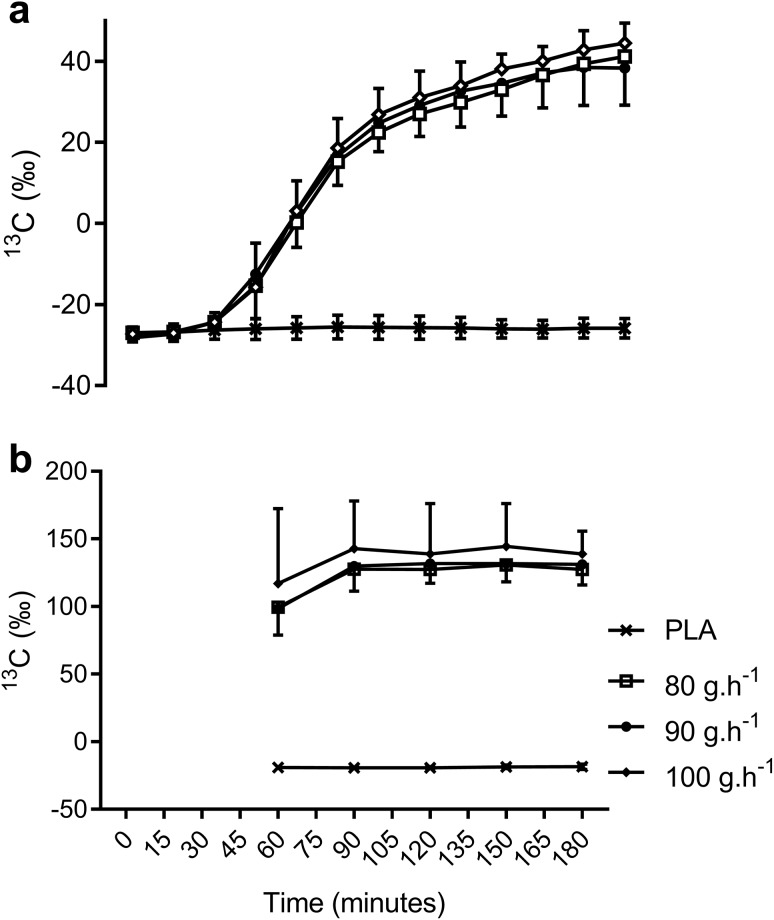
Eleven trained males cycled in a double-blind randomised order on 4 occasions at 60% [Formula: see text] for 3 h, followed by a 30-min time-trial whilst ingesting either 80 g h or 90 g h or 100 g hC-glucose-C-fructose [2:1] or placebo. CHO doses met, were marginally lower, or above previously reported intestinal saturation for glucose-fructose (90 g h). Indirect calorimetry and stable mass isotope [C] techniques were utilised to determine fuel use.
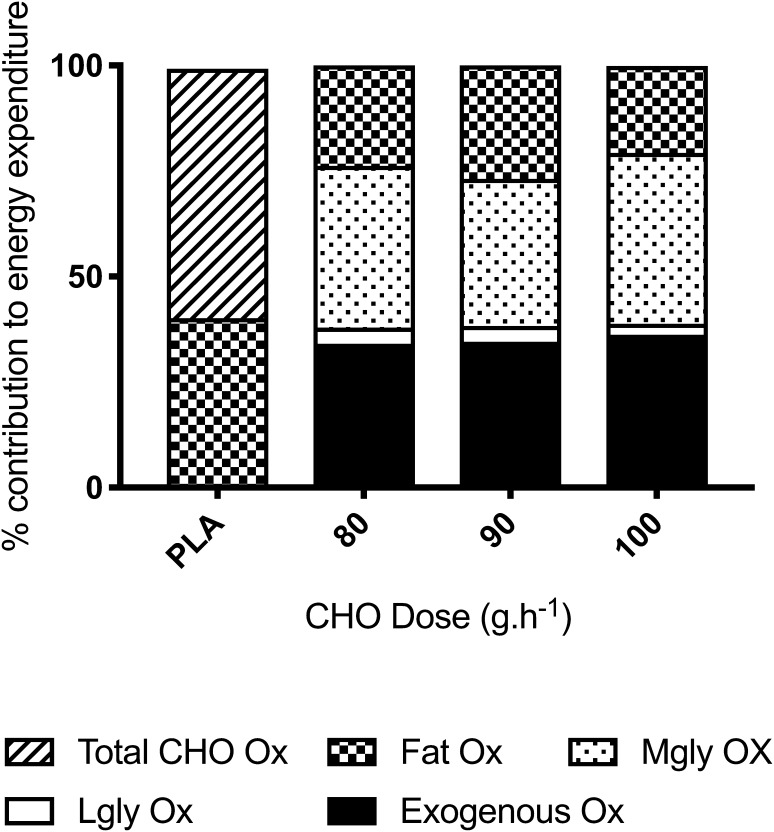
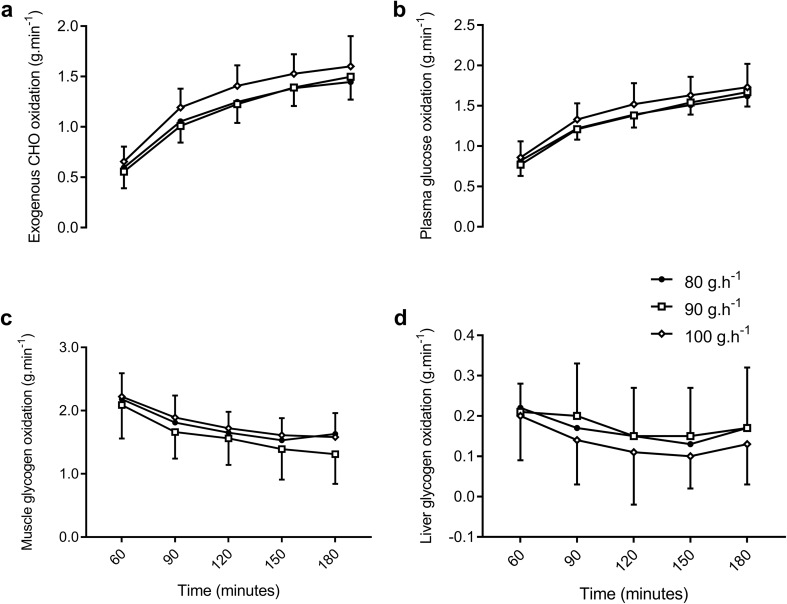
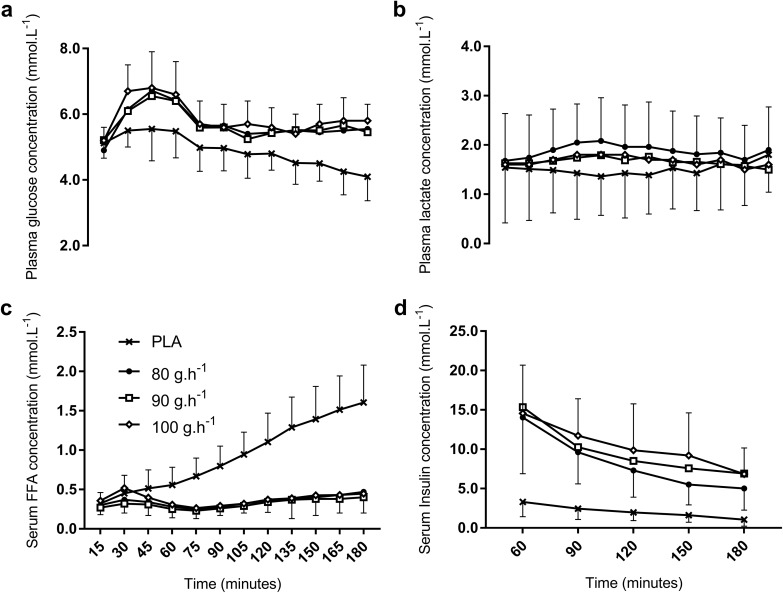
Time-trial performance was 86.5 to 93%, 'likely, probable' improved with 90 g h compared 80 and 100 g h. Exogenous CHO oxidation in the final hour was 9.8-10.0% higher with 100 g h compared with 80 and 90 g h (ES = 0.64-0.70, 95% CI 9.6, 1.4 to 17.7 and 8.2, 2.1 to 18.6). However, increasing CHO dose (100 g h) increased muscle glycogen use (101.6 ± 16.6 g, ES = 0.60, 16.1, 0.9 to 31.4) and its relative contribution to energy expenditure (5.6 ± 8.4%, ES = 0.72, 5.6, 1.5 to 9.8 g) compared with 90 g h. Absolute and relative muscle glycogen oxidation between 80 and 90 g h were similar (ES = 0.23 and 0.38) though a small absolute (85.4 ± 29.3 g, 6.2, - 23.5 to 11.1) and relative (34.9 ± 9.1 g, - 3.5, - 9.6 to 2.6) reduction was seen in 90 g h compared with 100 g h. Liver glycogen oxidation was not significantly different between conditions (ES < 0.42). Total fat oxidation during the 3-h ride was similar in CHO conditions (ES < 0.28) but suppressed compared with placebo (ES = 1.05-1.51).
'Overdosing' intestinal transport for glucose-fructose appears to increase muscle glycogen reliance and negatively impact subsequent TT performance.
本研究旨在探讨在运动过程中,碳水化合物(CHO)剂量的微小变化对外源性和内源性(肝脏和肌肉)燃料选择的影响。
11 名训练有素的男性以 60% [Formula: see text] 的强度进行 3 小时的双盲随机分组骑行,随后进行 30 分钟的计时赛,同时摄入 80 g·h -1 、90 g·h -1 或 100 g·h -1 的 C-葡萄糖-C-果糖[2:1]或安慰剂。CHO 剂量达到、略低于或高于先前报道的葡萄糖-果糖肠内饱和度(90 g·h -1 )。利用间接测热法和稳定同位素 [C] 技术来确定燃料的使用情况。
计时赛的表现为 86.5%至 93%,与 80 g·h -1 和 100 g·h -1 相比,摄入 90 g·h -1 可能、很可能会有所改善。与 80 g·h -1 和 90 g·h -1 相比,100 g·h -1 时最后 1 小时的外源性 CHO 氧化率高出 9.8-10.0%(ES = 0.64-0.70,95%CI 9.6,1.4 至 17.7 和 8.2,2.1 至 18.6)。然而,增加 CHO 剂量(100 g·h -1 )会增加肌肉糖原的利用(101.6 ± 16.6 g,ES = 0.60,16.1,0.9 至 31.4),并增加其对能量消耗的相对贡献(5.6 ± 8.4%,ES = 0.72,5.6,1.5 至 9.8 g),与 90 g·h -1 相比。尽管与 90 g·h -1 相比,摄入 80 g·h -1 和 90 g·h -1 时的绝对和相对肌肉糖原氧化量相似(ES = 0.23 和 0.38),但在 90 g·h -1 时观察到相对(34.9 ± 9.1 g,-3.5,-9.6 至 2.6)和绝对(85.4 ± 29.3 g,6.2,-23.5 至 11.1)的小幅度减少。CHO 条件下的 3 小时骑行过程中的总脂肪氧化量相似(ES < 0.28),但与安慰剂相比受到抑制(ES = 1.05-1.51)。
“过度”给予葡萄糖-果糖肠内转运似乎会增加肌肉糖原的依赖性,并对随后的计时赛表现产生负面影响。