Department of Physical Education, Federal University of Sergipe (UFS), São Cristovão, Sergipe 49100-000, Brazil.
Group of Studies and Research of Performance, Sport, Health and Paralympic Sports (GEPEPS), Federal University of Sergipe (UFS), São Cristovão, Sergipe 49100-000, Brazil.
Int J Environ Res Public Health. 2020 Jul 17;17(14):5157. doi: 10.3390/ijerph17145157.
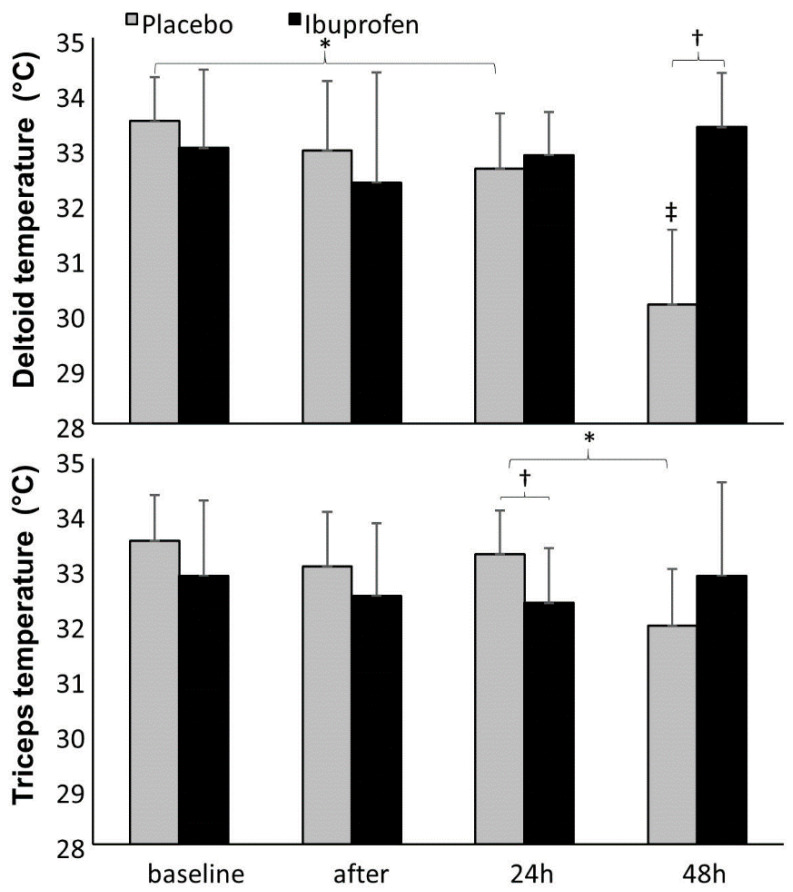
The aim of this study is to evaluate the effect of ingesting ibuprofen on post-workout recovery of muscle damage, body temperature and muscle power indicators in Paralympic powerlifting athletes. The study was carried out with eight Paralympic powerlifting athletes (aged 27.0 ± 5.3 years and 79.9 ± 25.5 kg of body mass) competing at the national level, with a minimum training experience of 12 months, who all submitted to two experimental conditions: Ibuprofen (2 × 00 mg) and control. The maximal isometric force of the upper limbs and rate of force development, thermography, and serum biochemical analyzes of creatine kinase, lactate dehydrogenase, aspartate aminotransferase and alanine aminotransferase were measured before, after, 24 h after and 48 h after the intervention. Maximal isometric force only decreased in the placebo condition, which increased back to baseline levels, while no substantial decline in baseline force was seen in the ibuprofen condition, although no effect for exercise condition was detected. After the exercise, the rate of force development decreased significantly for both conditions and did not exceed baseline levels again after 48 h. Muscle temperature decreased significantly at 48-h post-exercise in the placebo condition, when compared with the previous day of measurement; and deltoid muscle temperature at 48-h post-exercise was higher with the ibuprofen condition. Although the results indicate some positive effects of ibuprofen use, they do not enable a clear statement regarding its positive effects on muscle function and muscle damage. Ibuprofen seems to have caused a delay in the anti-inflammatory response following exercise.
本研究旨在评估摄入布洛芬对残奥会举重运动员运动后肌肉损伤、体温和肌肉力量指标恢复的影响。研究对象为 8 名参加国家级比赛的残奥会举重运动员(年龄 27.0±5.3 岁,体重 79.9±25.5 千克),他们均具有至少 12 个月的训练经验,分为两组接受两种实验条件:布洛芬(2×00mg)和安慰剂。在干预前、干预后、24 小时后和 48 小时后,测量了上肢最大等长力量和力量发展率、热成像、血清生化分析(肌酸激酶、乳酸脱氢酶、天门冬氨酸转氨酶和丙氨酸转氨酶)。只有安慰剂组的最大等长力量下降,恢复到基线水平,而布洛芬组的基线力量没有明显下降,但运动条件没有显著影响。运动后,两种条件下的力量发展率均显著下降,48 小时后均未再次超过基线水平。与前一天的测量相比,安慰剂组在运动后 48 小时肌肉温度显著下降,而布洛芬组在运动后 48 小时三角肌温度更高。虽然结果表明布洛芬的使用有一些积极影响,但不能明确说明其对肌肉功能和肌肉损伤的积极影响。布洛芬似乎导致运动后抗炎反应延迟。