Department of Biology and Center for Visual Sciences, Miami University, Oxford, OH, USA.
Transl Vis Sci Technol. 2020 Feb 18;9(3):21. doi: 10.1167/tvst.9.3.21.
Early in mammalian eye development, , , and expression marks neural retinal progenitors (NRPs), retinal ganglion cells (RGCs), and photoreceptors (PRs), respectively. The ability to create retinal organoids from human induced pluripotent stem cells (hiPSC) holds great potential for modeling both human retinal development and retinal disease. However, no methods allowing the simultaneous, real-time monitoring of multiple specific retinal cell types during development currently exist.
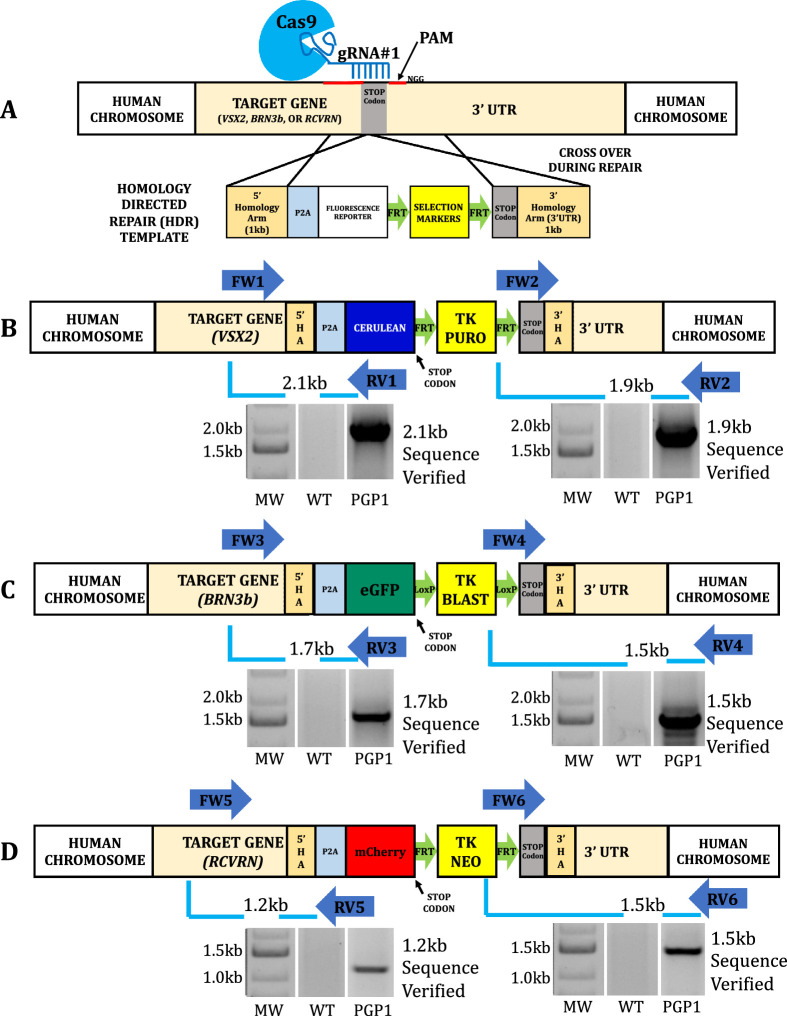
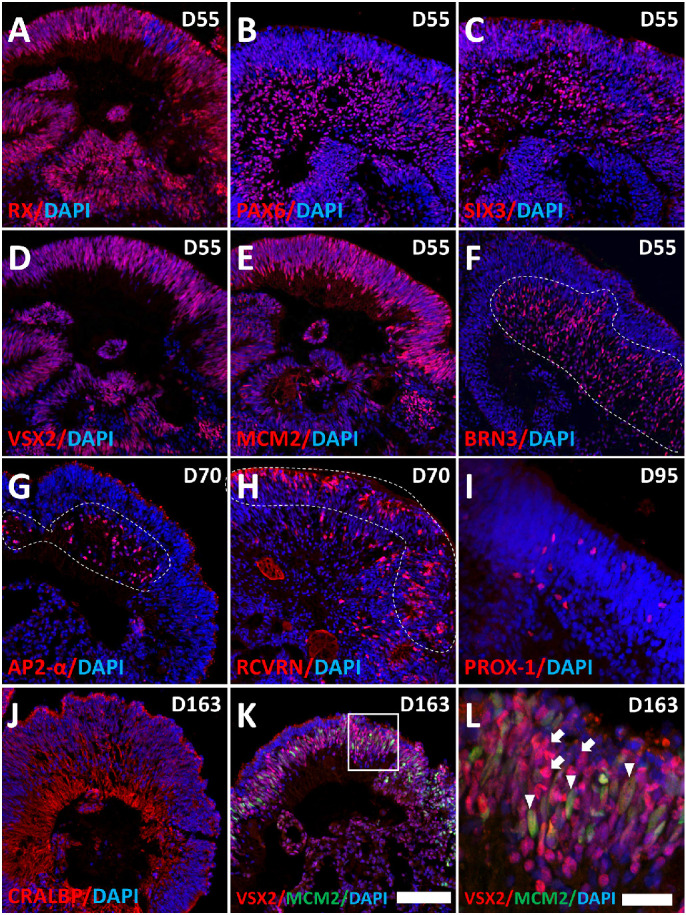
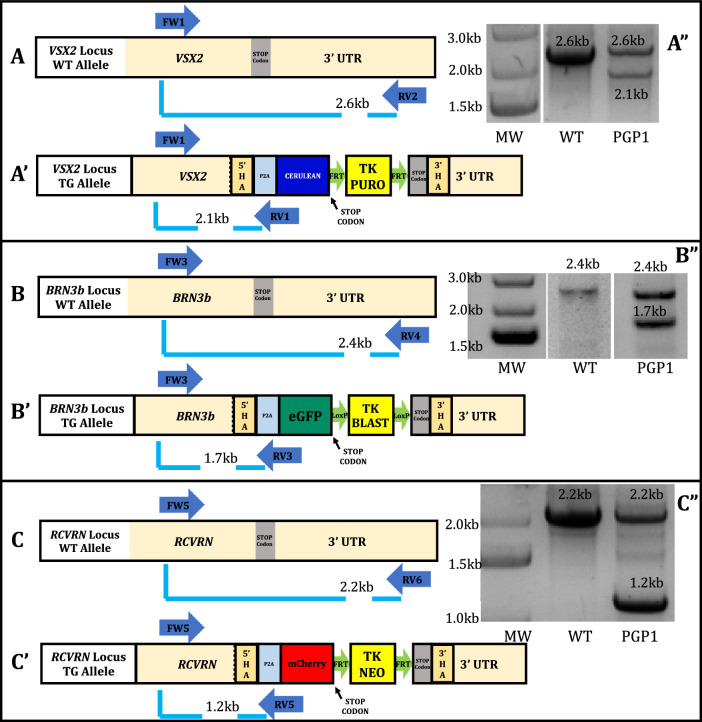
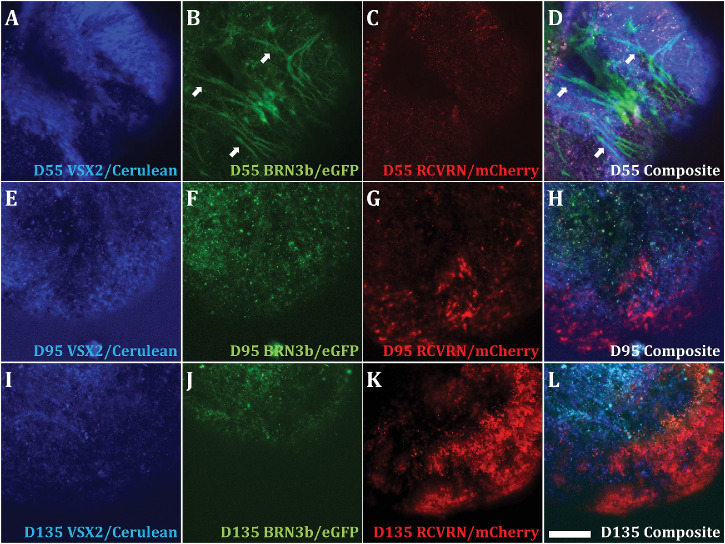
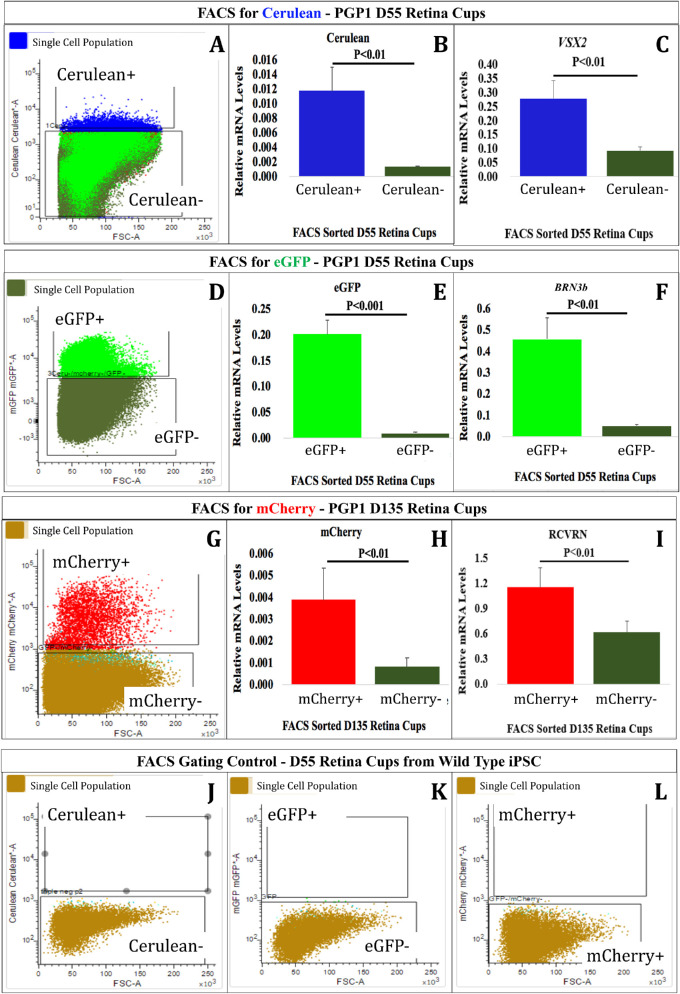
CRISPR/Cas9-mediated homology-directed repair (HDR) in hiPSCs facilitated the replacement of the (Progenitor), (Ganglion), and (Photoreceptor) stop codons with sequences encoding a viral P2A peptide fused to Cerulean, green fluorescent protein, and mCherry reporter genes, respectively, to generate a triple transgenic reporter hiPSC line called PGP1. This was accomplished by co-electroporating HDR templates and sgRNA/Cas9 vectors into hiPSCs followed by antibiotic selection. Functional validation of the PGP1 hiPSC line included the ability to generate retinal organoids, with all major retinal cell types, displaying the expression of the three fluorescent reporters consistent with the onset of target gene expression. Disaggregated organoids were also analyzed by fluorescence-activated cell sorting and fluorescent populations were tested for the expression of the targeted gene.
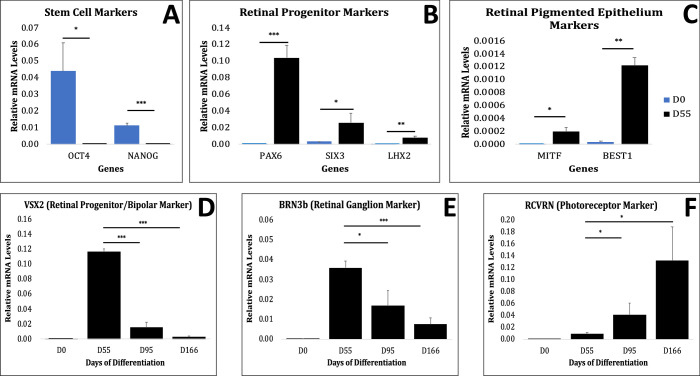
Retinal organoids formed from the PGP1 line expressed appropriate fluorescent proteins consistent with the differentiation of NRPs, RGCs, and PRs. Organoids produced from the PGP1 line expressed transcripts consistent with the development of all major retinal cell types.
The PGP1 line offers a powerful new tool to study retinal development, retinal reprogramming, and therapeutic drug screening.
在哺乳动物眼睛发育的早期,分别通过 、 、 表达标记神经视网膜祖细胞(NRPs)、视网膜神经节细胞(RGCs)和光感受器(PRs)。从人诱导多能干细胞(hiPSC)中创建视网膜类器官的能力在模拟人类视网膜发育和视网膜疾病方面具有巨大潜力。然而,目前尚无方法能够在发育过程中同时实时监测多种特定的视网膜细胞类型。
通过 CRISPR/Cas9 介导的同源定向修复(HDR)在 hiPSC 中,用编码病毒 P2A 肽融合到 Cerulean、绿色荧光蛋白和 mCherry 报告基因的序列分别替换 (祖细胞)、 (神经节)和 (感光器)的终止密码子,从而生成一种称为 PGP1 的三重转基因报告 hiPSC 系。这是通过共电穿孔 HDR 模板和 sgRNA/Cas9 载体到 hiPSC 中,然后进行抗生素选择来完成的。PGP1 hiPSC 系的功能验证包括生成视网膜类器官的能力,所有主要的视网膜细胞类型均显示出三种荧光报告基因的表达,与靶基因表达的起始一致。还通过荧光激活细胞分选分析分散的类器官,并测试荧光群体对靶向基因的表达。
从 PGP1 系形成的视网膜类器官表达适当的荧光蛋白,与 NRPs、RGCs 和 PRs 的分化一致。从 PGP1 系产生的类器官表达的转录物与所有主要视网膜细胞类型的发育一致。
PGP1 系为研究视网膜发育、视网膜重编程和治疗性药物筛选提供了一种强大的新工具。