Institute of Imaging and Computer Vision, RWTH Aachen University, Aachen, Germany.
Department of Diagnostic and Interventional Radiology, University Hospital Aachen, Aachen, Germany.
Sci Rep. 2020 Jul 29;10(1):12688. doi: 10.1038/s41598-020-69534-6.
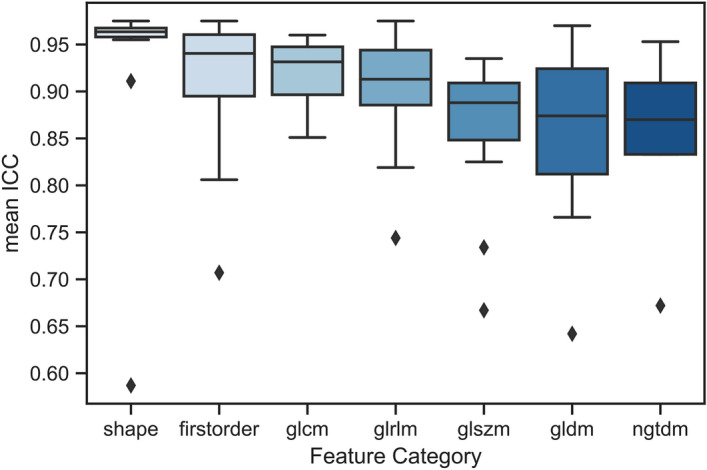
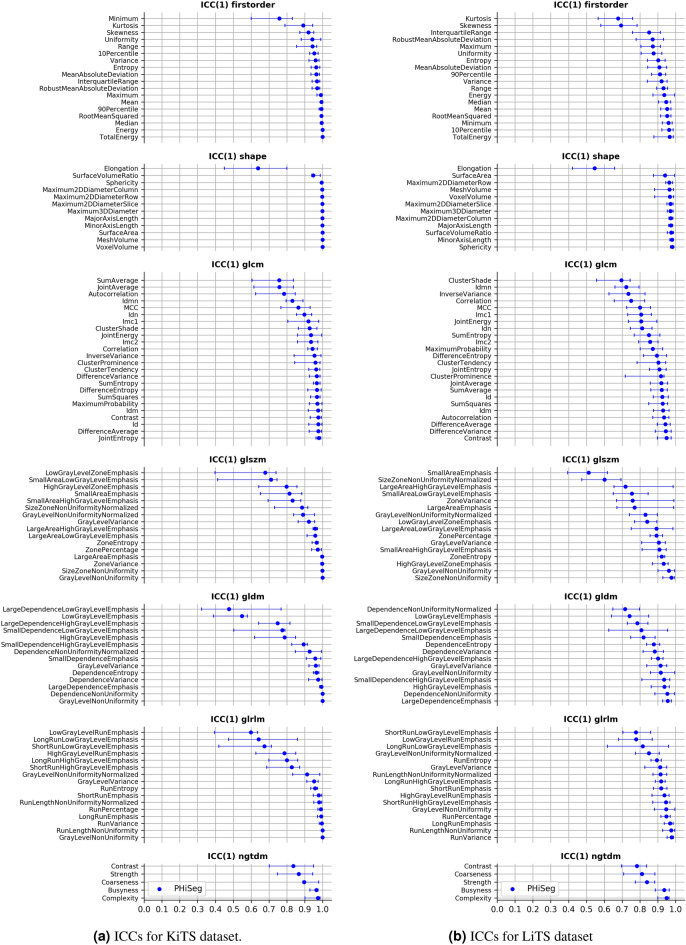
Identifying image features that are robust with respect to segmentation variability is a tough challenge in radiomics. So far, this problem has mainly been tackled in test-retest analyses. In this work we analyse radiomics feature reproducibility in two phases: first with manual segmentations provided by four expert readers and second with probabilistic automated segmentations using a recently developed neural network (PHiseg). We test feature reproducibility on three publicly available datasets of lung, kidney and liver lesions. We find consistent results both over manual and automated segmentations in all three datasets and show that there are subsets of radiomic features which are robust against segmentation variability and other radiomic features which are prone to poor reproducibility under differing segmentations. By providing a detailed analysis of robustness of the most common radiomics features across several datasets, we envision that more reliable and reproducible radiomic models can be built in the future based on this work.
在放射组学中,识别对分割变化具有鲁棒性的图像特征是一个艰巨的挑战。到目前为止,这个问题主要是在测试-重测分析中解决的。在这项工作中,我们在两个阶段分析放射组学特征的可重复性:首先是由四位专家读者提供的手动分割,其次是使用最近开发的神经网络(PHiseg)进行概率自动分割。我们在三个公开的肺部、肾脏和肝脏病变数据集上测试特征的可重复性。我们在所有三个数据集上都发现了手动和自动分割的一致结果,并表明存在一些放射组学特征子集,它们对分割变化具有鲁棒性,而其他放射组学特征在不同的分割下则容易出现较差的可重复性。通过对几个数据集的最常见放射组学特征的稳健性进行详细分析,我们设想未来可以在此基础上构建更可靠和可重复的放射组学模型。