Special Bacteriology Reference Laboratory, Bacterial Special Pathogens Branch, Division of High-Consequence Pathogens and Pathology, Centers for Disease Control and Prevention, Atlanta, Georgia 30333, USA.
National Collection of Type Cultures, Health Protection Agency, Colindale, London NW9 5EQ, UK.
Int J Syst Evol Microbiol. 2020 Aug;70(8):4432-4450. doi: 10.1099/ijsem.0.003935. Epub 2020 Jan 2.
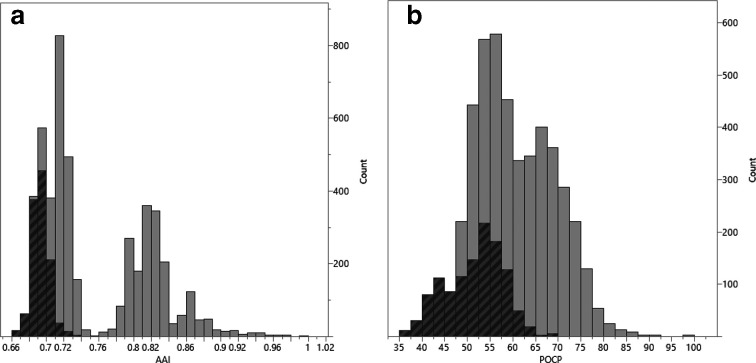
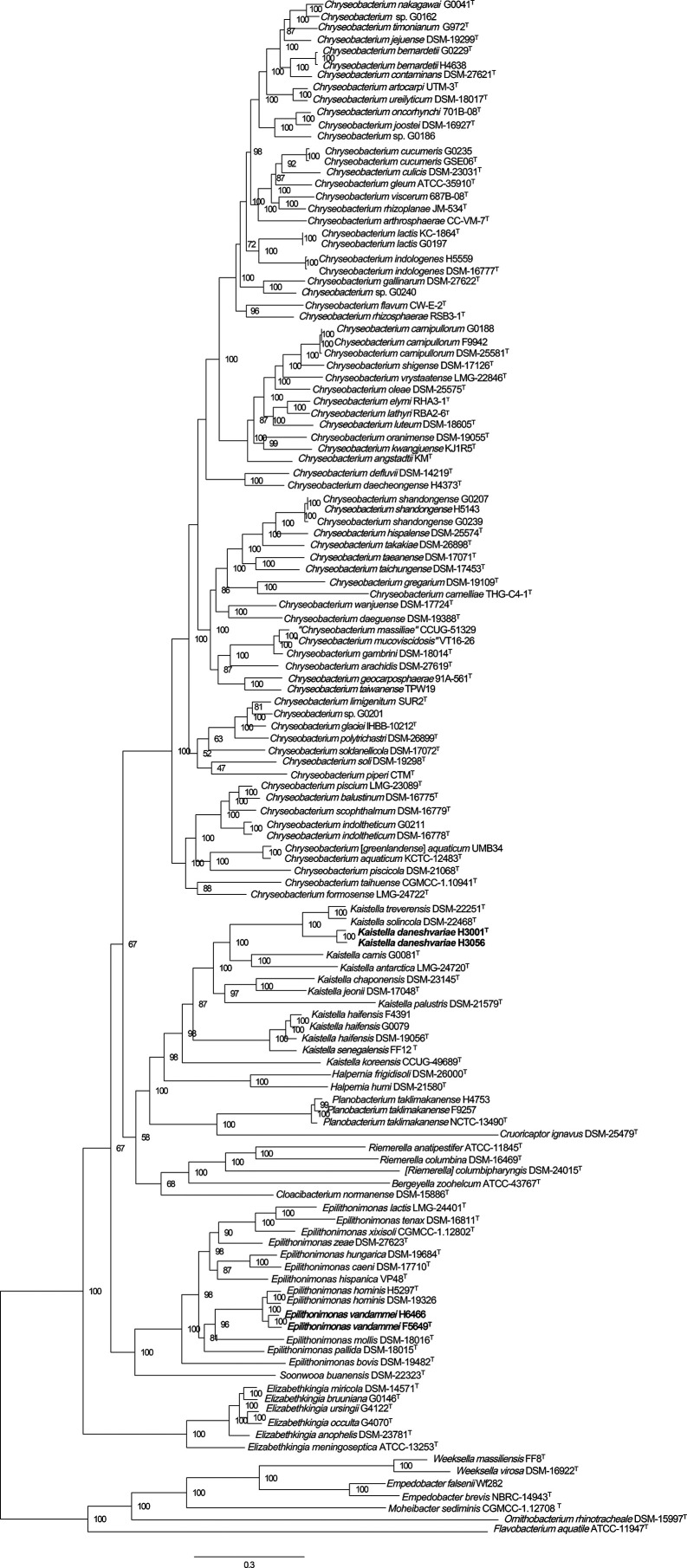
The genus in the family is known to be polyphyletic. Amino acid identity (AAI) values were calculated from whole-genome sequences of species of the genus and their distribution was found to be multi-modal. These naturally-occurring non-continuities were leveraged to standardise genus assignment of these species. We speculate that this multi-modal distribution is a consequence of loss of biodiversity during major extinction events, leading to the concept that a bacterial genus corresponds to a set of species that diversified since the Permian extinction. Transfer of nine species (, , and ) to the genus and eleven (, , , , , , , , and ) to the genus is proposed. Two novel species are described: sp. nov. and sp. nov. Evidence is presented to support the assignment of to a genus apart from to which comb nov. also belongs. The novel genus is proposed, to contain the type species comb. nov., along with comb. nov., and comb. nov.
该属在科中被认为是多系的。从该属物种的全基因组序列中计算出了氨基酸同一性 (AAI) 值,发现其分布呈多峰模式。这些自然发生的非连续性被利用来标准化这些物种的属分配。我们推测这种多峰分布是主要灭绝事件期间生物多样性丧失的结果,导致细菌属对应于自二叠纪灭绝以来多样化的一组物种的概念。建议将 9 个物种(、、、、、、、和)转移到属中,将 11 个物种(、、、、、、、、和)转移到属中。描述了两个新物种:sp. nov. 和 sp. nov. 提出了支持将 分配到一个属,而不是将 分配到与 科属的属,其中还包含 科属。新属 被提议,包含模式种 科属。 nov. 以及 科属。 nov. 和 科属。 nov.