An Jing, Xuan Xiaoqi, Wang Yanan, Wu Linwei, Zhou Jizhong, Mu Dashuai
Marine College, Shandong University, Weihai, China.
Institute of Ecology, Key Laboratory for Earth Surface Processes of the Ministry of Education, College of Urban and Environmental Sciences, Peking University, Beijing, China.
Front Microbiol. 2024 Sep 13;15:1483195. doi: 10.3389/fmicb.2024.1483195. eCollection 2024.
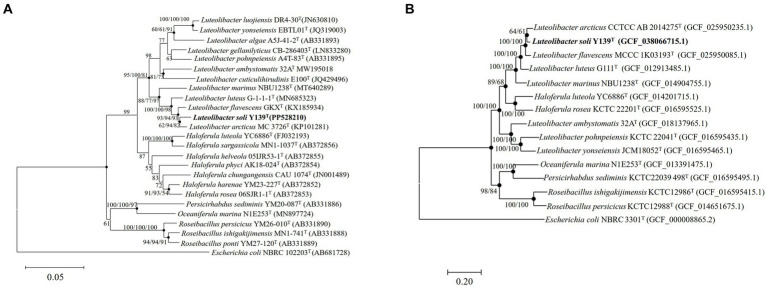
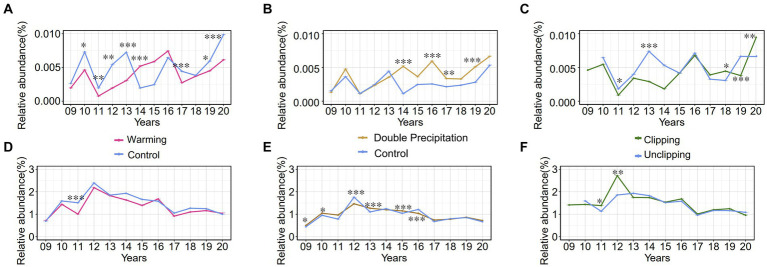
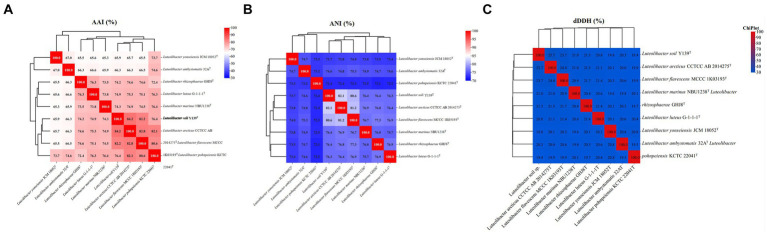
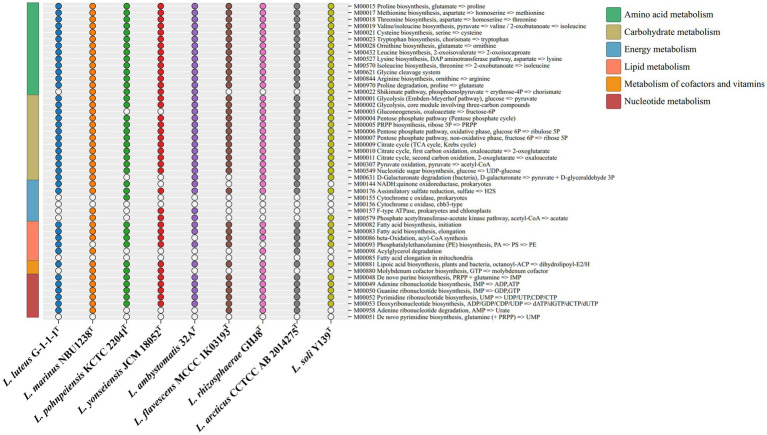
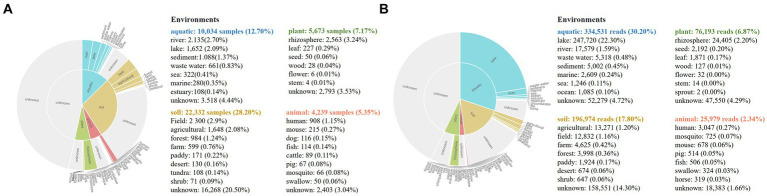
The strain designated as Y139 is a novel Gram-stain-negative, aerobic, and non-motile bacterium, was isolated from a soil sample in McClain County, Oklahoma, United States. The cells of strain Y139 were a rod-shaped, with the width of 0.4-0.7 and the length of 1.5-2.0 . Growth occurred at 20-37°C (optimum, 30°C), pH 5.5-9.5 (optimum, pH 7.0), and 0-1.0% NaCl (w/v) (optimum, 0%). The polar lipid profiles included phosphatidylethanolamine, phosphatidylglycerol, diphosphatidylglycerol, phosphatidyldimethylethanolamine, and an unidentified lipid. The major fatty acids included C, iso-C, and C 9. Menaquinone-9 (MK-9) was recognized as the only respiratory quinone. Strain Y139 showed the highest 16S rRNA gene sequence similarity to MCCC 1K03193 (98.3%). Phylogenetic analysis positioned it within the genus . The draft genome of strain Y139 consisted of 7,106,054 bp, and contained 5,715 open reading frames (ORFs), including 5,656 coding sequences (CDSs) and 59 RNA genes. The genomic DNA G + C content was found to be 62.5%. Comparing strain Y139 with MCCC 1K03193 and CCTCC AB 2014275, the average nucleotide identity (ANI) values were 80.6 and 82.1%, respectively. Following phylogenetic, physiological, biochemical, and chemotaxonomic analyses, a novel species within the genus , designated as sp. nov., was proposed for strain Y139, which was also assigned as the type strain (=KCTC 92644 = MCCC 1H01451). Further analysis of core genes across 9 species uncovered significant genomic divergence, particularly in those related to cofactor, vitamin, and energy metabolism. Analysis of biogeographic distribution suggested that lake and soil were the main habitats for the genus . Additionally, the genus was sensitive to climate warming and precipitation.
命名为Y139的菌株是一种新型革兰氏阴性、需氧且不运动的细菌,从美国俄克拉荷马州麦克莱恩县的一份土壤样本中分离得到。Y139菌株的细胞呈杆状,宽度为0.4 - 0.7 ,长度为1.5 - 2.0 。在20 - 37°C(最适温度30°C)、pH 5.5 - 9.5(最适pH 7.0)和0 - 1.0% NaCl(w/v)(最适0%)条件下生长。极性脂质谱包括磷脂酰乙醇胺、磷脂酰甘油、二磷脂酰甘油、磷脂酰二甲基乙醇胺和一种未鉴定的脂质。主要脂肪酸包括C、异C和C 9。甲基萘醌-9(MK - 9)被确认为唯一的呼吸醌。Y139菌株与MCCC 1K03193的16S rRNA基因序列相似性最高(98.3%)。系统发育分析将其定位在该属内。Y139菌株的基因组草图由7,106,054 bp组成,包含5,715个开放阅读框(ORF),包括5,656个编码序列(CDS)和59个RNA基因。发现基因组DNA的G + C含量为62.5%。将Y139菌株与MCCC 1K03193和CCTCC AB 2014275进行比较,平均核苷酸同一性(ANI)值分别为80.6%和82.1%。经过系统发育、生理、生化和化学分类分析,为Y139菌株提出了该属内的一个新物种,命名为 sp. nov.,它也被指定为模式菌株(=KCTC 92644 = MCCC 1H01451)。对9个 物种核心基因的进一步分析发现了显著的基因组差异,特别是在那些与辅因子、维生素和能量代谢相关的基因中。生物地理分布分析表明,湖泊和土壤是该属的主要栖息地。此外,该属对气候变暖和降水敏感。