Theoretical Biology and Biophysics Group, Los Alamos National Laboratory, Los Alamos, NM, United States of America.
Computational Physics Group, Los Alamos National Laboratory, Los Alamos, NM, United States of America.
PLoS One. 2020 Aug 6;15(8):e0236776. doi: 10.1371/journal.pone.0236776. eCollection 2020.
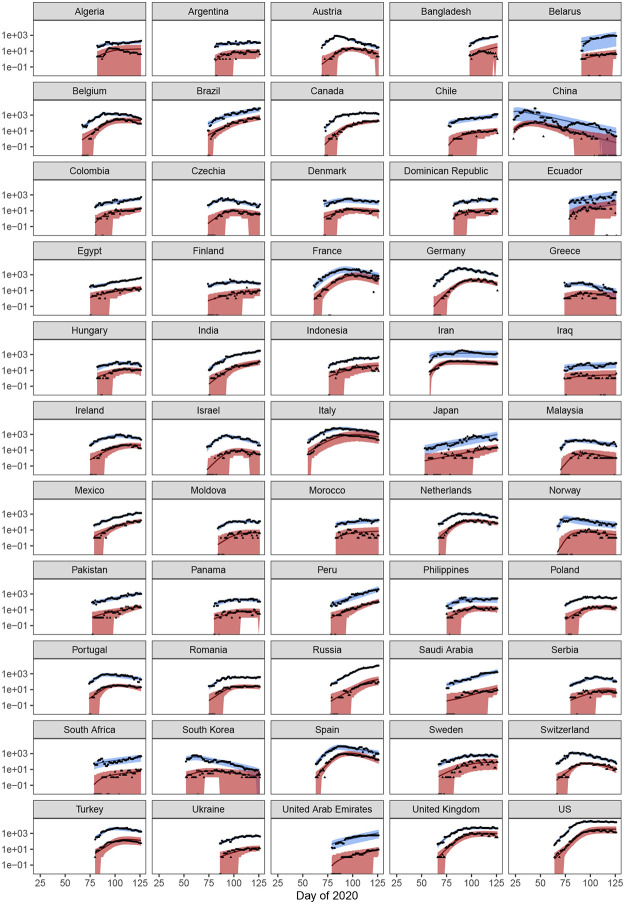
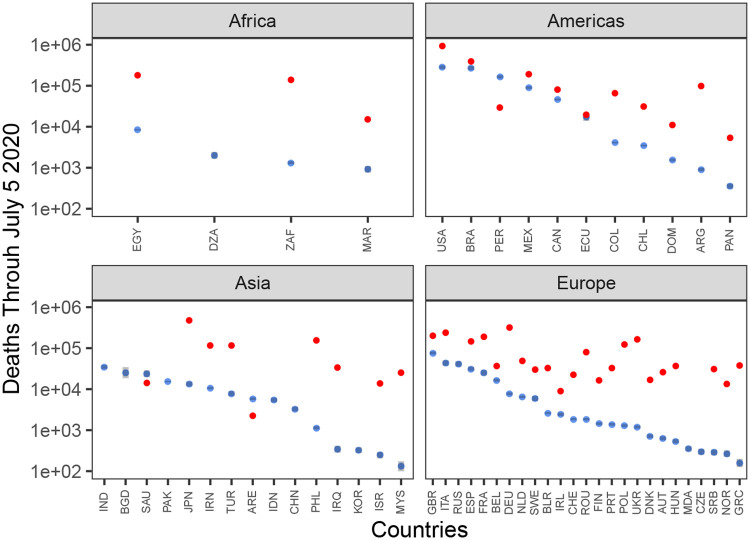
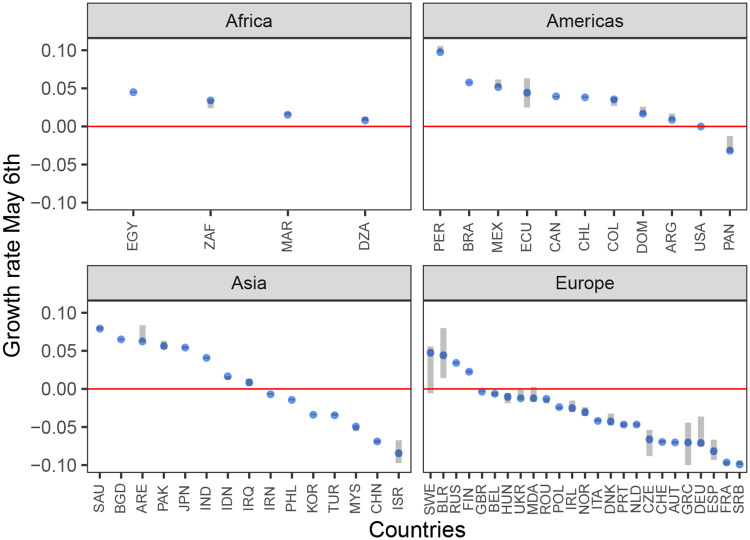
We analyzed COVID-19 data through May 6th, 2020 using a partially observed Markov process. Our method uses a hybrid deterministic and stochastic formalism that allows for time variable transmission rates and detection probabilities. The model was fit using iterated particle filtering to case count and death count time series from 55 countries. We found evidence for a shrinking epidemic in 30 of the 55 examined countries. Of those 30 countries, 27 have significant evidence for subcritical transmission rates, although the decline in new cases is relatively slow compared to the initial growth rates. Generally, the transmission rates in Europe were lower than in the Americas and Asia. This suggests that global scale social distancing efforts to slow the spread of COVID-19 are effective although they need to be strengthened in many regions and maintained in others to avoid further resurgence of COVID-19. The slow decline also suggests alternative strategies to control the virus are needed before social distancing efforts are partially relaxed.
我们使用部分观测马尔可夫过程分析了截至 2020 年 5 月 6 日的 COVID-19 数据。我们的方法使用了一种混合的确定性和随机性形式主义,允许时变的传播率和检测概率。该模型使用迭代粒子滤波对来自 55 个国家的病例数和死亡数时间序列进行拟合。我们发现,在 55 个被检查的国家中有 30 个国家的疫情呈缩小趋势。在这 30 个国家中,有 27 个国家的传播率有显著的亚临界证据,尽管与最初的增长率相比,新病例的下降速度相对较慢。一般来说,欧洲的传播率低于美洲和亚洲。这表明,全球范围内减缓 COVID-19 传播的社会隔离措施是有效的,尽管在许多地区需要加强这些措施,并在其他地区保持这些措施,以避免 COVID-19 的进一步爆发。这种缓慢的下降也表明,在部分放宽社会隔离措施之前,需要采取其他控制病毒的策略。