Program for Evolutionary Dynamics, Harvard University, Cambridge, Massachusetts, United States of America.
Department of Biostatistics, Epidemiology and Informatics, University of Pennsylvania, Philadelphia, Pennsylvania, United States of America.
PLoS Comput Biol. 2021 Feb 3;17(2):e1008684. doi: 10.1371/journal.pcbi.1008684. eCollection 2021 Feb.
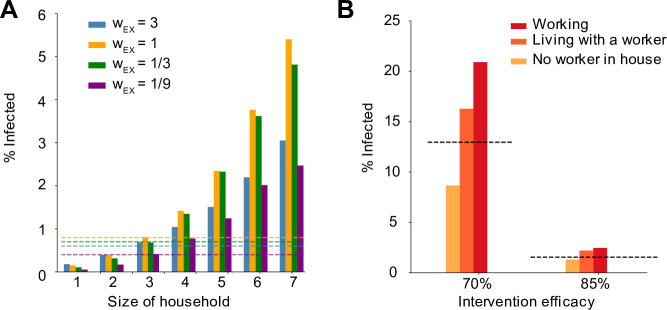
In the absence of pharmaceutical interventions, social distancing is being used worldwide to curb the spread of COVID-19. The impact of these measures has been inconsistent, with some regions rapidly nearing disease elimination and others seeing delayed peaks or nearly flat epidemic curves. Here we build a stochastic epidemic model to examine the effects of COVID-19 clinical progression and transmission network structure on the outcomes of social distancing interventions. Our simulations show that long delays between the adoption of control measures and observed declines in cases, hospitalizations, and deaths occur in many scenarios. We find that the strength of within-household transmission is a critical determinant of success, governing the timing and size of the epidemic peak, the rate of decline, individual risks of infection, and the success of partial relaxation measures. The structure of residual external connections, driven by workforce participation and essential businesses, interacts to determine outcomes. We suggest limited conditions under which the formation of household "bubbles" can be safe. These findings can improve future predictions of the timescale and efficacy of interventions needed to control second waves of COVID-19 as well as other similar outbreaks, and highlight the need for better quantification and control of household transmission.
在缺乏药物干预的情况下,社交隔离措施正在全球范围内被用来遏制 COVID-19 的传播。这些措施的效果并不一致,一些地区迅速接近消除疾病,而另一些地区则出现了延迟的高峰期或几乎平坦的疫情曲线。在这里,我们构建了一个随机传染病模型,以研究 COVID-19 临床进展和传播网络结构对社交隔离干预措施效果的影响。我们的模拟表明,在许多情况下,采取控制措施与观察到的病例、住院和死亡人数下降之间存在较长的延迟。我们发现,家庭内部传播的强度是成功的关键决定因素,它控制着疫情高峰期的时间和规模、下降速度、个体感染风险以及部分放松措施的成功。由劳动力参与和基本业务驱动的剩余外部联系结构相互作用,决定了结果。我们建议在有限的条件下,家庭“泡泡”的形成可以是安全的。这些发现可以提高对控制 COVID-19 第二波疫情以及其他类似疫情所需的干预措施的时间尺度和效果的未来预测,并强调需要更好地量化和控制家庭传播。