Coratella Giuseppe, Galas Annalisa, Campa Francesco, Pedrinolla Anna, Schena Federico, Venturelli Massimo
Department of Biomedical Sciences for Health, Università degli Studi di Milano, Milano, Italy.
Department of Neuroscience, Biomedicine and Movement Sciences, University of Verona, Verona, Italy.
Front Physiol. 2022 Mar 3;13:788473. doi: 10.3389/fphys.2022.788473. eCollection 2022.
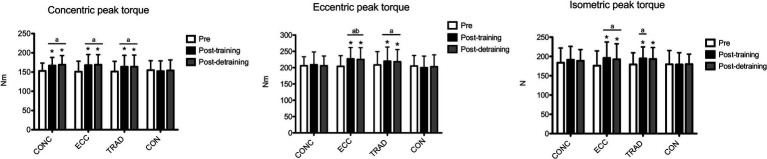
The current randomized controlled study investigated whether or not the inclusion of the eccentric phase in resistance training favors the contralateral strength gains after different unilateral protocols, and whether such gains are retained after detraining. Sixty healthy women were randomly assigned to a unilateral concentric-only (CONC), eccentric-only (ECC), concentric-eccentric (TRAD) volume-equated knee extension training or control group (CON). The participants trained 2 days/week for 8 weeks and then did not train for further 8 weeks. Knee extensors isokinetic concentric, eccentric, and isometric peak torque and muscle thickness were assessed in the contralateral limb at baseline, post-training, and post-detraining. At post-training, concentric peak torque increased in CONC [+9.2%, 95%CI (+6.2/+12.3), < 0.001, ES: 0.70, 95%CI (0.01/1.39)], ECC [+11.0% (+7.7/+14.2), < 0.001: ES: 0.66(0.09/1.23)] and TRAD [+8.5%(+5.7/+11.6), < 0.001, ES: 0.50(0.02/0.98)]. Eccentric peak torque increased in ECC in ECC [+15.0%(+11.4/+20.7), < 0.001, ES: 0.91(0.14/1.63)] and TRAD [+5.5%(+0.3/10.7), = 0.013, ES: 0.50(0.05/0.95)]. Isometric peak torque increased in ECC [+11.3(+5.8/16.8), < 0.001, ES: 0.52(0.10/0.94)] and TRAD [+8.6%(+3.4/+13.7), < 0.001, ES: 0.55(0.14/0.96)]. No change in eccentric and isometric peak torque occurred in CONC ( > 0.05). Muscle thickness did not change in any group ( > 0.05). At post-detraining, all groups preserved the contralateral strength gains observed at post-training ( < 0.05). The findings showed that ECC and TRAD increased contralateral knee extensors strength in concentric, eccentric, and isometric modality, while CONC only increased concentric strength. The eccentric phase appears to amplify the cross-education effect, permitting a transfer in strength gaining toward multiple testing modalities. Both eccentric-based and traditional eccentric-concentric resistance protocols are recommended to increase the contralateral retention in strength gains after a detraining period.
当前的随机对照研究调查了在不同的单侧训练方案中,阻力训练加入离心阶段是否有利于对侧力量增长,以及在停训后这些增长是否能得以保持。60名健康女性被随机分配到仅进行单侧向心收缩(CONC)、仅进行离心收缩(ECC)、向心-离心收缩(TRAD)且训练量相等的伸膝训练组或对照组(CON)。参与者每周训练2天,共训练8周,然后停训8周。在基线、训练后和停训后,对侧肢体的伸膝肌等速向心、离心和等长峰值扭矩以及肌肉厚度进行了评估。训练后,CONC组向心峰值扭矩增加了[+9.2%,95%可信区间(+6.2/+12.3),P<0.001,效应量:0.70,95%可信区间(0.01/1.39)],ECC组增加了[+11.0%(+7.7/+14.2),P<0.001:效应量:0.66(0.09/1.23)],TRAD组增加了[+8.5%(+5.7/+11.6),P<0.001,效应量:0.50(0.02/0.98)]。ECC组离心峰值扭矩增加了[+15.0%(+11.4/+20.7),P<0.001,效应量:0.91(0.14/1.63)],TRAD组增加了[+5.5%(+0.3/10.7),P = 0.013,效应量:0.50(0.05/0.95)]。ECC组等长峰值扭矩增加了[+11.3(+5.8/16.8),P<0.001,效应量:0.52(0.10/0.94)],TRAD组增加了[+8.6%(+3.4/+13.7),P<0.001,效应量:0.55(0.14/0.96)]。CONC组离心和等长峰值扭矩无变化(P>0.05)。所有组的肌肉厚度均无变化(P>0.05)。停训后,所有组均保持了训练后观察到的对侧力量增长(P<0.05)。研究结果表明,ECC组和TRAD组在向心、离心和等长模式下均增加了对侧伸膝肌力量,而CONC组仅增加了向心力量。离心阶段似乎放大了交叉训练效应,使力量增长能够转移到多种测试模式。推荐采用基于离心收缩和传统的向心-离心阻力训练方案,以增加停训期后对侧力量增长的保持。