Wu Yining, Wei Jia, Zhang Wei, Xie Mengxiao, Wang Xueying, Xu Jian
Department of Laboratory Medicine, The First Affiliated Hospital of Nanjing Medical University, Nanjing 210029, People's Republic of China.
National Key Clinical Department of Laboratory Medicine, Nanjing 210029, People's Republic of China.
Onco Targets Ther. 2020 Aug 5;13:7809-7818. doi: 10.2147/OTT.S263934. eCollection 2020.
Lung cancer is a leading cause of cancer-related death, with lung adenocarcinoma (LUAD) representing the most common subtype. Recently, exosome-based biomarkers have provided new diagnostic approaches for malignancies. We aimed to identify specific exosomal microRNAs (miRNAs) as noninvasive biomarkers for LUAD.
A total of 110 participants were enrolled and randomly divided into two sets: the discovery set (n=20) and the validation set (n=90). Exosomes were isolated from serum, and miRNAs were subsequently extracted. Candidate miRNAs (miR-21, miR-221-3p, miR-222-3p, miR-223, miR-638 and miR-1290) were detected by quantitative real-time PCR (qRT-PCR) in the discovery set. The upregulated miR-1290 was then selected for further analysis in the validation set along with three tumor markers (CEA, CYFRA21-1 and NSE). The diagnostic and prognostic value of exosomal miR-1290 were estimated through receiver-operating characteristic (ROC) and survival analysis.
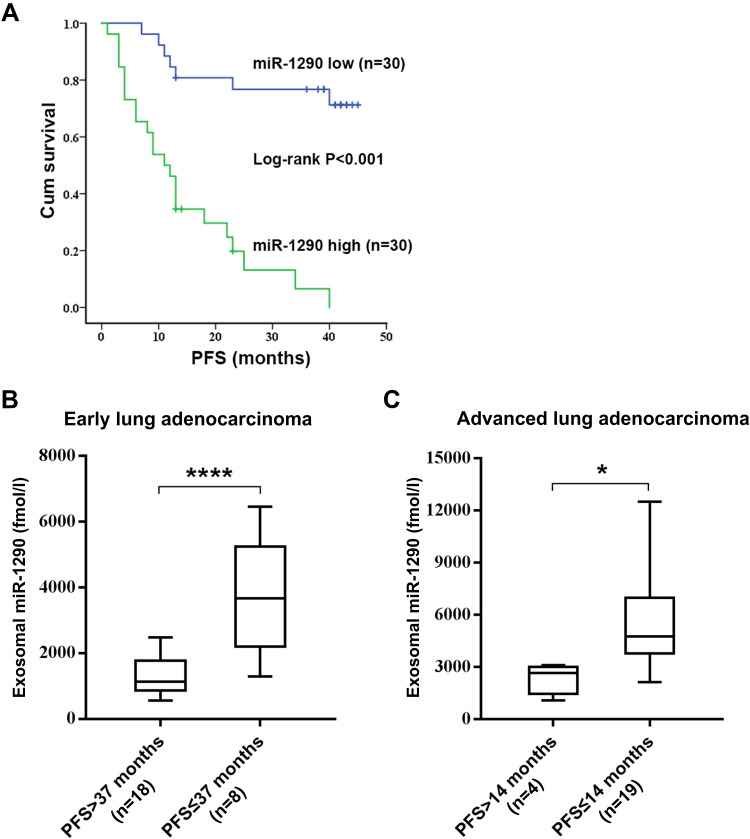
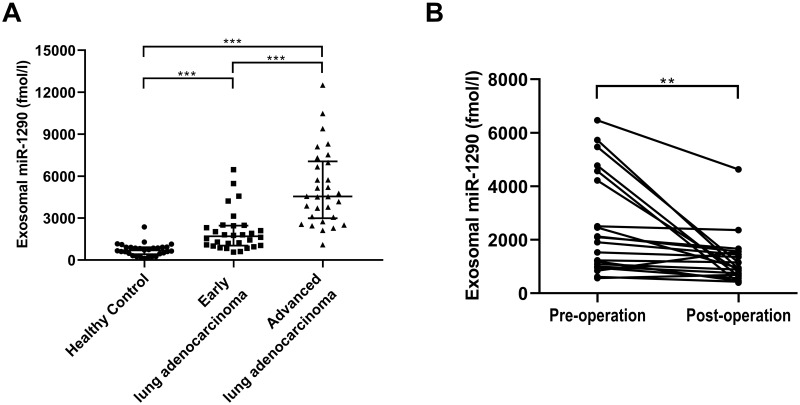
Serum exosomal miR-1290 was significantly upregulated in LUAD patients compared to healthy controls (P<0.001) and decreased after resection (P=0.0029). Its expression level was associated with tumor stage, tumor size, lymph node and distant metastasis (all P <0.05). Exosomal miR-1290 had a higher diagnostic efficacy than CEA, CYFRA21-1 and NSE, with a sensitivity of 80.0% and specificity of 96.7% (AUC: 0.937, 95% CI: 0.890-0.985; P<0.001). Moreover, LUAD patients with a high level of exosomal miR-1290 had significantly poorer progression-free survival (PFS) than those with a low level of exosomal miR-1290 (mean PFS: 14 months vs 37 months, P<0.001). Cox proportional hazards model analysis demonstrated that exosomal miR-1290 could be an independent risk factor for the prognosis of LUAD (HR=7.80, P=0.017).
Serum exosomal miR-1290 could be a potential diagnostic and prognostic biomarker for LUAD.
肺癌是癌症相关死亡的主要原因,肺腺癌(LUAD)是最常见的亚型。近来,基于外泌体的生物标志物为恶性肿瘤提供了新的诊断方法。我们旨在鉴定特定的外泌体微小RNA(miRNA)作为LUAD的非侵入性生物标志物。
共纳入110名参与者并随机分为两组:发现组(n = 20)和验证组(n = 90)。从血清中分离出外泌体,随后提取miRNA。在发现组中通过定量实时PCR(qRT-PCR)检测候选miRNA(miR-21、miR-221-3p、miR-222-3p、miR-223、miR-638和miR-1290)。然后选择上调的miR-1290连同三种肿瘤标志物(癌胚抗原、细胞角蛋白19片段和神经元特异性烯醇化酶)在验证组中进行进一步分析。通过受试者工作特征(ROC)和生存分析评估外泌体miR-1290的诊断和预后价值。
与健康对照相比,LUAD患者血清外泌体miR-1290显著上调(P < 0.001),切除后降低(P = 0.0029)。其表达水平与肿瘤分期、肿瘤大小、淋巴结及远处转移相关(均P < 0.05)。外泌体miR-1290的诊断效能高于癌胚抗原、细胞角蛋白19片段和神经元特异性烯醇化酶,敏感性为80.0%,特异性为96.7%(AUC:0.937,95% CI:0.890 - 0.985;P < 0.001)。此外,外泌体miR-1290水平高的LUAD患者无进展生存期(PFS)明显短于外泌体miR-1290水平低的患者(平均PFS:14个月对37个月,P < 0.001)。Cox比例风险模型分析表明外泌体miR-1290可能是LUAD预后的独立危险因素(HR = 7.80,P = 0.017)。
血清外泌体miR-1290可能是LUAD潜在的诊断和预后生物标志物。