Computer-Chemie-Centrum and Institute of Organic Chemistry, University of Erlangen-Nuremberg, Naegelsbachstrasse 25, 91052, Erlangen, Germany.
Chemphyschem. 2020 Oct 16;21(20):2233-2242. doi: 10.1002/cphc.202000518. Epub 2020 Sep 28.
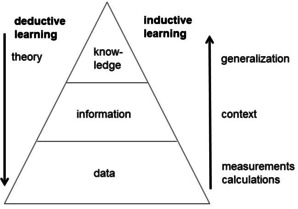
Chemists have to a large extent gained their knowledge by doing experiments and thus gather data. By putting various data together and then analyzing them, chemists have fostered their understanding of chemistry. Since the 1960s, computer methods have been developed to perform this process from data to information to knowledge. Simultaneously, methods were developed for assisting chemists in solving their fundamental questions such as the prediction of chemical, physical, or biological properties, the design of organic syntheses, and the elucidation of the structure of molecules. This eventually led to a discipline of its own: chemoinformatics. Chemoinformatics has found important applications in the fields of drug discovery, analytical chemistry, organic chemistry, agrichemical research, food science, regulatory science, material science, and process control. From its inception, chemoinformatics has utilized methods from artificial intelligence, an approach that has recently gained more momentum.
化学家在很大程度上通过做实验获得知识,从而收集数据。通过将各种数据放在一起,然后对其进行分析,化学家加深了他们对化学的理解。自 20 世纪 60 年代以来,已经开发出计算机方法来执行从数据到信息再到知识的这个过程。同时,还开发了一些方法来帮助化学家解决他们的基本问题,如化学、物理或生物性质的预测、有机合成的设计以及分子结构的阐明。这最终导致了一个独立的学科:化学信息学。化学信息学在药物发现、分析化学、有机化学、农化研究、食品科学、监管科学、材料科学和过程控制等领域找到了重要的应用。从一开始,化学信息学就利用了人工智能的方法,这种方法最近获得了更多的动力。