Dartmouth College Mathematics Department, Hanover, NH, United States of America.
PLoS One. 2020 Aug 26;15(8):e0237780. doi: 10.1371/journal.pone.0237780. eCollection 2020.
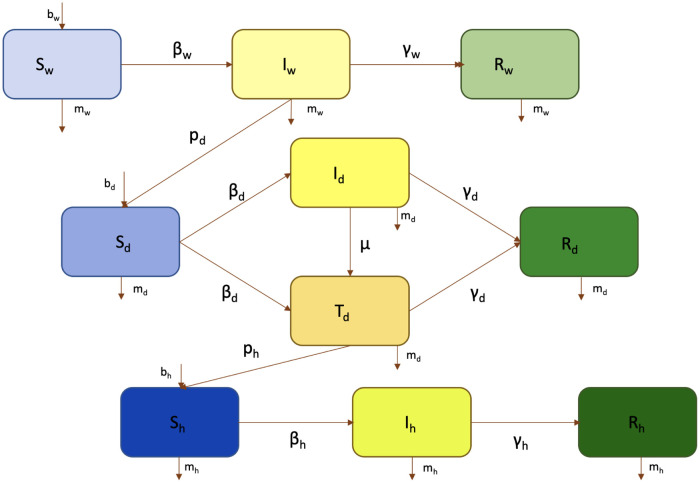
Modeling the behavior of zoonotic pandemic threats is a key component of their control. Many emerging zoonoses, such as SARS, Nipah, and Hendra, mutated from their wild type while circulating in an intermediate host population, usually a domestic species, to become more transmissible among humans, and this transmission route will only become more likely as agriculture and trade intensifies around the world. Passage through an intermediate host enables many otherwise rare diseases to become better adapted to humans, and so understanding this process with accurate mathematical models is necessary to prevent epidemics of emerging zoonoses, guide policy interventions in public health, and predict the behavior of an epidemic. In this paper, we account for a zoonotic disease mutating in an intermediate host by introducing a new mathematical model for disease transmission among three species. We present a model of these disease dynamics, including the equilibria of the system and the basic reproductive number of the pathogen, finding that in the presence of biologically realistic interspecies transmission parameters, a zoonotic disease with the capacity to mutate in an intermediate host population can establish itself in humans even if its R0 in humans is less than 1. This result and model can be used to predict the behavior of any zoonosis with an intermediate host and assist efforts to protect public health.
对人畜共患病威胁行为进行建模是其控制的关键组成部分。许多新出现的人畜共患病,如 SARS、尼帕和亨德拉,在中间宿主种群(通常是一种家畜物种)中传播时,从其野生型发生突变,从而更容易在人类中传播,随着世界各地农业和贸易的加剧,这种传播途径将变得更加可能。通过中间宿主,许多原本罕见的疾病变得更容易适应人类,因此,使用准确的数学模型来理解这一过程对于预防新出现的人畜共患病的流行、指导公共卫生政策干预以及预测传染病的行为是必要的。在本文中,我们通过引入一个新的三种物种间疾病传播的数学模型来解释中间宿主中发生的人畜共患病的突变。我们提出了这些疾病动力学的模型,包括系统的平衡点和病原体的基本繁殖数,发现如果中间宿主种群中存在具有生物学意义的种间传播参数,那么一种具有在中间宿主种群中发生突变能力的人畜共患病即使其在人类中的 R0 小于 1,也可以在人类中建立自己。这一结果和模型可用于预测任何具有中间宿主的人畜共患病的行为,并有助于保护公共卫生的努力。