Beam Kayla, Ascencio-Ibáñez José Trinidad
Department of Molecular and Structural Biology, North Carolina State University, Raleigh, NC, United States.
Front Plant Sci. 2020 Jul 23;11:1131. doi: 10.3389/fpls.2020.01131. eCollection 2020.
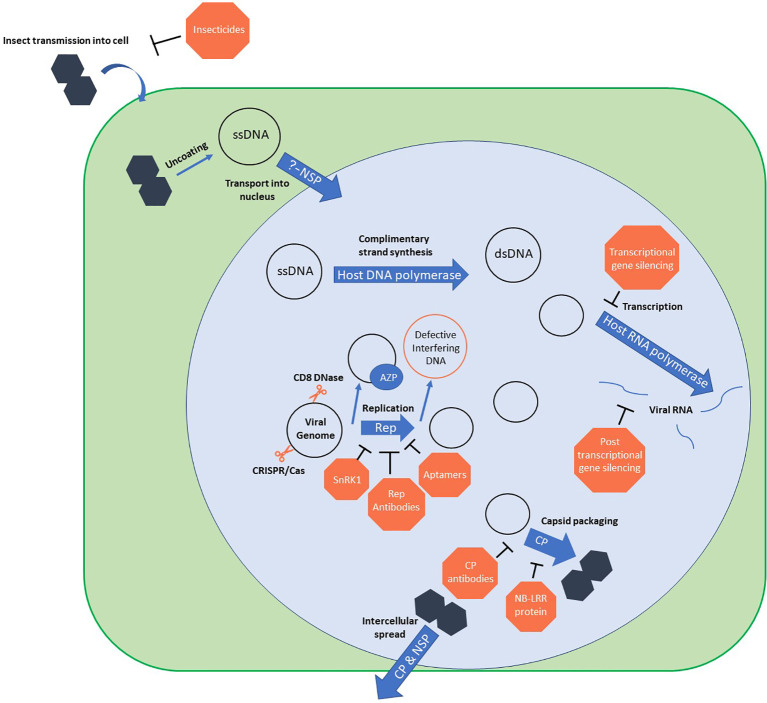
A continuing challenge to crop production worldwide is the spectrum of diseases caused by geminiviruses, a large family of small circular single-stranded DNA viruses. These viruses are quite diverse, some containing mono- or bi-partite genomes, and infecting a multitude of monocot and dicot plants. There are currently many efforts directed at controlling these diseases. While some of the methods include controlling the insect vector using pesticides or genetic insect resistance (Rodríguez-López et al., 2011), this review will focus on the generation of plants that are resistant to geminiviruses themselves. Genetic resistance was traditionally found by surveying the wild relatives of modern crops for resistance loci; this method is still widely used and successful. However, the quick rate of virus evolution demands a rapid turnover of resistance genes. With better information about virus-host interactions, scientists are now able to target early stages of geminivirus infection in the host, preventing symptom development and viral DNA accumulation.
双生病毒是一类大型的小环状单链DNA病毒,由其引发的一系列病害一直是全球作物生产面临的挑战。这些病毒种类繁多,有些含有单分体或双分体基因组,可感染多种单子叶和双子叶植物。目前人们为控制这些病害付出了诸多努力。虽然一些方法包括使用杀虫剂或遗传抗虫性来控制昆虫载体(Rodríguez-López等人,2011年),但本综述将聚焦于培育对双生病毒本身具有抗性的植物。传统上,通过调查现代作物的野生近缘种来寻找抗性基因座,从而获得遗传抗性;这种方法仍被广泛使用且成效显著。然而,病毒进化速度很快,需要不断更新抗性基因。随着对病毒-宿主相互作用有了更多了解,科学家们现在能够针对双生病毒在宿主中的早期感染阶段采取措施,防止症状出现和病毒DNA积累。