Department of Psychology, University of Cambridge, Cambridge CB2 3EB, UK.
Department of Cognitive Neuroscience, Faculty of Psychology and Neuroscience, Maastricht University, Maastricht 6229 ER, The Netherlands.
Curr Biol. 2020 Nov 2;30(21):4177-4187.e4. doi: 10.1016/j.cub.2020.08.016. Epub 2020 Sep 3.
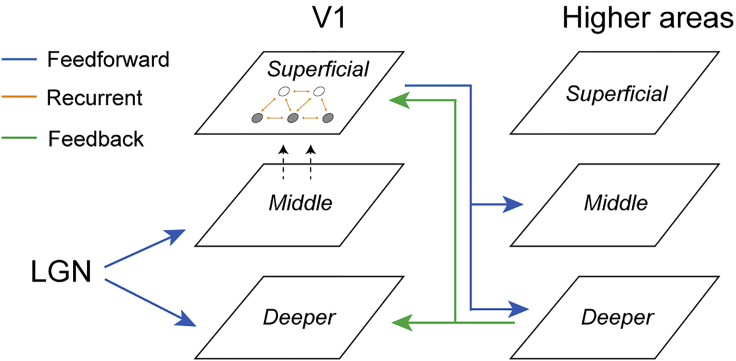
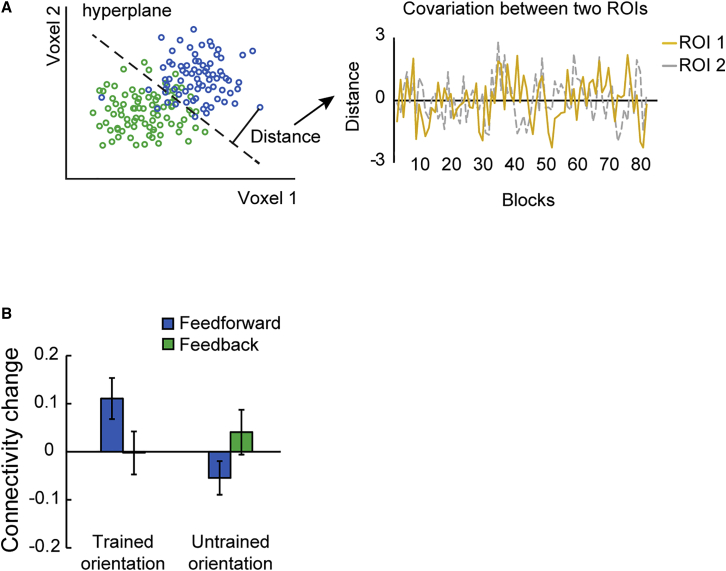
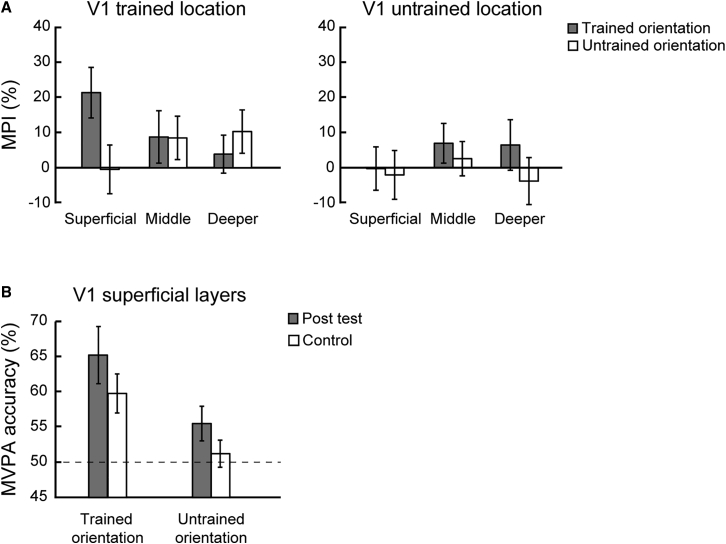
Learning and experience are critical for translating ambiguous sensory information from our environments to perceptual decisions. Yet evidence on how training molds the adult human brain remains controversial, as fMRI at standard resolution does not allow us to discern the finer scale mechanisms that underlie sensory plasticity. Here, we combine ultra-high-field (7T) functional imaging at sub-millimeter resolution with orientation discrimination training to interrogate experience-dependent plasticity across cortical depths that are known to support dissociable brain computations. We demonstrate that learning alters orientation-specific representations in superficial rather than middle or deeper V1 layers, consistent with recurrent plasticity mechanisms via horizontal connections. Further, learning increases feedforward rather than feedback layer-to-layer connectivity in occipito-parietal regions, suggesting that sensory plasticity gates perceptual decisions. Our findings reveal finer scale plasticity mechanisms that re-weight sensory signals to inform improved decisions, bridging the gap between micro- and macro-circuits of experience-dependent plasticity.
学习和经验对于将我们环境中的模糊感觉信息转换为知觉决策至关重要。然而,关于培训如何塑造成人大脑的证据仍然存在争议,因为标准分辨率的 fMRI 不允许我们辨别感知可塑性背后的更精细的尺度机制。在这里,我们结合了超高场(7T)亚毫米分辨率的功能成像和方向辨别训练,以探究已知支持可分离大脑计算的皮质深度范围内的经验依赖性可塑性。我们证明,学习改变了浅层而非中层或深层 V1 层的特定于方向的表示,这与通过水平连接的递归可塑性机制一致。此外,学习增加了枕顶区域的前馈而不是反馈层到层的连通性,这表明感觉可塑性控制了知觉决策。我们的发现揭示了更精细的可塑性机制,这些机制重新加权感觉信号以提供更好的决策,从而弥合了经验依赖性可塑性的微观和宏观电路之间的差距。