School of Food Science & Nutrition, University of Leeds, Leeds LS2 9JT, UK.
School of Medicine, University of Leeds, Leeds LS2 9JT, UK.
Toxins (Basel). 2020 Sep 12;12(9):591. doi: 10.3390/toxins12090591.
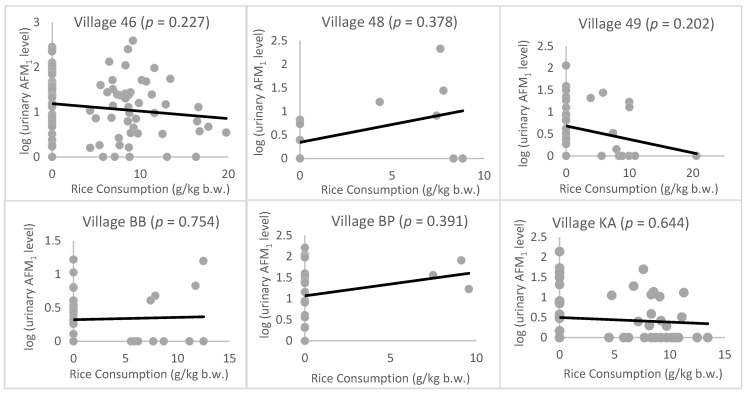
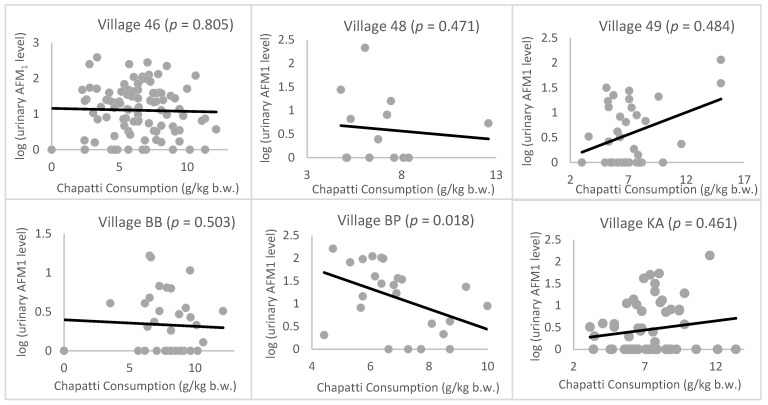
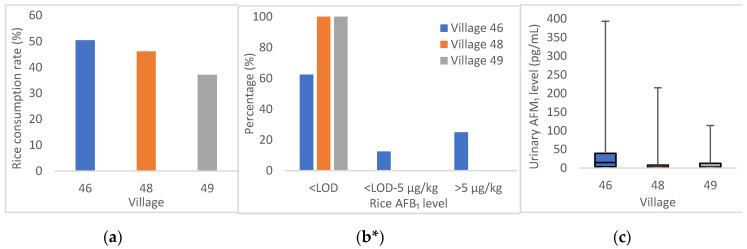
There are limited data on exposure to mycotoxins in Pakistan. Here, we measured exposure to deoxynivalenol (DON), a common contaminant of wheat, and aflatoxin B (AFB), a known contaminant of rice, using biomarkers of exposure. Wheat ( = 195) and rice ( = 62) samples were analyzed for AFB and DON levels, and the corresponding urinary biomarkers were analyzed in urine samples from a rural population ( = 264, aged 4-80 years, male 58%) using ultra-sensitive liquid chromatography-tandem mass spectrometry. AFB was detected in 66% of rice (5.04 ± 11.94 µg/kg) and 3% of wheat samples. AFM (hydroxylated form of AFB)was detected in 69% of urine samples, mean 0.023 ± 0.048 ng/mL and DON was detected in 20% of urine samples, mean 0.170 ± 0.129 ng/mL. The maximum probable daily intake for DON derived from the urinary biomarker was 59.8 ng/kg b.w./day, which is below the Joint Food and Agriculture Organization/World Health Organization Expert Committee on Food Additives' tolerable daily intake (1000 ng/kg b.w./day). However, for aflatoxin, the derived margin of exposure (MoE) of (13.2) was well below the safe MoE (10,000) suggested by the European Food Safety Authority. The calculated aflatoxin-associated cancer risk of 0.514/10 individuals/year suggests that measures should be taken to reduce the AFB contamination in food, particularly rice, in Pakistan.
巴基斯坦接触霉菌毒素的数据有限。在这里,我们使用暴露标志物测量了脱氧雪腐镰刀菌烯醇 (DON)(小麦的常见污染物)和黄曲霉毒素 B (AFB)(已知的大米污染物)的暴露情况。对 195 份小麦和 62 份大米样本进行了 AFB 和 DON 水平分析,并使用超灵敏液相色谱-串联质谱法对农村人群(=264 人,年龄 4-80 岁,男性占 58%)的尿液样本中的相应尿液生物标志物进行了分析。在 66%的大米(5.04 ± 11.94 µg/kg)和 3%的小麦样本中检测到 AFB。在 69%的尿液样本中检测到 AFM(AFB 的羟基化形式),平均值为 0.023 ± 0.048 ng/mL,在 20%的尿液样本中检测到 DON,平均值为 0.170 ± 0.129 ng/mL。根据尿液生物标志物推断出的 DON 最大可能每日摄入量为 59.8 ng/kg b.w./天,低于食品和农业组织/世界卫生组织食品添加剂联合专家委员会的可耐受每日摄入量(1000 ng/kg b.w./天)。然而,对于黄曲霉毒素,推断的暴露边际(MoE)(13.2)远低于欧洲食品安全局建议的安全 MoE(10000)。计算出的黄曲霉毒素相关癌症风险为 0.514/10 个人/年,表明应采取措施减少巴基斯坦食品,特别是大米中的 AFB 污染。