Guangzhou Center for Disease Control and Prevention, Guangzhou, 510440, China.
Guangdong Second Provincial General Hospital, Guangzhou, 510000, China.
Sci Rep. 2020 May 14;10(1):7973. doi: 10.1038/s41598-020-64295-8.
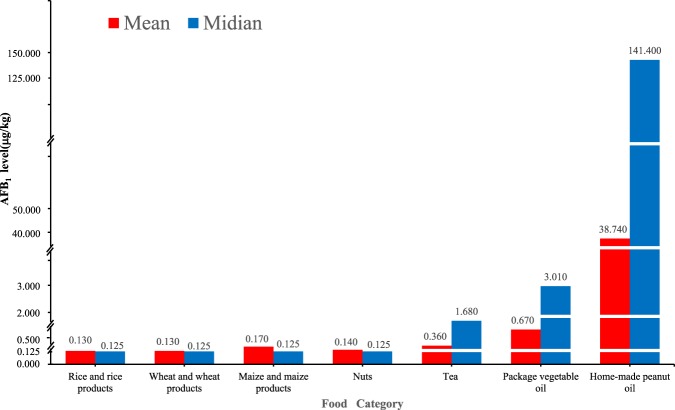
Aflatoxin B (AFB) contamination in foods is an important health challenge for low-and middle-income countries in subtropical regions. AFB has been detected in a variety of foodsin Guangzhou, while the risk of dietary exposure is unknown. This study aimed to assess the probabilistic risk of dietary exposure to AFB contamination in food stuffs in Guangzhou by using margin of exposure (MOE) and quantitative liver cancer risk approaches. A total of1854 AFB-contaminated foodstuffs were sampled in supermarkets, agricultural markets, retail shops, and family workshops from 11 districts of Guangzhou, and AFB content was determined by HPLC-fluorescence detector. In total, 9.9% (184/1854) of the test samples had AFB concentrations above the limit of detection. Home-made peanut oil had the highest AFB concentration, with a mean value of 38.74 ± 47.45 μg kg. The average MOE levels of Guangzhou residents ranged from 100 to 1000. The risk of liver cancer was 0.0264 cancers (100,000 population year). The health risks of suburban people were higher than those of urban people, and home-made peanut oil was the main contributorto dietary exposure to AFB among suburban residents in Guangzhou. The production of home-made peanut oil should be supervised to reduce the risk of AFB exposure.
食品中的黄曲霉毒素 B(AFB)污染是亚热带地区低收入和中等收入国家面临的一个重要健康挑战。在广州的各种食品中都检测到了 AFB,而饮食暴露的风险尚不清楚。本研究旨在通过使用暴露边际(MOE)和定量肝癌风险方法评估广州食品中 AFB 污染的膳食暴露概率风险。在广州的 11 个区的超市、农贸市场、零售店和家庭作坊中采集了 1854 份 AFB 污染食品样本,并通过 HPLC-荧光检测器测定 AFB 含量。共有 9.9%(184/1854)的测试样本 AFB 浓度超过检测限。自制花生油的 AFB 浓度最高,平均值为 38.74±47.45μg/kg。广州居民的平均 MOE 水平在 100 到 1000 之间。肝癌风险为 0.0264 例癌症(每 10 万人年)。郊区居民的健康风险高于城市居民,自制花生油是广州郊区居民摄入 AFB 的主要来源。应加强对自制花生油的生产监管,以降低 AFB 暴露的风险。