• 文献检索
  • 文档翻译
  • 深度研究
  • 学术资讯
  • Suppr Zotero 插件Zotero 插件
  • 邀请有礼
  • 套餐&价格
  • 历史记录
应用&插件
Suppr Zotero 插件Zotero 插件浏览器插件Mac 客户端Windows 客户端微信小程序
定价
高级版会员购买积分包购买API积分包
服务
文献检索文档翻译深度研究API 文档MCP 服务
关于我们
关于 Suppr公司介绍联系我们用户协议隐私条款
关注我们

Suppr 超能文献

核心技术专利:CN118964589B侵权必究
粤ICP备2023148730 号-1Suppr @ 2026

文献检索

告别复杂PubMed语法,用中文像聊天一样搜索,搜遍4000万医学文献。AI智能推荐,让科研检索更轻松。

立即免费搜索

文件翻译

保留排版,准确专业,支持PDF/Word/PPT等文件格式,支持 12+语言互译。

免费翻译文档

深度研究

AI帮你快速写综述,25分钟生成高质量综述,智能提取关键信息,辅助科研写作。

立即免费体验

帕金森病患者和医疗保健专业人员希望如何通过电子健康进行合作护理:共同设计研究。

How People with Parkinson's Disease and Health Care Professionals Wish to Partner in Care Using eHealth: Co-Design Study.

机构信息

Medical Management Centre, Department of Learning, Informatics, Management and Ethics (LIME), Karolinska Institutet, Stockholm, Sweden.

Centre for Clinical Research, County of Västmanland, Uppsala University, Västerås, Sweden.

出版信息

J Med Internet Res. 2020 Sep 21;22(9):e19195. doi: 10.2196/19195.

DOI:10.2196/19195
PMID:32955448
原文链接:https://pmc.ncbi.nlm.nih.gov/articles/PMC7536604/
Abstract

BACKGROUND

Worldwide, the number of people with Parkinson's disease (PD) is predicted to double between the years 2005 and 2030. Chronic care management requires active collaboration and knowledge exchange between patients and health care professionals (HCPs) for best possible health outcomes, which we describe as co-care. eHealth services have the potential to support the realization of co-care between people with PD (PwP) and HCPs.

OBJECTIVE

This study aimed to explore how co-care could be operationalized in PD care, supported by eHealth. More specifically, this study explores PwP's and HCPs' expectations and desired eHealth functionalities to achieve co-care.

METHODS

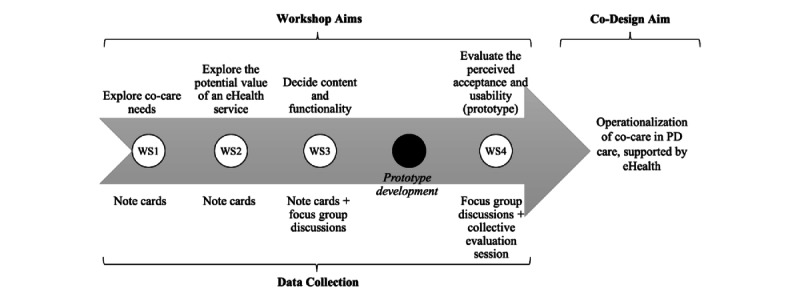
Principles of participatory design were used to enable the identification of co-care needs and design ideas, in a series of 4 half-day co-design workshops. The sample included 7 (4 women) PwP and 9 (4 women) HCPs, including 4 neurologists, 3 nurses, and 2 physiotherapists. The co-design process resulted in a functional prototype that was evaluated by the co-design participants in the last workshop. Data were collected through note cards produced by the participants during the first 3 workshops and focus group discussions during the 3rd and 4th workshops. The data were analyzed using qualitative thematic analysis. After the workshop series, the prototype was demonstrated at a Mini Fair for ongoing PD research and evaluated using a self-developed questionnaire with 37 respondents: 31 PwP (14 women) and 6 informal caregivers (3 women). Descriptive statistics are reported.

RESULTS

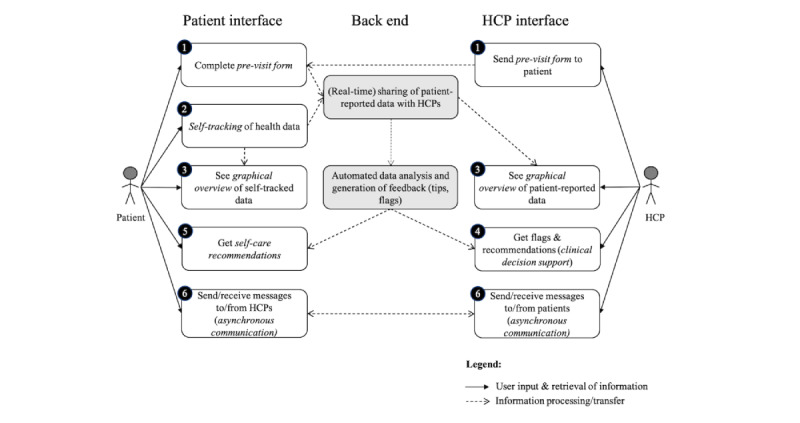
The qualitative analysis of data resulted in 2 main themes. The first theme, core eHealth functionalities and their expected values, describes 6 desired eHealth functionalities for supporting PD co-care between PwP and HCPs: (1) self-tracking, (2) previsit forms, (3) graphical visualization, (4) clinical decision support, (5) self-care recommendations, and (6) asynchronous communication. The second theme, individual and organizational constraints, describes constraints that need to be addressed to succeed with an eHealth service for co-care. Individual constraints include eHealth literacy and acceptance; organizational constraints include teamwork and administrative workload. The majority of the questionnaire respondents (31/37, 84%) perceived that they would benefit from an eHealth service similar to the demonstrated prototype. All prototype functionalities were rated as very important or important by the majority of respondents (ranging from 86% to 97% per functionality).

CONCLUSIONS

This study adds to our knowledge on how PD co-care could be operationalized. Co-care implies a shift from episodic routine-driven care to more flexible care management that is driven by the mutual needs of patients and HCPs and supported by active information exchange between them, as well as automated information processing to generate patient-specific advice. More research is needed to further explore the concept of co-care in chronic care management and what it means for self-care and health care.

INTERNATIONAL REGISTERED REPORT IDENTIFIER (IRRID): RR2-10.2196/11278.

摘要

背景

据预测,2005 年至 2030 年期间,全球帕金森病(PD)患者人数将增加一倍。慢性病管理需要患者和医疗保健专业人员(HCPs)之间积极协作和知识交流,以实现最佳健康结果,我们将其描述为共同护理。电子健康服务有可能支持 PD 患者(PwP)和 HCPs 之间共同护理的实现。

目的

本研究旨在探索如何通过电子健康支持来实现 PD 护理中的共同护理。更具体地说,本研究探讨了 PwP 和 HCP 实现共同护理的期望和所需的电子健康功能。

方法

采用参与式设计原则,在一系列 4 个为期半天的共同设计工作坊中确定共同护理需求和设计思路。样本包括 7 名(4 名女性)PwP 和 9 名(4 名女性)HCP,包括 4 名神经科医生、3 名护士和 2 名物理治疗师。共同设计过程产生了一个功能原型,在最后一个工作坊中由共同设计参与者进行了评估。数据通过参与者在前三轮工作坊中制作的笔记卡和第三轮和第四轮工作坊中的焦点小组讨论收集。数据使用定性主题分析进行分析。工作坊系列结束后,该原型在正在进行的 PD 研究的小型博览会上进行了展示,并使用自行开发的问卷对 37 名受访者(31 名 PwP(14 名女性)和 6 名非正式护理人员(3 名女性)进行了评估。报告描述性统计数据。

结果

数据的定性分析产生了 2 个主要主题。第一个主题是核心电子健康功能及其预期价值,描述了支持 PwP 和 HCP 之间 PD 共同护理的 6 项预期电子健康功能:(1)自我跟踪,(2)预访表格,(3)图形可视化,(4)临床决策支持,(5)自我护理建议和(6)异步通信。第二个主题是个人和组织约束,描述了成功实施电子健康共同护理服务所需解决的约束。个人约束包括电子健康素养和接受度;组织约束包括团队合作和行政工作量。大多数问卷受访者(31/37,84%)认为他们将受益于类似于演示原型的电子健康服务。大多数受访者(每个功能范围从 86%到 97%)都认为所有原型功能都非常重要或重要。

结论

本研究增加了我们对 PD 共同护理如何实施的认识。共同护理意味着从偶发性常规驱动的护理转变为更灵活的护理管理,这种管理由患者和 HCP 的共同需求驱动,并通过他们之间的积极信息交换以及自动化信息处理来生成患者特定的建议来支持。需要进一步研究来进一步探索慢性病管理中共同护理的概念,以及它对自我护理和医疗保健的意义。

国际注册报告标识符(IRRID):RR2-10.2196/11278。
https://cdn.ncbi.nlm.nih.gov/pmc/blobs/a362/7536604/5c0e263a85af/jmir_v22i9e19195_fig2.jpg
https://cdn.ncbi.nlm.nih.gov/pmc/blobs/a362/7536604/a2bb2f621634/jmir_v22i9e19195_fig1.jpg
https://cdn.ncbi.nlm.nih.gov/pmc/blobs/a362/7536604/5c0e263a85af/jmir_v22i9e19195_fig2.jpg
https://cdn.ncbi.nlm.nih.gov/pmc/blobs/a362/7536604/a2bb2f621634/jmir_v22i9e19195_fig1.jpg
https://cdn.ncbi.nlm.nih.gov/pmc/blobs/a362/7536604/5c0e263a85af/jmir_v22i9e19195_fig2.jpg

相似文献

1
How People with Parkinson's Disease and Health Care Professionals Wish to Partner in Care Using eHealth: Co-Design Study.帕金森病患者和医疗保健专业人员希望如何通过电子健康进行合作护理:共同设计研究。
J Med Internet Res. 2020 Sep 21;22(9):e19195. doi: 10.2196/19195.
2
Co-Designing an eHealth Service for the Co-Care of Parkinson Disease: Explorative Study of Values and Challenges.共同设计帕金森病共同照护的电子健康服务:价值观与挑战的探索性研究
JMIR Res Protoc. 2018 Oct 30;7(10):e11278. doi: 10.2196/11278.
3
Digital tools/eHealth to support CKD self-management: A qualitative study of perceptions, attitudes and needs of patients and health care professionals in China.数字工具/电子健康支持慢性肾脏病自我管理:对中国患者和医疗保健专业人员的认知、态度和需求的定性研究。
Int J Med Inform. 2022 Sep;165:104811. doi: 10.1016/j.ijmedinf.2022.104811. Epub 2022 Jun 10.
4
eHealth Technologies, Multimorbidity, and the Office Visit: Qualitative Interview Study on the Perspectives of Physicians and Nurses.电子健康技术、多重疾病与门诊诊疗:关于医生和护士观点的定性访谈研究
J Med Internet Res. 2018 Jan 26;20(1):e31. doi: 10.2196/jmir.8983.
5
Experiences and Factors Affecting Usage of an eHealth Tool for Self-Management Among People With Chronic Obstructive Pulmonary Disease: Qualitative Study.慢性阻塞性肺疾病患者使用电子健康工具进行自我管理的体验及影响因素:定性研究。
J Med Internet Res. 2021 Apr 30;23(4):e25672. doi: 10.2196/25672.
6
How mHealth can facilitate collaboration in diabetes care: qualitative analysis of co-design workshops.移动健康如何促进糖尿病护理中的协作:协同设计研讨会的定性分析
BMC Health Serv Res. 2020 Nov 30;20(1):1104. doi: 10.1186/s12913-020-05955-3.
7
Requirements for an Electronic Health Tool to Support the Process of Help Seeking by Caregivers of Functionally Impaired Older Adults: Co-Design Approach.支持功能受损老年人照顾者寻求帮助过程的电子健康工具要求:协同设计方法
JMIR Aging. 2019 Jun 7;2(1):e12327. doi: 10.2196/12327.
8
The Value of Including People with Dementia in the Co-Design of Personalized eHealth Technologies.将痴呆症患者纳入个性化电子健康技术共同设计的价值。
Dement Geriatr Cogn Disord. 2019;47(3):164-175. doi: 10.1159/000497804. Epub 2019 Jun 27.
9
Participatory Development of an Integrated, eHealth-Supported, Educational Care Pathway (Diabetes Box) for People With Type 2 Diabetes: Development and Usability Study.参与式开发一种综合的、电子健康支持的、针对 2 型糖尿病患者的教育护理路径(糖尿病盒):开发和可用性研究。
JMIR Hum Factors. 2024 May 31;11:e45055. doi: 10.2196/45055.
10
Identifying Persuasive Design Principles and Behavior Change Techniques Supporting End User Values and Needs in eHealth Interventions for Long-Term Weight Loss Maintenance: Qualitative Study.确定有说服力的设计原则和行为改变技术,以支持电子健康干预长期体重维持的最终用户的价值观和需求:定性研究。
J Med Internet Res. 2020 Nov 30;22(11):e22598. doi: 10.2196/22598.

引用本文的文献

1
Examining Challenges to Co-Design Digital Health Interventions With End Users: Systematic Review.审视与终端用户共同设计数字健康干预措施所面临的挑战:系统综述
J Med Internet Res. 2025 Mar 14;27:e50178. doi: 10.2196/50178.
2
Development of an eHealth Intervention Including Self-Management for Reducing Sedentary Time in the Transition to Retirement: Participatory Design Study.一项包括自我管理在内的电子健康干预措施的开发,旨在减少退休过渡阶段的久坐时间:参与式设计研究。
JMIR Form Res. 2025 Jan 20;9:e63567. doi: 10.2196/63567.
3
A Framework for the Human-Centered Design of Service Processes Enabled by Medical Devices: A Case Study of Wearable Devices for Parkinson's Disease.

本文引用的文献

1
Designing a mHealth clinical decision support system for Parkinson's disease: a theoretically grounded user needs approach.设计一个用于帕金森病的移动医疗临床决策支持系统:一种基于理论基础的用户需求方法。
BMC Med Inform Decis Mak. 2020 Feb 19;20(1):34. doi: 10.1186/s12911-020-1027-1.
2
Current State of Digital Biomarker Technologies for Real-Life, Home-Based Monitoring of Cognitive Function for Mild Cognitive Impairment to Mild Alzheimer Disease and Implications for Clinical Care: Systematic Review.用于轻度认知障碍至轻度阿尔茨海默病的现实生活、居家认知功能监测的数字生物标志物技术现状及对临床护理的影响:系统评价
J Med Internet Res. 2019 Aug 30;21(8):e12785. doi: 10.2196/12785.
3
医疗器械支持的以人为中心的服务流程设计框架:以帕金森病可穿戴设备为例。
Int J Environ Res Public Health. 2024 Oct 16;21(10):1367. doi: 10.3390/ijerph21101367.
4
Data Visualization Preferences in Remote Measurement Technology for Individuals Living With Depression, Epilepsy, and Multiple Sclerosis: Qualitative Study.远程测量技术中个体患有抑郁症、癫痫和多发性硬化症的数据可视化偏好:定性研究。
J Med Internet Res. 2024 Oct 18;26:e43954. doi: 10.2196/43954.
5
Digital Intervention Promoting Physical Activity in People Newly Diagnosed with Parkinson's Disease: Feasibility and Acceptability of the Knowledge, Exercise-Efficacy and Participation (KEEP) Intervention.数字干预促进新诊断帕金森病患者的身体活动:知识、运动效能和参与(KEEP)干预的可行性和可接受性。
J Parkinsons Dis. 2024;14(6):1193-1210. doi: 10.3233/JPD-240071.
6
[Chat messenger use in the care of patients with Parkinson's disease].[帕金森病患者护理中聊天信使的使用]
Nervenarzt. 2024 Aug;95(8):714-720. doi: 10.1007/s00115-024-01686-6. Epub 2024 Jul 22.
7
The Perspectives of Healthcare Professionals and Managers on Patient Involvement in Care Pathway Development: A Discourse Analysis.医疗保健专业人员和管理人员对患者参与护理路径制定的看法:话语分析。
Health Expect. 2024 Jun;27(3):e14101. doi: 10.1111/hex.14101.
8
Nurses' Roles in mHealth App Development: Scoping Review.护士在移动健康应用程序开发中的角色:范围综述
JMIR Nurs. 2023 Oct 17;6:e46058. doi: 10.2196/46058.
9
Co-Designing Digital Technologies for Improving Clinical Care in People with Parkinson's Disease: What Did We Learn?共同设计数字技术以改善帕金森病患者的临床护理:我们学到了什么?
Sensors (Basel). 2023 May 22;23(10):4957. doi: 10.3390/s23104957.
10
Successful implementation of technology in the management of Parkinson's disease: Barriers and facilitators.帕金森病管理中技术的成功应用:障碍与促进因素。
Clin Park Relat Disord. 2023 Feb 16;8:100188. doi: 10.1016/j.prdoa.2023.100188. eCollection 2023.
From Information Seekers to Innovators: Qualitative Analysis Describing Experiences of the Second Generation of E-Patients.
从信息寻求者到创新者:描述第二代电子患者经历的定性分析
J Med Internet Res. 2019 Aug 15;21(8):e13022. doi: 10.2196/13022.
4
Artificial intelligence for assisting diagnostics and assessment of Parkinson's disease-A review.用于辅助帕金森病诊断和评估的人工智能——综述
Clin Neurol Neurosurg. 2019 Sep;184:105442. doi: 10.1016/j.clineuro.2019.105442. Epub 2019 Jul 16.
5
New technologies, new disparities: The intersection of electronic health and digital health literacy.新技术,新差距:电子健康与数字健康素养的交集。
Int J Cardiol. 2019 Oct 1;292:280-282. doi: 10.1016/j.ijcard.2019.05.066. Epub 2019 May 28.
6
Improving patient-centred care for persons with Parkinson's: Qualitative interviews with care partners about their engagement in discussions of "off" periods.提高帕金森病患者的以患者为中心的护理:对护理伙伴关于他们参与讨论“关闭”期的定性访谈。
Health Expect. 2019 Jun;22(3):555-564. doi: 10.1111/hex.12884. Epub 2019 Apr 12.
7
A roadmap for implementation of patient-centered digital outcome measures in Parkinson's disease obtained using mobile health technologies.利用移动健康技术实施以患者为中心的帕金森病数字结局测量的路线图。
Mov Disord. 2019 May;34(5):657-663. doi: 10.1002/mds.27671. Epub 2019 Mar 22.
8
The Use and Effects of Electronic Health Tools for Patient Self-Monitoring and Reporting of Outcomes Following Medication Use: Systematic Review.电子健康工具在患者用药后自我监测及结果报告中的应用与效果:系统评价
J Med Internet Res. 2018 Dec 18;20(12):e294. doi: 10.2196/jmir.9284.
9
Co-Designing an eHealth Service for the Co-Care of Parkinson Disease: Explorative Study of Values and Challenges.共同设计帕金森病共同照护的电子健康服务:价值观与挑战的探索性研究
JMIR Res Protoc. 2018 Oct 30;7(10):e11278. doi: 10.2196/11278.
10
A survey on computer-assisted Parkinson's Disease diagnosis.计算机辅助帕金森病诊断研究综述。
Artif Intell Med. 2019 Apr;95:48-63. doi: 10.1016/j.artmed.2018.08.007. Epub 2018 Sep 7.