Department of Epidemiology and Biostatistics, Institute of Public Health, College of Medicine and Health Sciences, University of Gondar, Gondar, Ethiopia.
Ital J Pediatr. 2020 Sep 21;46(1):138. doi: 10.1186/s13052-020-00893-6.
Neonatal mortality remains a serious public health concern in developing countries including Ethiopia. Ethiopia is one of the countries with the highest neonatal mortality in Africa. However, there is limited evidence on the incidence and predictors of neonatal mortality at the national level. Therefore, this study aimed to investigate the incidence of neonatal mortality and its predictors among live births in Ethiopia. Investigating the incidence and predictors of neonatal mortality is essential to design targeted public health interventions to reduce neonatal mortality.
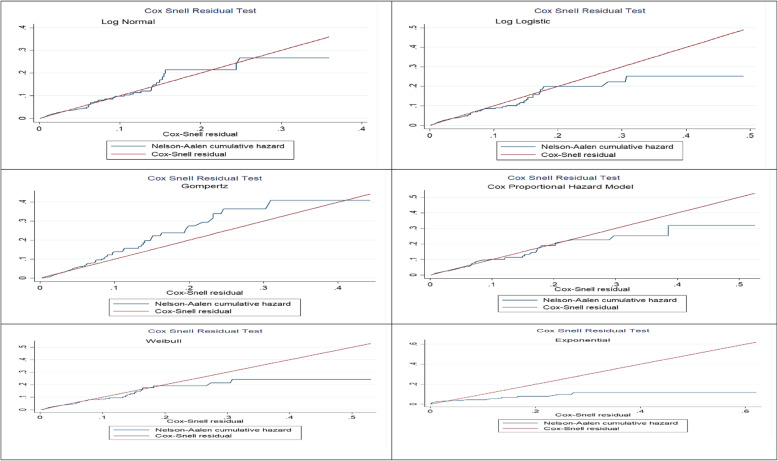
A secondary data analysis was conducted based on the 2016 Ethiopian Demographic and Health Survey (EDHS) data. A total weighted sample of 11,022 live births was included in the analysis. The shared frailty model was applied since the EDHS data has hierarchical nature, and neonates are nested within-cluster, and this could violate the independent and equal variance assumption. For checking the proportional hazard assumption, Schoenfeld residual test was applied. Akakie Information Criteria (AIC), Cox-Snell residual test, and deviance were used for checking model adequacy and for model comparison. Gompertz gamma shared frailty model was the best-fitted model for this data since it had the lowest deviance, AIC value, and the Cox-Snell residual graph closet to the bisector. Variables with a p-value of less than 0.2 were considered for the multivariable Gompertz gamma shared frailty model. In the multivariable Gompertez gamma shared frailty model, the Adjusted Hazard Ratio (AHR) with a 95% confidence interval (CI) was reported to identify significant predictors of neonatal mortality.
Overall, the neonatal mortality rate in Ethiopia was 29.1 (95% CI: 26.1, 32.4) per 1000 live births. In the multivariable Gompertz gamma shared frailty model; male sex (AHR = 1.92, 95% CI: 1.52, 2.43), twin birth (AHR = 5.22, 95% CI: 3.62, 7.53), preceding birth interval less than 18 months (AHR = 2.07, 95% CI: 1.51, 2.85), small size at birth (AHR = 1.64, 95% CI: 1.24, 2.16), large size at birth (AHR = 1.53, 95% CI: 1.16, 2.01) and did not have Antenatal Care (ANC) visit (AHR = 2.10, 95% CI: 1.44, 3.06) were the significant predictors of neonatal mortality.
Our study found that neonatal mortality remains a public health problem in Ethiopia. Shorter birth interval, small and large size at birth, ANC visits, male sex, and twin births were significant predictors of neonatal mortality. These results suggest that public health programs that increase antenatal care service utilization should be designed to reduce neonatal mortality and special attention should be given for twin births, large and low birth weight babies. Besides, providing family planning services for mothers to increase birth intervals and improving accessibility and utilization of maternal health care services such as ANC is crucial to improve neonatal survival.
新生儿死亡率仍然是发展中国家(包括埃塞俄比亚)严重的公共卫生问题。埃塞俄比亚是非洲新生儿死亡率最高的国家之一。然而,关于国家层面新生儿死亡率的发生率和预测因素的证据有限。因此,本研究旨在调查埃塞俄比亚活产儿的新生儿死亡率及其预测因素。调查新生儿死亡率的发生率和预测因素对于设计有针对性的公共卫生干预措施以降低新生儿死亡率至关重要。
基于 2016 年埃塞俄比亚人口与健康调查(EDHS)数据进行二次数据分析。在分析中包括了总计 11022 例活产儿的加权样本。由于 EDHS 数据具有层次结构,且新生儿嵌套在簇内,这可能违反独立性和平等方差假设,因此应用了共享脆弱性模型。为了检查比例风险假设,应用了 Schoenfeld 残差检验。Akaike 信息准则(AIC)、Cox-Snell 残差检验和离差用于检查模型充分性和进行模型比较。由于 Gompertz 伽马共享脆弱性模型具有最低的离差、AIC 值和最接近等分线的 Cox-Snell 残差图,因此是该数据的最佳拟合模型。具有 p 值小于 0.2 的变量被认为是多变量 Gompertz 伽马共享脆弱性模型的候选变量。在多变量 Gompertez 伽马共享脆弱性模型中,报告了调整后的危险比(AHR)及其 95%置信区间(CI),以确定新生儿死亡率的显著预测因素。
总体而言,埃塞俄比亚的新生儿死亡率为每 1000 例活产儿 29.1(95%CI:26.1,32.4)。在多变量 Gompertz 伽马共享脆弱性模型中;男性(AHR=1.92,95%CI:1.52,2.43)、双胞胎出生(AHR=5.22,95%CI:3.62,7.53)、出生间隔小于 18 个月(AHR=2.07,95%CI:1.51,2.85)、出生体重小(AHR=1.64,95%CI:1.24,2.16)、出生体重大(AHR=1.53,95%CI:1.16,2.01)和未接受产前护理(ANC)就诊(AHR=2.10,95%CI:1.44,3.06)是新生儿死亡率的显著预测因素。
我们的研究发现,新生儿死亡率仍然是埃塞俄比亚的一个公共卫生问题。较短的出生间隔、较小和较大的出生体重、ANC 就诊、男性和双胞胎出生是新生儿死亡率的显著预测因素。这些结果表明,应设计增加产前保健服务利用率的公共卫生计划,以降低新生儿死亡率,并特别关注双胞胎出生、大体重和低体重婴儿。此外,为母亲提供计划生育服务以增加生育间隔,并改善获得和利用孕产妇保健服务(如 ANC),对于提高新生儿生存至关重要。
