Tesema Getayeneh Antehunegn, Teshale Achamyeleh Birhanu, Tessema Zemenu Tadesse
Department of Epidemiology and Biostatistics, institute of public health, College of medicine and health science, University of Gondar, Gondar, Ethiopia.
Arch Public Health. 2021 Nov 12;79(1):196. doi: 10.1186/s13690-021-00727-9.
In 2017, an estimated 5.3 million under-five children died annually in Sub-Saharan African countries, more than half of those deaths occurred in East Africa. Though East African countries share the huge burden of global under-five mortality, there is limited evidence on the incidence and predictors of under-five mortality. Therefore, this study investigated the incidence and predictors of under-five mortality in East Africa.
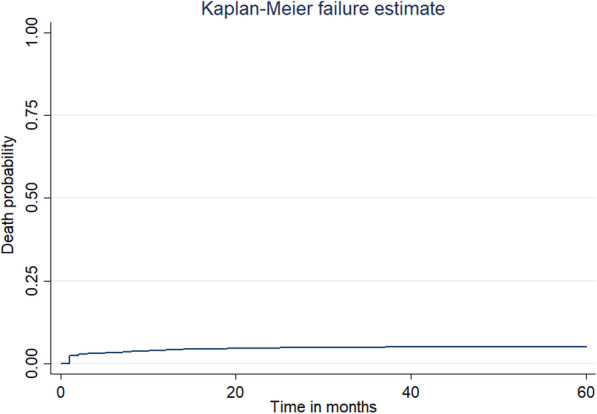
A community-based cross-sectional study was done based on the Demographic and Health Survey (DHS) data of 12 East African countries conducted from 2008 to 2019. A total weighted sample of 138,803 live births within 5 years preceding the survey were included for analysis. The Kaplan-Meier curve and Log-rank test were done to assess the children's survival experience across variable categories. The Global Schoenfeld residual test was employed for checking Proportional Hazard (PH) assumptions and it was violated (p-value< 0.05). Considering the hierarchical nature of DHS data, multilevel parametric survival models were fitted. Model comparison was made by AIC, deviance, and shape of the hazard function. Variables with a p-value of less than 0.2 in the bi-variable analysis were considered for the multivariable analysis. In the multilevel Weibull regression analysis, the Adjusted Hazard Ratio (AHR) with 95% Confidence Interval (CI) was reported to declare the significant predictors of under-five mortality.
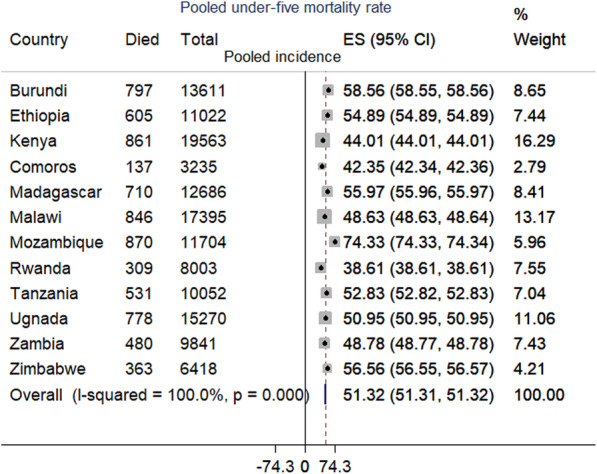
Under-five mortality rate in East Africa was 51.318 (95% CI: 51.311, 51.323) per 1000 live births. Babies born to mothers attained secondary education and above (AHR = 0.83, 95% CI: 0.75, 0.91), being 2nd - 4th birth order (AHR = 0.62, 95% CI: 0.56, 0.67), ≥ 5th birth order (AHR = 0.68, 95% CI: 0.61, 0.76), health facility delivery (AHR = 0.87, 95% CI: 0.82, 0.93), 1-3 ANC visit (AHR = 0.61, 95% CI: 0.54, 0.68), births interval of 24-48 months (AHR = 0.53, 95% CI: 0.50, 0.57), wanted pregnancy (AHR = 0.72, 95% CI: 0.68, 0.76), middle wealth status (AHR = 0.90, 95% CI: 0.83, 0.97), and richest wealth status (AHR = 0.81, 95% CI:0.73, 0.90) were significantly associated with lower hazards of under-five mortality. Whereas, advanced maternal age (≥35 years) (AHR = 1.13, 95% CI: 1.04, 1.24),, babies born to household who did not have media exposure (AHR = 1.13, 95% CI: 1.07, 1.20), twin births (AHR = 3.81, 95% CI: 3.52, 4.12), being male child (AHR = 1.27, 95%CI: 1.21, 1.33), small birth size at birth (AHR = 1.73, 95% CI: 1.63, 1.84), and large size at birth (AHR = 1.11, 95% CI: 1.04, 1.11) were significantly associated with higher hazards of under-five mortality.
Under-five mortality is a major public health concern in East African countries. Health facility delivery, ANC visit, higher wealth status, adequate birth spacing, wanted pregnancy, and maternal education were significantly correlated with a lower risk of under-5 mortality. Whereas, higher birth order, small or large size at birth, male birth, twin birth, advanced maternal age and mothers who didn't have media exposure were significantly correlated with a higher risk of under-five mortality. This study highlights that public health programs should enhance health facility delivery, ANC visit, media exposure, maternal education, and adequate birth spacing to decrease the incidence of under-five mortality in East Africa.
2017年,撒哈拉以南非洲国家估计每年有530万5岁以下儿童死亡,其中一半以上的死亡发生在东非。尽管东非国家承担着全球5岁以下儿童死亡的巨大负担,但关于5岁以下儿童死亡率的发病率和预测因素的证据有限。因此,本研究调查了东非5岁以下儿童死亡率的发病率和预测因素。
基于2008年至2019年对12个东非国家进行的人口与健康调查(DHS)数据开展了一项基于社区的横断面研究。纳入调查前5年内138,803例活产的加权样本进行分析。采用Kaplan-Meier曲线和对数秩检验评估不同类别变量下儿童的生存情况。采用全局Schoenfeld残差检验来检验比例风险(PH)假设,该假设被违反(p值<0.05)。考虑到DHS数据的分层性质,拟合了多级参数生存模型。通过AIC、偏差和风险函数形状进行模型比较。在双变量分析中p值小于0.2的变量纳入多变量分析。在多级Weibull回归分析中,报告了调整风险比(AHR)及95%置信区间(CI),以确定5岁以下儿童死亡率的显著预测因素。
东非5岁以下儿童死亡率为每1000例活产51.318例(95%CI:51.311,51.323)。母亲接受过中等及以上教育的婴儿(AHR = 0.83,95%CI:0.75,0.91)、第二至第四胎次(AHR = 0.62,95%CI:0.56,0.67)、第五胎次及以上(AHR = 0.68,95%CI:0.61,0.76)、在医疗机构分娩(AHR = 0.87,95%CI:0.82,0.93)、产前检查1 - 3次(AHR = 0.61,95%CI:0.54,0.68)、生育间隔24 - 48个月(AHR = 0.53,95%CI:0.50,0.57)、意愿妊娠(AHR = 0.72,95%CI:0.68,0.76)、中等财富状况(AHR = 0.90,95%CI:0.83,0.97)和最富有财富状况(AHR = 0.81,95%CI:0.73,0.90)与5岁以下儿童死亡风险较低显著相关。而高龄产妇(≥35岁)(AHR = 1.13,95%CI:1.04,1.24)、家庭没有媒体接触的婴儿(AHR = 1.13,95%CI:1.07,1.20)、双胞胎(AHR = 3.81,95%CI:3.52,4.12)、男性婴儿(AHR = 1.27,95%CI:1.21,1.33)、出生时体型小(AHR = 1.73,95%CI:1.63,1.84)和出生时体型大(AHR = 1.11,95%CI:1.04,1.18)与5岁以下儿童死亡风险较高显著相关。
5岁以下儿童死亡是东非国家主要的公共卫生问题。在医疗机构分娩、产前检查、较高的财富状况、适当的生育间隔、意愿妊娠和母亲教育与5岁以下儿童死亡风险较低显著相关。而较高的胎次、出生时体型小或大、男性出生、双胞胎出生、高龄产妇和没有媒体接触的母亲与5岁以下儿童死亡风险较高显著相关。本研究强调,公共卫生项目应加强医疗机构分娩、产前检查、媒体接触、母亲教育和适当的生育间隔,以降低东非5岁以下儿童死亡率。