Jiangxi Institute of Respiratory Disease, The First Affiliated Hospital of Nanchang University, Nanchang, Jiangxi, China.
Department of Clinical laboratory, The First Affiliated Hospital of Nanchang University, Nanchang, Jiangxi, China.
Immunol Res. 2020 Dec;68(6):398-404. doi: 10.1007/s12026-020-09156-2. Epub 2020 Sep 28.
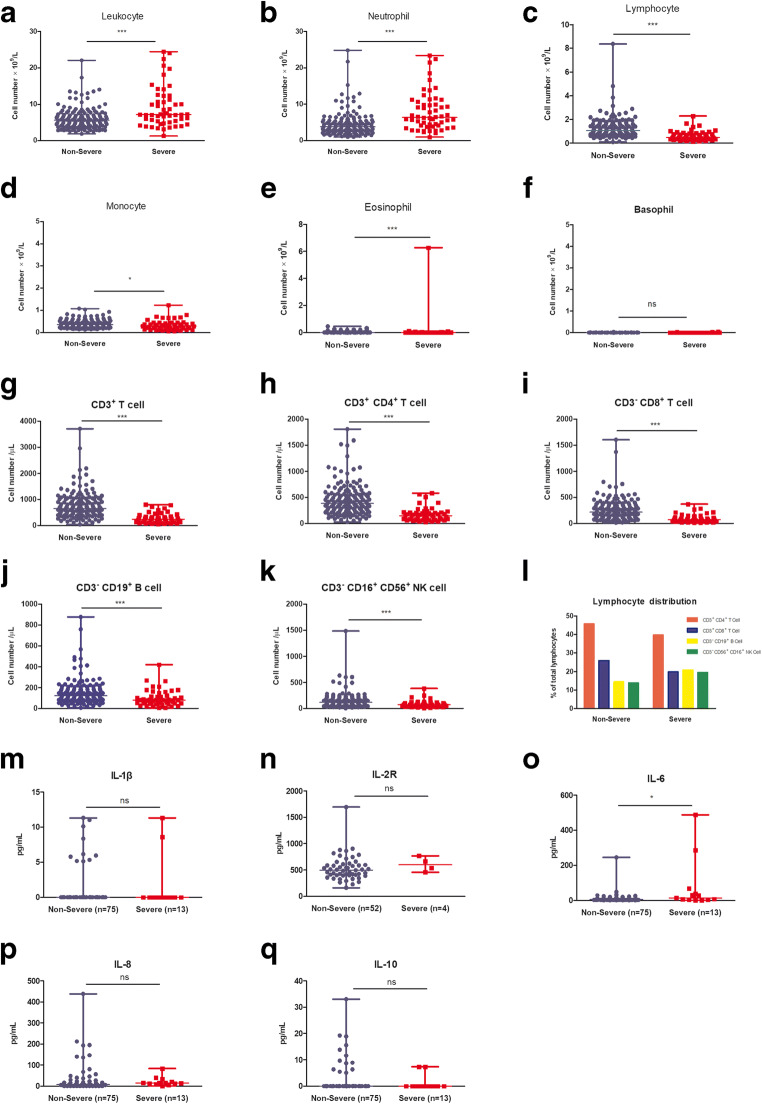
This single-center, retrospective study aimed to explore the immune characteristics of COVID-19 and biomarkers to predict the severity of this disease. Patients infected with SARS-CoV-2 (n = 215) treated at the First Affiliated Hospital of Nanchang University from January 24 to March 12, 2020, were included in the study and classified into severe and non-severe groups. Peripheral immunocyte count and cytokine statuses were compared. The correlation between immune status, cytokine levels, and disease severity was analyzed. Leukocyte numbers were normal in both groups; however, they were relatively high (7.19 × 10/L) in patients of the severe group. Leukocyte distributions differed between the two groups; the severe group had a higher percentage of neutrophils and lower percentage of lymphocytes compared with the non-severe group, and absolute lymphocyte numbers were below normal in both groups, and particularly deficient in patients in the severe group. Lymphocyte counts have negative correlation with duration of hospital period whereas neutrophil count has no significant correlation with it. Of tested cytokines, IL-6 levels were significantly higher in the severe group (P = 0.0418). Low level of lymphocyte predicts severity of COVID-19. IL-6 levels were significantly higher in the severe group, especially in some extremely severe patients. But we did not detect the significant correlation between severity of COVID-19 with IL-6 level which may be due to limited case numbers. Our observations encourage future research to understand the underlying molecular mechanisms and to improve treatment outcome of COVID-19.
本单中心回顾性研究旨在探索 COVID-19 的免疫特征和预测疾病严重程度的生物标志物。纳入 2020 年 1 月 24 日至 3 月 12 日南昌大学第一附属医院收治的 215 例 SARS-CoV-2 感染患者,分为重症和非重症组。比较外周免疫细胞计数和细胞因子状态。分析免疫状态、细胞因子水平与疾病严重程度的相关性。两组白细胞计数均正常;然而,重症组白细胞计数相对较高(7.19×10/L)。两组白细胞分布不同;重症组中性粒细胞比例较高,淋巴细胞比例较低,两组绝对淋巴细胞计数均低于正常,重症组尤为明显。淋巴细胞计数与住院时间呈负相关,而中性粒细胞计数与住院时间无显著相关性。在检测的细胞因子中,重症组 IL-6 水平显著升高(P=0.0418)。淋巴细胞计数低预示 COVID-19 严重程度。重症组 IL-6 水平显著升高,尤其是部分极重症患者。但我们未检测到 COVID-19 严重程度与 IL-6 水平之间的显著相关性,这可能是由于病例数有限。我们的观察结果鼓励未来的研究以了解潜在的分子机制并改善 COVID-19 的治疗效果。