Conti Sara, Ferrara Pietro, Mazzaglia Giampiero, D'Orso Marco I, Ciampichini Roberta, Fornari Carla, Madotto Fabiana, Magoni Michele, Sampietro Giuseppe, Silenzi Andrea, Sileo Claudio V, Zucchi Alberto, Cesana Giancarlo, Manzoli Lamberto, Mantovani Lorenzo G
Center for Public Health Research, University of Milano - Bicocca, Monza, Italy.
Health Protection Agency of Bergamo (ATS Bergamo), Bergamo, Italy.
ERJ Open Res. 2020 Sep 28;6(3). doi: 10.1183/23120541.00458-2020. eCollection 2020 Jul.
The real impact of severe acute respiratory syndrome coronavirus 2 (SARS-CoV-2) on overall mortality remains uncertain as surveillance reports have attributed a limited number of deaths to novel coronavirus disease 2019 (COVID-19) during the outbreak. The aim of this study was to assess the excess mortality during the COVID-19 outbreak in highly impacted areas of northern Italy.
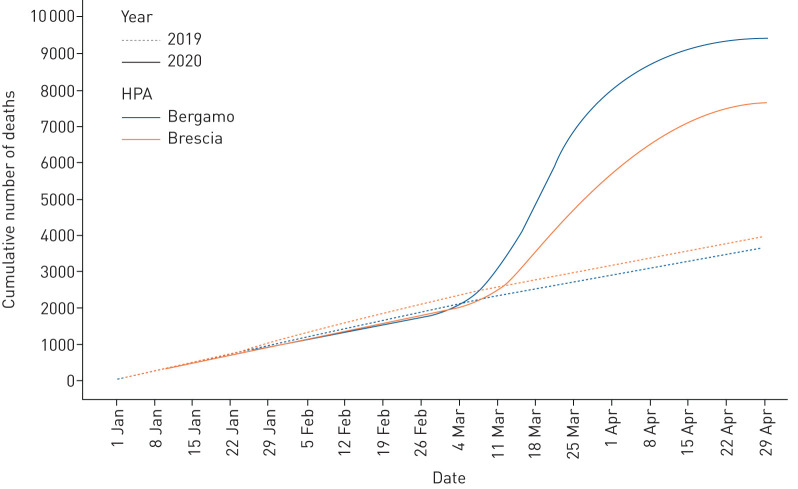
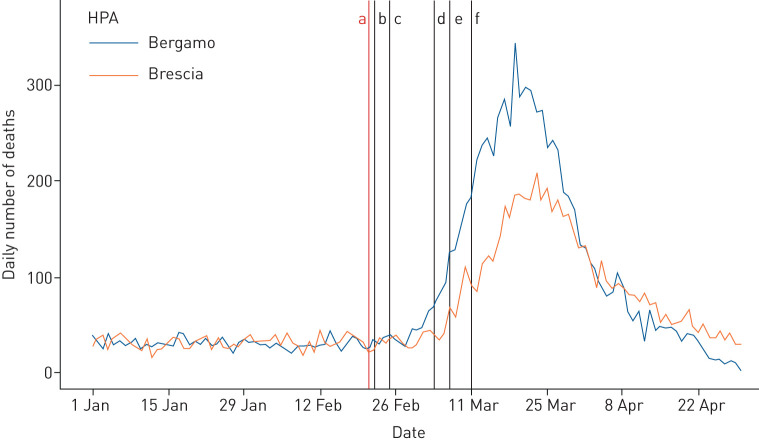
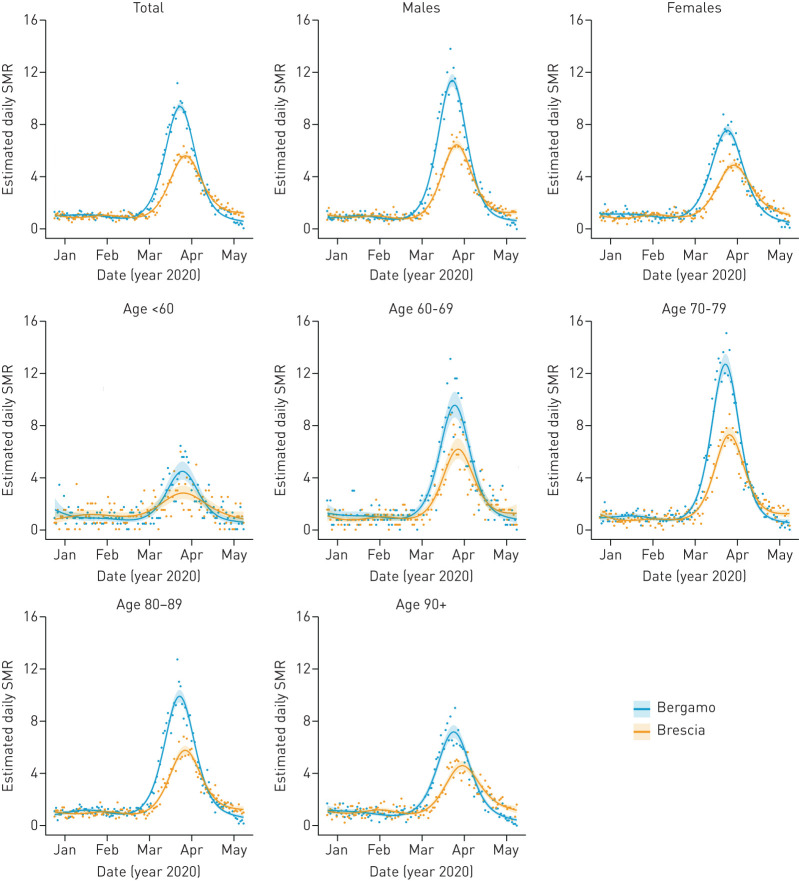
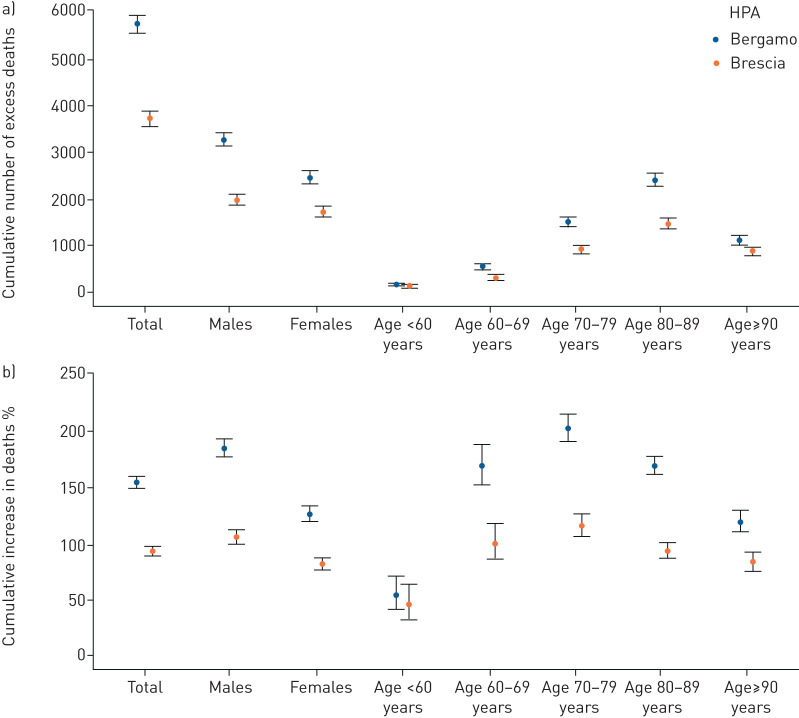
We analysed data on deaths that occurred in the first 4 months of 2020 provided by the health protection agencies (HPAs) of Bergamo and Brescia (Lombardy), building a time-series of daily number of deaths and predicting the daily standardised mortality ratio (SMR) and cumulative number of excess deaths through a Poisson generalised additive model of the observed counts in 2020, using 2019 data as a reference.
We estimated that there were 5740 (95% credible set (CS) 5552-5936) excess deaths in the HPA of Bergamo and 3703 (95% CS 3535-3877) in Brescia, corresponding to a 2.55-fold (95% CS 2.50-2.61) and 1.93 (95% CS 1.89-1.98) increase in the number of deaths. The excess death wave started a few days later in Brescia, but the daily estimated SMR peaked at the end of March in both HPAs, roughly 2 weeks after the introduction of lockdown measures, with significantly higher estimates in Bergamo (9.4, 95% CI 9.1-9.7).
Excess mortality was significantly higher than that officially attributed to COVID-19, disclosing its hidden burden likely due to indirect effects on the health system. Time-series analyses highlighted the impact of lockdown restrictions, with a lower excess mortality in the HPA where there was a smaller delay between the epidemic outbreak and their enforcement.
严重急性呼吸综合征冠状病毒2(SARS-CoV-2)对总体死亡率的实际影响仍不确定,因为在疫情爆发期间,监测报告将有限数量的死亡归因于2019年新型冠状病毒病(COVID-19)。本研究的目的是评估意大利北部受影响严重地区在COVID-19疫情期间的超额死亡率。
我们分析了贝加莫和布雷西亚(伦巴第)的卫生保护机构(HPA)提供的2020年前4个月的死亡数据,构建了每日死亡人数的时间序列,并通过2020年观察计数的泊松广义相加模型预测每日标准化死亡率(SMR)和超额死亡累计数,以2019年数据作为参考。
我们估计,贝加莫的HPA有5740例(95%可信区间(CS)5552 - 5936)超额死亡,布雷西亚有3703例(95% CS 3535 - 3877),死亡人数分别增加了2.55倍(95% CS 2.50 - 2.61)和1.93倍(95% CS 1.89 - 1.98)。布雷西亚的超额死亡浪潮在几天后开始,但两个HPA的每日估计SMR在3月底达到峰值,大约在实施封锁措施两周后,贝加莫的估计值显著更高(9.4,95% CI 9.1 - 9.7)。
超额死亡率显著高于官方归因于COVID-19的死亡率,揭示了其可能因对卫生系统的间接影响而产生的隐藏负担。时间序列分析突出了封锁限制的影响,在疫情爆发与其实施之间延迟较小的HPA中,超额死亡率较低。