Zhao Mingwei, Tang Kai, Liu Fengsheng, Zhou Weidong, Fan Jun, Yan Guangxuan, Qin Shibing, Pang Yu
Department of Orthopedics, Qingdao Chest Hospital, Qingdao, China.
Department of Orthopedics, Beijing Chest Hospital, Capital Medical University, Beijing Tuberculosis and Thoracic Tumor Research Institute, Beijing, China.
Front Microbiol. 2020 Sep 15;11:2034. doi: 10.3389/fmicb.2020.02034. eCollection 2020.
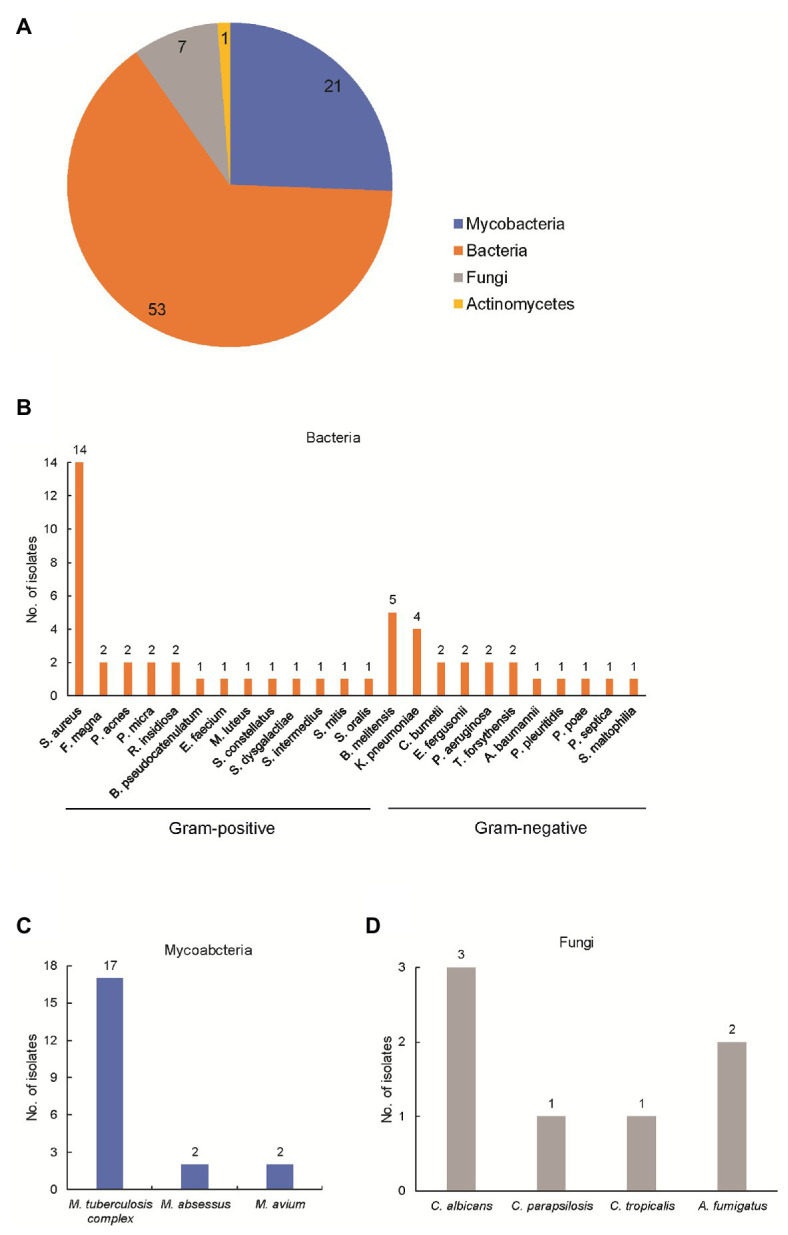
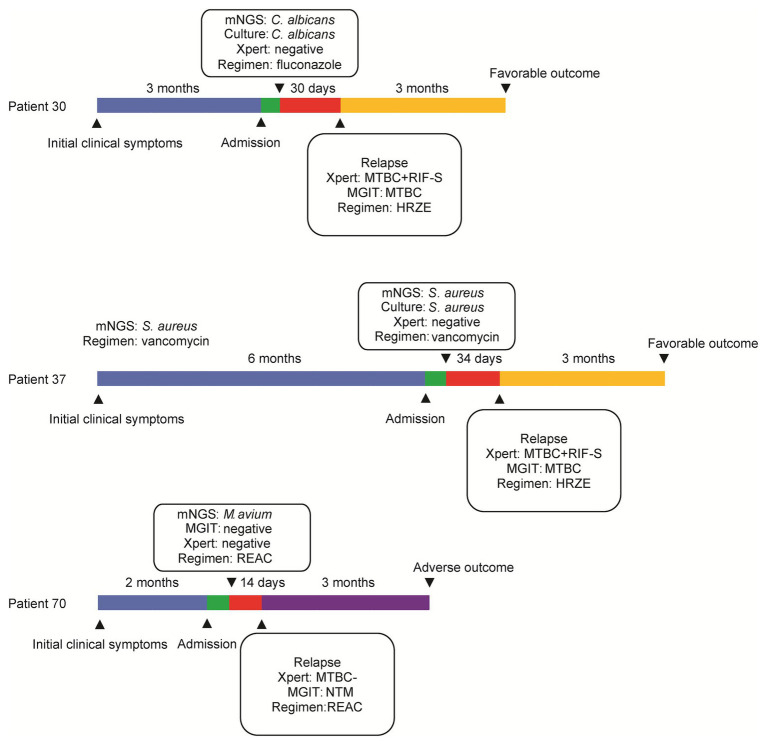
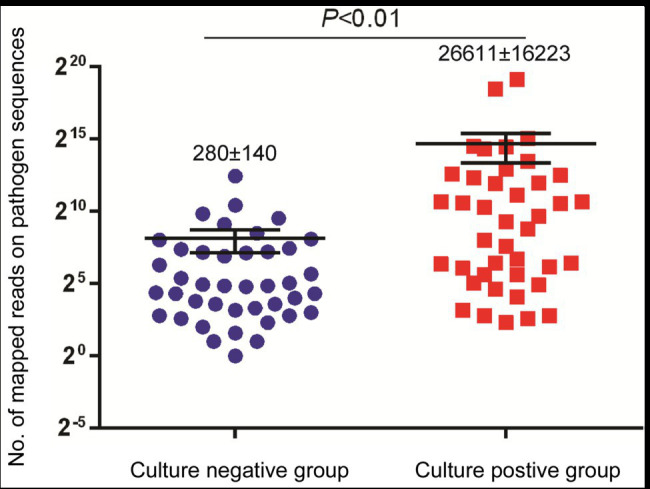
: We conducted this retrospective study to reveal the accuracy of metagenomic next-generation sequencing (mNGS) for diagnosing osteoarticular infections from fresh abscess specimens obtained from patients in an HIV-naive population. : We retrospectively analyzed hospital records at three participating TB-specialized hospitals for patients admitted with suggestive diagnoses of osteoarticular tuberculosis between January 2018 and August 2019. Abscess specimens obtained from each patient were tested pathogen culture, GeneXpert (MTB)/rifampicin (RIF), and mNGS assay. : A total of 82 abscess samples were collected from patients with osteoarticular infections, including 53 cases with (64.6%) bacterial, 21 (25.6%) with mycobacterial, 7 (8.5%) with fungal, and 1 (1.2%) with actinomycetal organisms detected. Analysis of mNGS assay results identified potential pathogens in all cases, with complex (MTBC) most frequently isolated, followed by and . Conventional culture testing identified causative pathogens in only 48.4% of samples, a significantly lower rate than the mNGS pathogen identification rate (100%, < 0.01). Culture-positive group specimens yielded significantly greater numbers of sequence reads than did culture-negative group specimens ( < 0.01). Of patients receiving surgical interventions and mNGS-guided treatment, 76 (92.7%) experienced favorable outcomes by the time of follow-up assessment at 3 months post-treatment. Notably, MTBC detection in two patients experiencing treatment failure suggests that they had mixed infections with MTBC and other pathogens. : Results presented here demonstrate that mNGS has a greater pathogen detection rate in osteoarticular infections than conventional culture-based methods.
我们开展了这项回顾性研究,以揭示宏基因组下一代测序(mNGS)从初治HIV人群患者新鲜脓肿标本中诊断骨关节炎感染的准确性。我们回顾性分析了三家参与研究的结核病专科医院在2018年1月至2019年8月期间收治的疑似骨结核患者的医院记录。对每位患者获取的脓肿标本进行病原体培养、GeneXpert(MTB)/利福平(RIF)检测和mNGS检测。共收集了82份骨关节炎感染患者的脓肿样本,其中检测到细菌感染53例(64.6%)、分枝杆菌感染21例(25.6%)、真菌感染7例(8.5%)、放线菌感染1例(1.2%)。mNGS检测结果分析在所有病例中均鉴定出潜在病原体,其中最常分离出的是复合群结核分枝杆菌(MTBC),其次是……。传统培养检测仅在48.4%的样本中鉴定出致病病原体,显著低于mNGS病原体鉴定率(100%,P<0.01)。培养阳性组标本产生的序列读数明显多于培养阴性组标本(P<0.01)。在接受手术干预和mNGS指导治疗的患者中,76例(92.7%)在治疗后3个月的随访评估时预后良好。值得注意的是,两名治疗失败患者中检测到MTBC,提示他们存在MTBC与其他病原体的混合感染。此处呈现的结果表明,mNGS在骨关节炎感染中的病原体检测率高于传统的基于培养的方法。