Sadiq Mohammad Ali, Hassan Muhammad, Afridi Rubbia, Halim Muhammad Sohail, Do Diana V, Sepah Yasir J, Nguyen Quan Dong
Department of Ophthalmology, University of Louisville, Louisville, KY USA.
Spencer Center for Vision Research, Byers Eye Institute, Stanford University, 2370 Watson Court, Suite 200, Palo Alto, CA 94303 USA.
Int J Retina Vitreous. 2020 Oct 6;6:47. doi: 10.1186/s40942-020-00245-w. eCollection 2020.
Although fluorescein angiography (FA) is a frequently used imaging modality in patients with non-infectious uveitis (NIU), it has not been reliably used for objective assessment of posterior segment inflammatory outcomes in these patients. In this index study we report the posterior segment inflammatory outcomes of two different doses of intravenous (IV) infusions of tocilizumab (TCZ), an IL-6 inhibitor, in eyes with NIU using a semi-quantitative FA scoring system.
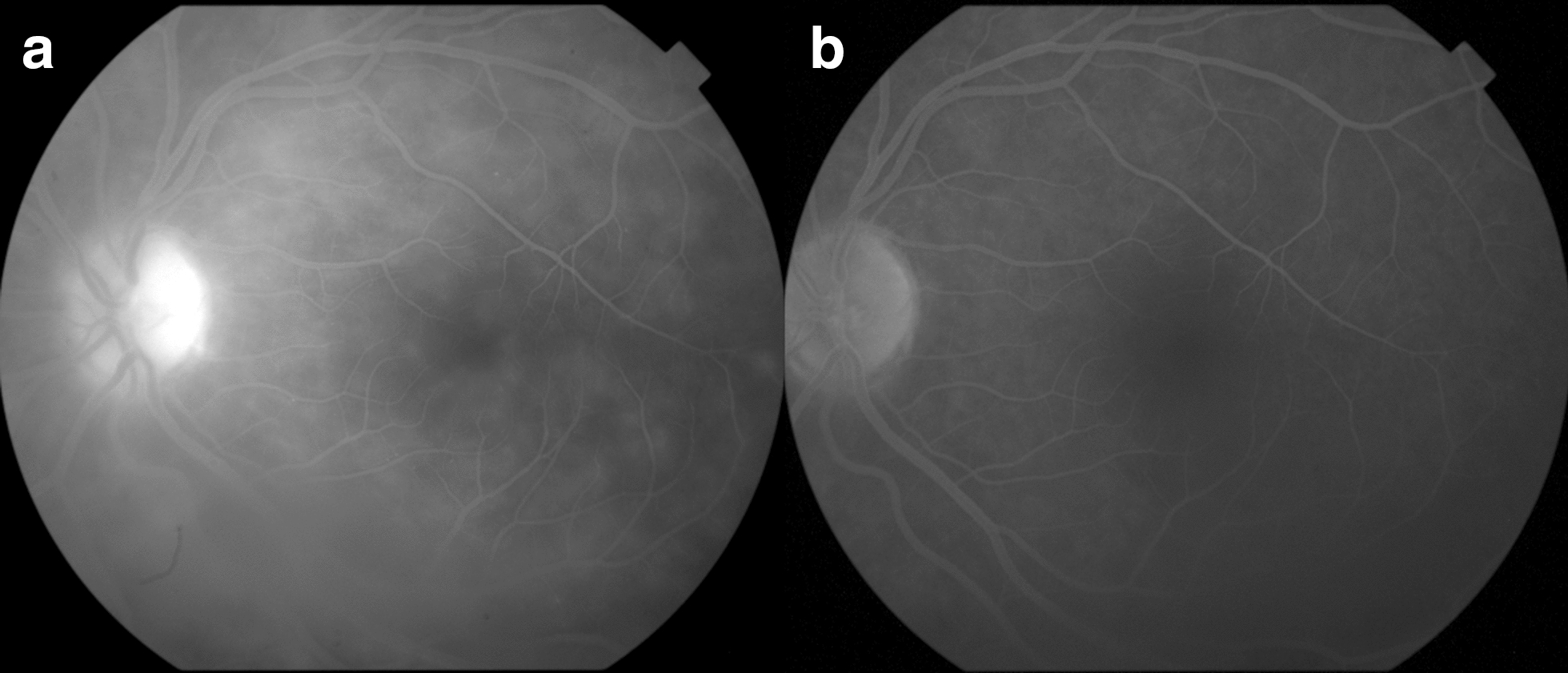
STOP-Uveitis is a randomized, multi-center clinical trial conducted at 5 clinical centers across the United States. The study evaluated the role of TCZ in patients with NIU. Thirty-seven (37) patients with NIU were randomized into one of two treatment groups in a ratio of 1:1. Group 1 received IV infusions of 4 mg/kg TCZ and group 2 received IV infusions of 8 mg/kg TCZ. Infusions were given every 4 weeks in both groups until month 6 (primary endpoint). Posterior segment inflammatory outcomes were assessed by evaluating FA at baseline and month 6 by graders at a central reading center. A previously reported, semi-quantitative, scoring system for FA was used to assess signs that represent ongoing inflammatory processes in the posterior segment. These signs included optic disc hyperfluorescence, macular edema, retinal vascular staining and/or leakage, capillary leakage, retinal capillary nonperfusion, neovascularization of the optic disc, neovascularization elsewhere, pinpoint leaks, and retinal staining and/or subretinal pooling. Statistical significance was set at p < 0.05. Main outcome measures included change in posterior segment inflammation as assessed using FA at month 6.
37 eyes (37 patients) were randomized in the STOP-Uveitis study. 30 eyes were found to be eligible for this sub-study based on study criteria. Seven eyes had ungradable images at either baseline or month 6 and were therefore excluded from the analysis. The reduction in FA inflammatory scores at month 6 were statistically significant in both groups (p < 0.05). The difference between the two groups was not significant (p = 0.351).
IV infusions of tocilizumab (both 4 and 8 mg/kg) are effective in improving posterior segment inflammation in eyes with NIU. A semi-quantitative FA scoring system may be used as a reliable outcome measure for assessment of posterior segment inflammation.ClinicalTrials.gov Identifier: NCT01717170.
尽管荧光素血管造影(FA)是用于非感染性葡萄膜炎(NIU)患者的常用成像方式,但它尚未可靠地用于客观评估这些患者的后段炎症结果。在本指标研究中,我们使用半定量FA评分系统报告了两种不同剂量的静脉注射(IV)托珠单抗(TCZ,一种IL-6抑制剂)在NIU患者眼中的后段炎症结果。
STOP-Uveitis是在美国5个临床中心进行的一项随机、多中心临床试验。该研究评估了TCZ在NIU患者中的作用。37例NIU患者按1:1的比例随机分为两个治疗组之一。第1组接受4mg/kg TCZ的静脉输注,第2组接受8mg/kg TCZ的静脉输注。两组均每4周输注一次,直至第6个月(主要终点)。在基线和第6个月时,由中央阅读中心的评分者通过评估FA来评估后段炎症结果。使用先前报道的FA半定量评分系统来评估代表后段持续炎症过程的体征。这些体征包括视盘高荧光、黄斑水肿、视网膜血管染色和/或渗漏、毛细血管渗漏、视网膜毛细血管无灌注、视盘新生血管、其他部位新生血管、点状渗漏以及视网膜染色和/或视网膜下积液。统计学显著性设定为p<0.05。主要结局指标包括在第6个月时使用FA评估的后段炎症变化。
37只眼(37例患者)被纳入STOP-Uveitis研究。根据研究标准,30只眼被认为符合本亚研究的条件。7只眼在基线或第6个月时有无法分级的图像,因此被排除在分析之外。两组在第6个月时FA炎症评分的降低均具有统计学显著性(p<0.05)。两组之间的差异不显著(p=0.351)。
静脉输注托珠单抗(4mg/kg和8mg/kg)均能有效改善NIU患者眼中的后段炎症。半定量FA评分系统可作为评估后段炎症的可靠结局指标。ClinicalTrials.gov标识符:NCT01717170。