Department of Psychiatry, Fatemi Hospital, School of Medicine, Ardabil University of Medical Sciences, Ardabil, Iran.
Department of Scienze Cognitive della Formazione e degli Studi Culturali, University of Messina, Messina, Italy.
BMC Psychiatry. 2020 Oct 12;20(1):502. doi: 10.1186/s12888-020-02887-4.
Attention-deficit hyperactivity disorder (ADHD) is a major neurodevelopmental disorder with heterogeneous symptoms, subtypes, and cognitive deficits. Cognitive deficits are central to ADHD pathophysiology and one potential source of heterogeneity in ADHD. Subtype-specific cognitive correlates are not, however, well-studied. We explored cognitive correlates of ADHD subtypes based on the Wechsler Intelligence Scale for Children (WISC-IV) scores. We also assessed subtype-specific self-esteem rating in ADHD subtypes and explored its association with cognitive correlates.
One hundred thirty-nine children with ADHD (80.6% boy, 19.4% girl) were categorized into the predominantly "hyperactive (ADHD-H)", "inattentive (ADHD-I)" and "combined (ADHD-C)" subtype based on their symptoms and scores on the Kiddie Schedule for Affective Disorders and Schizophrenia (K-SADS-PL) and Conners Parent-Rating Scale (CPRS-RS). They were then individually administrated the WISC-IV and completed a self-esteem inventory. Group differences in the WISC-IV indices and their predictability in discriminating ADHD subtypes were analyzed.
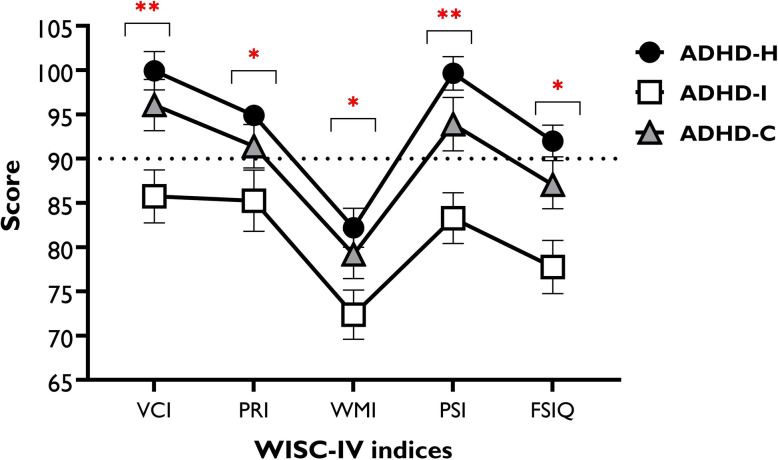
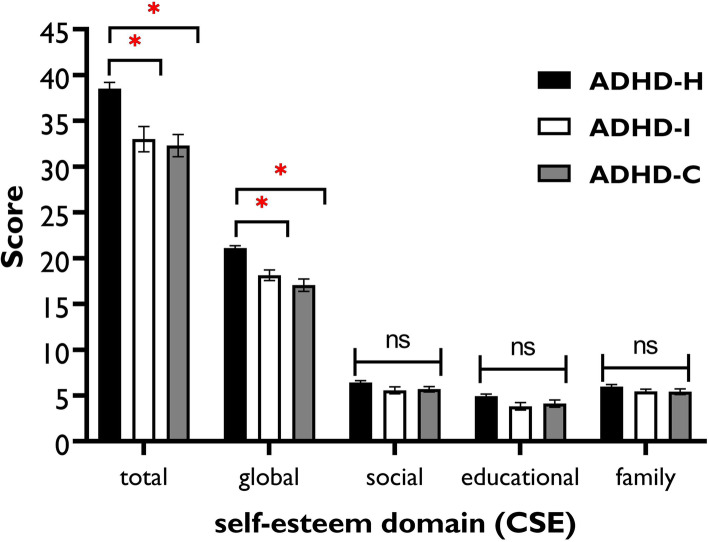
We found a quantitative differentiation of cognitive abilities among ADHD subtypes with "working memory" as the most compromised cognitive domain. ADHD-I had the poorest cognitive profile while ADHD-H scored highest in all cognitive domains. Importantly, cognitive abilities were negatively correlated with inattention and positively correlated with hyperactive symptoms. Moreover, self-esteem ratings were positively correlated with the cognitive domains and were rated differently based on the subtypes. ADHD-H, with the highest cognitive strength, reported the highest level of self-esteem among all subtypes.
ADHD subtype-specific symptoms, cognitive deficits, and self-esteem problems should be considered for precise diagnosis and effective and personalized treatment in ADHD in light of further supporting evidence and assessments. Cognitive interventions might be more compatible with and effective in inattentive and combined subtypes of ADHD. Working memory improving-based interventions can benefit all ADHD subtypes. A supportive educational system in school and providing adjunct supportive interventions should be considered for children with ADHD as well.
注意缺陷多动障碍(ADHD)是一种主要的神经发育障碍,具有异质的症状、亚型和认知缺陷。认知缺陷是 ADHD 病理生理学的核心,也是 ADHD 异质性的潜在来源之一。然而,亚型特异性认知相关性研究还不够充分。我们根据韦氏儿童智力量表(WISC-IV)的分数,探讨了 ADHD 亚型的认知相关性。我们还评估了 ADHD 亚型的特定亚型自尊评分,并探讨了其与认知相关性的关系。
根据 Kiddie 情感障碍和精神分裂症检查表(K-SADS-PL)和康纳斯父母评定量表(CPRS-RS)的症状和评分,将 139 名 ADHD 儿童(80.6%为男孩,19.4%为女孩)分为主要“多动(ADHD-H)”、“注意力不集中(ADHD-I)”和“混合(ADHD-C)”亚型。然后,他们分别接受 WISC-IV 测试并完成自尊量表。分析 WISC-IV 指数的组间差异及其在区分 ADHD 亚型中的可预测性。
我们发现 ADHD 亚型之间存在认知能力的量化差异,其中“工作记忆”是最受影响的认知领域。ADHD-I 的认知状况最差,而 ADHD-H 在所有认知领域的得分最高。重要的是,认知能力与注意力不集中呈负相关,与多动症状呈正相关。此外,自尊评分与认知领域呈正相关,并根据亚型进行不同评分。ADHD-H 的认知能力最强,报告的所有亚型中自尊心最高。
鉴于进一步的支持证据和评估,应考虑 ADHD 亚型特异性症状、认知缺陷和自尊问题,以便对 ADHD 进行准确诊断和有效、个性化的治疗。认知干预可能更适合和有效治疗注意力不集中和混合 ADHD 亚型。基于工作记忆改善的干预措施可以使所有 ADHD 亚型受益。还应考虑为 ADHD 儿童提供支持性的学校教育系统和辅助支持性干预措施。