Bartels Sara Laureen, van Knippenberg Rosalia J M, Malinowsky Camilla, Verhey Frans R J, de Vugt Marjolein E
Department of Psychiatry and Neuropsychology, School for Mental Health and Neuroscience, Alzheimer Centre Limburg, Maastricht University, Maastricht, Netherlands.
Division of Occupational Therapy, Department of Neurobiology, Care Science and Society, Karolinska Institutet, Stockholm, Sweden.
JMIR Aging. 2020 Oct 16;3(2):e19852. doi: 10.2196/19852.
Daily functioning of people with cognitive disorders such as mild cognitive impairment (MCI) is usually depicted by retrospective questionnaires, which can be memory-biased and neglect fluctuations over time or contexts.
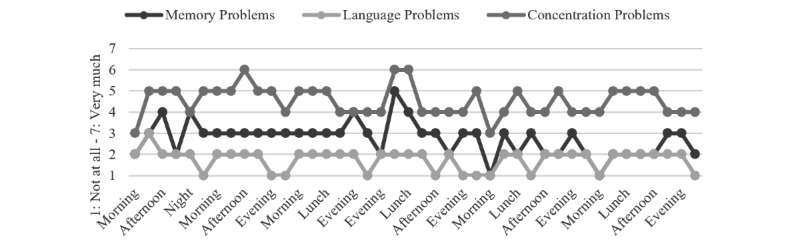
This study examines the feasibility and usability of applying the experience sampling method (ESM) in people with MCI to provide a detailed and dynamic picture of behavioral, emotional, and cognitive patterns in everyday life.
For 6 consecutive days, 21 people with MCI used an ESM app on their smartphones. At 8 semi-random timepoints per day, participants filled in momentary questionnaires on mood, activities, social context, and subjective cognitive complaints. Feasibility was determined through self-reports and observable human-technology interactions. Usability was demonstrated on an individual and group level.
Of the 21 participants, 3 dropped out due to forgetting to carry their smartphones or forgetting the study instructions. In the remaining 18 individuals, the compliance rate was high, at 78.7%. Participants reported that momentary questions reflected their daily experiences well. Of the 18 participants, 13 (72%) experienced the increase in awareness of their own memory functions as pleasant or neutral.
Support was found for the general feasibility of smartphone-based experience sampling in people with MCI. However, many older adults with MCI are currently not in possession of smartphones, and study adherence seems challenging for a minority of individuals. Momentary data can increase the insights into daily patterns and may guide the person-tailored development of self-management strategies in clinical settings.
认知障碍患者(如轻度认知障碍[MCI])的日常功能通常通过回顾性问卷来描述,这种问卷可能存在记忆偏差,且忽视了随时间或情境的波动。
本研究探讨在MCI患者中应用经验取样法(ESM)的可行性和可用性,以提供日常生活中行为、情绪和认知模式的详细动态图景。
21名MCI患者连续6天在智能手机上使用ESM应用程序。每天在8个半随机时间点,参与者填写关于情绪、活动、社会情境和主观认知抱怨的即时问卷。通过自我报告和可观察到的人机交互来确定可行性。在个体和群体层面展示可用性。
21名参与者中,3人因忘记携带智能手机或忘记研究说明而退出。在其余18人中,依从率很高,为78.7%。参与者报告即时问题很好地反映了他们的日常经历。18名参与者中,13人(72%)认为对自己记忆功能的意识增强是愉快的或中性的。
研究发现基于智能手机的经验取样法在MCI患者中总体可行。然而,目前许多患有MCI的老年人没有智能手机,少数个体的研究依从性似乎具有挑战性。即时数据可以增加对日常模式的洞察,并可能指导临床环境中针对个人的自我管理策略的制定。