Weston Sara J, Graham Eileen K, Turiano Nicholas A, Aschwanden Damaris, Booth Tom, Harrison Fleur, James Bryan D, Lewis Nathan A, Makkar Steven R, Mueller Swantje, Wisniewski Kristi M, Yoneda Tomiko, Zhaoyang Ruixue, Spiro Avron, Drewelies Johanna, Wagner Gert G, Steinhagen-Thiessen Elisabeth, Demuth Ilja, Willis Sherry, Schaie K Warner, Sliwinski Martin, Lipton Richard A, Katz Mindy, Deary Ian J, Zelinski Elizabeth M, Bennett David A, Sachdev Perminder S, Brodaty Henry, Trollor Julian N, Ames David, Wright Margaret J, Gerstorf Denis, Allemand Mathias, Muniz-Terrera Graciela, Piccinin Andrea M, Hofer Scott M, Mroczek Daniel K
University of Oregon, Department of Psychology, Eugene, OR, USA.
Northwestern University, Department of Medical Social Sciences, Chicago, IL, USA.
Collabra Psychol. 2020;6(1). doi: 10.1525/collabra.267. Epub 2020 Aug 12.
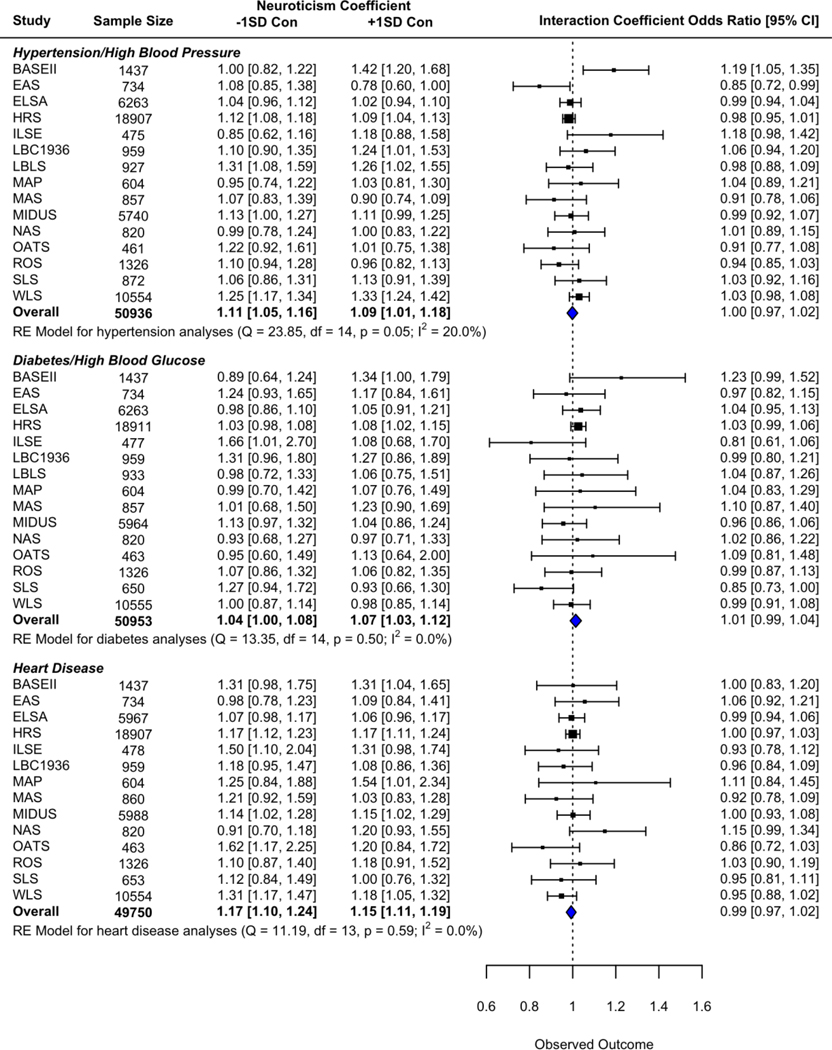
Early investigations of the neuroticism by conscientiousness interaction with regards to health have been promising, but to date, there have been no systematic investigations of this interaction that account for the various personality measurement instruments, varying populations, or aspects of health. The current study - the second of three - uses a coordinated analysis approach to test the impact of the neuroticism by conscientiousness interaction on the prevalence and incidence of chronic conditions. Using 15 pre-existing longitudinal studies ( > 49,375), we found that conscientiousness did not moderate the relationship between neuroticism and having hypertension ( = 1.00,95%[0.98,1.02]), diabetes ( = 1.02[0.99,1.04]), or heart disease ( = 0.99[0.97,1.01]). Similarly, we found that conscientiousness did not moderate the prospective relationship between neuroticism and onset of hypertension ( = 0.98,[0.95,1.01]), diabetes ( = 0.99[0.94,1.05]), or heart disease ( = 0.98[0.94,1.03]). Heterogeneity of effect sizes was largely nonsignificant, with one exception, indicating that the effects are consistent between datasets. Overall, we conclude that there is no evidence that healthy neuroticism, operationalized as the conscientiousness by neuroticism interaction, buffers against chronic conditions.
早期关于神经质与尽责性相互作用对健康影响的研究颇具前景,但迄今为止,尚未有针对这种相互作用的系统性研究,这些研究需考虑各种人格测量工具、不同人群或健康方面。当前这项研究(三项研究中的第二项)采用了一种协同分析方法,来检验神经质与尽责性相互作用对慢性病患病率和发病率的影响。我们使用了15项已有的纵向研究(超过49375人),发现尽责性并未调节神经质与患高血压(β = 1.00,95%[0.98, 1.02])、糖尿病(β = 1.02[0.99, 1.04])或心脏病(β = 0.99[0.97, 1.01])之间的关系。同样,我们发现尽责性并未调节神经质与高血压发病(β = 0.98,[0.95, 1.01])、糖尿病(β = 0.99[0.94, 1.05])或心脏病(β = 0.98[0.94, 1.03])之间的前瞻性关系。效应量的异质性在很大程度上不显著,只有一个例外,这表明不同数据集之间的效应是一致的。总体而言,我们得出结论,没有证据表明以神经质与尽责性相互作用来衡量的健康神经质能够缓冲慢性病。